52 Ancestors in 52 Weeks #51 & 52—Knud Sjursen and Brita Kristoffersdatter
 January 1st, 2017 |
  Author:
  Knud and Brita, my third great-grandparents, were rebels.
Both were born in the Hordaland District of Norway, but they fled their homes so they could marry. She was born into a higher-status family than he, and that was a barrier to their marriage. No matter. Together they went north to Nordland, and they did as they pleased.
Knud Sjursen was born on February 23, 1816 at Fenne Farm in the Voss Municipality of Hordaland. He was baptized two days later in the Vangen parish. His parents were Sjur Mathissen and Ingebor Knudsdatter. It seems he was named for his maternal grandfather.
Brita, the daughter of Christopher Monsen and Martha Olsdatter, was born just a few weeks before Knud, on January 9, 1816, at Oppeim, also in the Voss Municipality. She was baptized a month later, on February 2, 1816, at Voss.
Both Knud and Brita followed the same rites of passage as most other Norwegian youths of their time. They received their smallpox vaccinations and were confirmed in the Lutheran church.
By 1842, when they were 26 years old, they had both left their families and made their way to the distant island of Øksnes in the Vesterålen District of Nordland. Knud found work on the Sorsand farm, and Brita was on the Vottestad farm. They got married in Øksnes parish on July 11, 1842. Together they went on to have six children:
- Sivert Knudsen (1843-1907), my second great-grandfather,
- Kristoffer Knudsen (b. about 1844),
- Ingeborg Knudsdatter (b. about 1846),
- Elias Knudsen (b. about 1849),
- Karoline Knudsdatter (b. about 1853),
- Karl Knudsen (b. about 1860).
By 1865, the family had moved on to the Bjorndal farm in the Hadsel Municipality of Vesterålen. Knud worked as a tenant farmer. He and Brita stayed there for the rest of their lives and watched their family grow. On July 15, 1866, they served as godparents for their son Sivert’s first child, Kaspara Helmine Sivertsdatter at Øksnes.
After a lifetime together, Knud was the first to pass away. He died on February 24, 1885, the day after his 69th birthday. He was buried two months later, on April 12, 1885 in the Eidsfjord parish of Nordland.
Brita outlived him by just two years. She died on January 2, 1887, a week before what would have been her 71st birthday. She was buried the following spring, on May 30, also at Eidsfjord parish.
Knud and Brita had successfully defied their families to be together. Their marriage lasted 42 years.
 Posted in
52 Ancestors in 52 Weeks #49 & 50—Johan Larsen and Sara Möllersdatter
My third great-grandfather Johan Larsen was born March 22, 1824 on the island of Alstahaug in Nordland, Norway, just south of the Arctic Circle. His parents Lars Hemingsen and Jonelle Jonsdatter had him baptized in the Herøy i Alstahaug parish some time later.
When he was twenty-one years old, Johan married Sara Andrine Möllersdatter in the same parish on the nearby island of Slapøen on July 19, 1845. Sara was the daughter of Möller Zacariasen. Much older than Johan, Sara had been born about 1814 on the Berfjorden farm in the Alstahaug Municipality.
The couple set up housekeeping at Slapøen and began their family:
- Johana Maria, born at Slapøen on September 25, 1845,
- Bergitta Susanna, born at Slapøen on September 8, 1848,
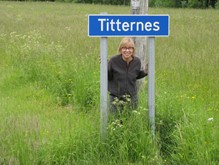
- Karen Marie, born at Titternes farm in Dønnes on April 7, 1851 (my great-great grandmother),
- Ludvig Edvart, born at Næsna in Dønnes on May 17, 1855,
- Anne Margrete Kristine, born at Skeidsøen farm in Dønnes on March 12 1859,
- Mortine Lovise, born at Skeidsøen farm in Dønnes on June 19, 1863.
As he raised his family, Johan became a small landholder at Skeidsøen, and he worked sometimes as a fisherman. Perhaps during the fishing season that ran from January to May each year, he traveled with the other men from his area to the rich Lofoten fishing grounds north of Dønnes to earn some extra cash.
On March 6, 1876, shortly before his 52nd birthday, Johan died in a fishing accident. His death is recorded not in his home parish in Dønnes, but further north in Lofoten. He must have gone there to fish that season. Many of the deaths recorded on the same page of the Vågan parish register in Lofoten note a death at sea, so perhaps that is how Johan died, too. It seems the boats lost many men that fishing season.
Johan was buried later that month on March 25, 1876 in the Vågan parish of Lofoten.
Sara remained at Dønnes to live out the remainder of her life. She passed away on August 1, 1880 when she was about 66 years old. She was buried in the Herøy I Herøy parish.
Finishing Up for 2016
 I am closing out another research year. For the last twelve months I have researched the life of my blacksmith great-great grandfather, Thomas Sherman. I have learned about his life and written up my findings for distribution to my family. For wider dissemination of the information I have gathered, I have put all the names, dates, and places into the family tree on Family Search (www.familysearch.org).
During the year I learned that Thomas, like many in the nineteenth century, moved around a bit, as evidenced by these life events:
- Born 23 November 1841 in Ohio,
- Grew to manhood in Kentucky, and learned the blacksmith trade from his father, Daniel Sherman,
- Married his first wife, fathered his first child, and registered for the Civil War draft in Johnson County, Indiana,
- Married twice more and fathered five more children in eastern Illinois,
- Died 3 February 1912 at Charleston, Illinois.
A big mystery still not answered from my research this year is the identity of his first wife. Next year I plan to continue with the Sherman research in an effort to discover who she may have been. I do have a name and place to go on—Katherine Stillenbaugh/Stanabaugh of Indianapolis, Indiana. Family lore says she immigrated from Germany.
I would just love to place this woman, my great-great grandmother, into her birth family. I plan a trip to Germany in 2017, and it would be wonderful to know more about her by then.
52 Ancestors in 52 Weeks #47 and 48—Anders Bentsen and Anne Larsdatter
 Anders Bentsen was the last Bentsen ancestor of mine who did not immigrate to America. He was also the man from whom my mother’s family took their surname when they did move to the United States from Norway. Because most Norwegians of his time did not have surnames, the family had to choose one when they immigrated. In Norway, they were known simply by their father’s name (a patronymic) plus the name of farm where they lived.
Anders was the son of Bent Iversen. Thus, his patronymic name was Bentsen, or Bent’s son. When Anders’ son Lorenz Nikolai and his grandson Ole Jørgen crossed the pond, they both decided to call themselves Bentsen, as their patriarch had, instead of using their own patronymic names, Andersen and Lorenzen.
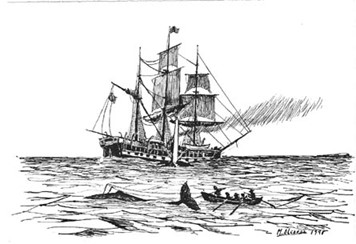
Anders was born October 16, 1823, perhaps at the Norwegian coastal city of Bergen. By 1844 he had relocated north to the cod fishing area of Nordland, Norway, north of the Arctic Circle. He lived in Bø parish on one of the islands in the Vesterålen District and worked as a cottager. He fished, too, and sometimes worked on a whaling ship. One time they harpooned a huge whale off the north coast of Norway. It started pulling them toward Russia so they cut the line and let it go.
Anders’ daughter Christina Andrea was born at Bø on August 28, 1851. Anders finally married her mother, Anne Larsdatter, a couple of months later on October 24, 1851. They later had a son, Lorenz Nikolai, born on July 5, 1854 on Fjærvold farm.
In 1857, life for Anders and Anne took a terrible turn. On April 17 of that year, Anders reported the February 25 birth of an unnamed stillborn son. The following fall, Anders came down with a terrible fever.
He never recovered. Anders passed away from the fever on September 11, 1857 at the age of thirty-three. He was later buried in Bø parish on October 18. He left behind a widow, a six-year-old daughter, and a three-year-old son. That son grew up and emigrated to America.
Although Anders died young, Bentsen descendants live across the United States today.
52 Ancestors in 52 Weeks no. 46—Rhoda Hall (1784-1850)
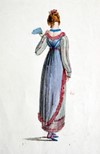 My ancestor Rhoda Hall was born to a father, Gershom Hall, who was a Revolutionary War soldier and a mother, Lucy Snow, who died young. Rhoda was born on March 12, 1784, in Massachusetts.
Rhoda had a couple of older siblings and several who were younger. She was probably pressed into duty to help care for them after her mother died in 1795 when Rhoda was eleven years old.
On June 2, 1805, Rhoda married a local saltmaker, Benjamin E. Dunbar, in Chatham, Massachusetts. She was 21 years old and he was twenty-eight. Rhoda and Benjamin had twelve children, including my ancestor Olive Hall Dunbar. They lived at Chatham until shortly after 1830.
By then the saltmaking business on Cape Cod was no longer profitable. The family left Cape Cod and moved away to Stow, Ohio. Why they chose this location remains unknown.
Benjamin died shortly after their arrival, leaving 47-year-old Rhoda a widow with most of her children still at home. Benjamin had provided for her, and the family had some land in Stow. They lived at the north end of town. Rhoda sent her children to school and served as the executor of Benjamin’s estate.
She remained in Stow for most of the remainder of her life. In 1850, when the U.S. census was taken, she was enumerated in her daughter Olive’s household in Mendon, Michigan. Perhaps she was visiting there.
According to Rhoda’s cemetery marker, she passed away that same year at the age of sixty-six. She was buried next to her husband in the Stow, Ohio cemetery.
Writing for “The Colorado Genealogist”
 The latest issue of The Colorado Genealogist came out this week. The periodical’s Editor, Nancy Ratay, put together for this issue some articles on integrating DNA matches with traditional research. I felt privileged to contribute the account of my own discovery of a Colorado cousin through DNA testing.
As I have written before, a DNA match identified my previously unknown third cousin in Colorado. She actively pursues genealogy, too, so we had a great time swapping information this summer. She gave me permission to tell our story in the Colorado Genealogical Society’s quarterly publication.
In addition to the honor of being published in this periodical, I also had the chance to promote my own research. My article necessarily includes some of the names in my family tree. These names appear in the journal’s annual end-of-year index. This issue goes out to libraries and societies across the country. Perhaps someone searching for my surnames will see my ancestors’ names and contact me.
Access to The Colorado Genealogist is one of the perks of belonging to the Colorado Genealogical Society (CGS). Even if one does not have Colorado ancestors, belonging to the local society does so much for the genealogical community. CGS, which meets in Denver, began in 1924 and is still going strong. In addition to publishing the Quarterly, as they call it, they offer monthly genealogy training classes and an annual seminar. They purchase materials for the Denver Public Library’s genealogy collection, one of the largest west of the Mississippi River. They work to preserve, publish and index local records.
I am very happy this week that I could contribute to the efforts of this wonderful group. I have learned so much from their members and classes. Thanks to Nancy Ratay for pitching a theme idea that allowed me to share my experience and help her put out another great issue of the Quarterly.
52 Ancestors in 52 Weeks, no. 45, Benjamin E. Dunbar (1776-1831)
This ancestor came into the world on December 1, 1776, just as the Revolutionary War was beginning. He was named after his father, Benjamin Dunbar (b. 1749). His mother was Hannah Hathaway. Young Benjamin was joined by a brother, Hosea, the next year. The family lived in Halifax, Massachusetts, but it did not remain intact for long. The father died when Benjamin and Hosea were just small boys.
We know nothing more of Benjamin’s young life. By the time he had reached his late 20’s, he had moved down the coast of Massachusetts to Chatham, on Cape Cod. There he married Rhoda Hall on June 2, 1805.
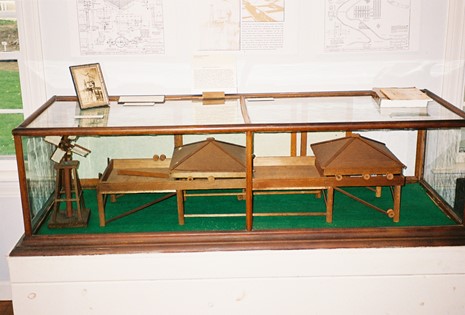
Benjamin became a saltmaker at Chatham. The British blockade during the Revolutionary War had made it impossible for the colonists to obtain salt, so they began experimenting making salt from seawater. Benjamin owned one of the numerous saltworks along the coast. Perhaps his operation looked like this replica found in the museum in Chatham:
During his years as a saltmaker, Benjamin and Rhoda raised their large family at Chatham:
- Safronay (b. 1806)
- Rhoday (b. 1807-bef. 1810)
- Daniel H. (b. 1809)
- Rhoda Ann (b. 1811)
- Benjamin S. (b. 1812)
- Moses (b.1814)
- Rebecca W. (1817-1873)
- Susannah H. (b. 1819)
- Hannah S. (b. 1821)
- Olive Hall (1823-1902), my ancestor
- Lucy Snow (b. 1827)
- Laura Ann (b. 1829)
During these years, America fought the British in the War of 1812. Benjamin did his part by serving in the Massachusetts militia. He was a private in Captain Hugh Nickerson’s Company of Infantry, Snow’s 2nd Regiment. They marched in the defense of Eastham from September 15-17, 1814. Benjamin earned wages as the rate of $8 per month, for a total of $.53. His other compensation included $.40 for rations, $.17 for private’s clothing, and $.03 for arms. For supplies he had a musket with iron rod, a bayonet, a scabbard and belt, 3 flints, 1 cartridge box, 24 cartridges with balls, a knapsack, and a blanket.
After the war, outside competition eventually ruined the salt trade for Cape Cod. Benjamin and his family stayed there through 1830 and then made the decision to move on.
They relocated to the interior of the country, settling in Stow, Portage County, Ohio. Unfortunately, Benjamin’s life was nearing its end. Before he could build a new life for himself and his family, he passed away at the age of 54 on September 11, 1831.
Benjamin E. Dunbar was buried in the Stow Cemetery, in Portage [now Summit] County, Ohio.
Ancestors, Community, and the Vote
 After this week’s tumultuous election, I began to reflect on why I may have voted the way I did. I hope I objectively examined the issues and voted for those candidates who would best represent my views. Yet I cannot help but think that my upbringing and surroundings played a part in influencing my opinions.
How did my ancestors think, and what did I hear discussed at home as I grew up? Over years of genealogical research, I have assembled some information about the political leanings of my forbears:
- Caleb Reed (1818-1903), an Illinois farmer. According to the history of Coles County, he was a strong Whig although he never sought political office. The conservative Whig party (1833-1854) was organized by the politician Henry Clay in opposition to the Jacksonian Democrats, and they derided Jackson as “King Andrew”. Appealing to large landowners, the Whigs supported the supremacy of Congress over the President and favored economic protectionism. They opposed Jackson’s Indian removal policies. Many Whigs gravitated to the Republican Party after the demise of the Whig Party. I wonder whether Caleb voted for Republican Abraham Lincoln, a fellow resident of Illinois, in 1860 and 1864. Lincoln’s parents lived near Caleb in Coles County.
- John Carter (1790-1841), another Illinois farmer and neighbor of Caleb Reed. Originally from Tennessee, John had served in the War of 1812 under Andrew Jackson. I do not know how he felt about Jackson and his policies. Was John a Jackson Democrat?
- Bjarne Bentsen (1906-1986), a policeman, later an electrician, who grew up in Montana and lived in several western and Midwestern states. He professed strong support of the Democratic Party.
- Grace Riddle (1896-1976) and Martha Mattila (1906-1977). I find it amazing that when these women, my grandmothers, were born, women did not have the right to vote. That did not come until 1920. Even so, neither of them talked about politics, and I do not know if or how they voted.
- Joyce Bentsen (1929-2000), a schoolteacher from Minnesota. She never disclosed how she voted, but over the years she expressed admiration for Minnesota Democratic native sons Walter Mondale and Hubert “The Happy Warrior” Humphrey.
- My Dad, a petroleum landman. During my lifetime, he usually has expressed conservative views and leaned Republican, not surprising for an oilman. Yet he proudly cast his first vote in a Presidential election for Harry Truman in 1948. He told me that his mother kept a photograph of Democrat Franklin Roosevelt in their home.
These family members obviously did not agree about politics, so I received mixed messages at home. What about the influence of my community?
- I grew up in Wyoming, a politically conservative state. This week nearly 70% of their electorate voted for Donald Trump. Although Wyoming was the first state to grant women the right to vote, they did not do so for progressive reasons. Without women counted as citizens, Wyoming could not reach the requisite number of voters to qualify for statehood in 1890.
- Today I live in the purple state of Colorado where I have been for over 30 years. I reside between very-conservative Colorado Springs, and very-liberal Boulder (referred to by the locals as “The People’s Republic of Boulder”). Ironically, the Libertarian Party was founded in Boulder, so we have that influence as well.
These conflicting views around me all contribute to my political views. I hope I did a good job synthesizing them before I cast my vote this year.
52 Ancestors in 52 Weeks nos. 39-44—Unknown Ancestors
 Six of my third great-grandparents remain unidentified. Four lurk in the shadows of history, nameless and faceless. Two others, I can name only as Mr. and Mrs. Riddle, and I know nothing more about them.
The four unknown subjects had a grandson who fathered my grandmother. Who was he, and who were his people?
As I have written many times on these pages, my grandmother arrived in the world in Palisade, Nebraska in August, 1896. When I quizzed her about it in the 1960’s, she stated she had no knowledge of her father’s identity. Information on her parentage did not come down through collateral family lines even though many cousins knew that her mom was an unwed mother. The father’s name has been a well-guarded secret for over 100 years.
No clues have come to light in all these years. Her father did not give her his name. Did he even know she existed? Before she married, Grandma sometimes went by her mother’s maiden name, Riddle, and sometimes she used the surname of the aunt who raised her, Evert.
Grandma’s maternal Riddle family, presents only slightly less of a challenge. Her grandfather, John Davis Riddle (1821-1896), reportedly was born in Pennsylvania to the elusive Mr. and Mrs. Riddle. The first record of John was when he (as John Davis, not John Davis Riddle) married Olla Dunbar in Summit County, Ohio in 1843. The couple shortly relocated to Mendon, Michigan where they lived out their lives. No Riddle descendant ever heard or recorded any information about John’s birth family. Who were his people?
Six unknown ancestors. How will I ever identify them? DNA testing might provide some answers, and I keep hoping for a promising match. Beyond that, the riddle of the Riddles will make an interesting research project one day.
A Plan to Create My Genealogical Legacy
 I have done genealogical research for a long time, decades in fact. What will happen to all my work? Genealogists often discuss this issue.
In a perfect world, I would pass it on to another interested family member who would continue my work. In the real world, however, no one like that exists. My sons have little interest in their family tree, nor do my nieces and nephew. My cousins and their children do not pursue genealogy either.
That fact leaves me with a lifetime accumulation of family group sheets spanning many generations. It leaves me with a file cabinet full of documentation I have not scanned into digital form. It leaves me with hundreds of volumes of genealogical publications that fill many bookcases in my home office.
I do not want this work to go for naught. If family members do not want it, what can I do? I have thought about it over the years, and so far, I have developed something of a plan:
- I continually publish newly-discovered information and family relationships online at my Web Trees site. Source citations appear here. Anyone can re-trace my research steps without the physical copies of the documents. Someday I may digitize them and attach them to the online tree, as my husband/tech adviser has done with his. But for now, the paper copies serve only for my own quick reference use. Except for heirloom documents like my grandmother’s 8th grade diploma, they could be tossed.
- I think no one will maintain my website when I no longer can. For this reason, I have begun entering my family group sheets into the FamilySearch online tree. The information that has taken me a lifetime to collect can remain there, accessible to anyone, forever. If my family wants to throw away all my paper copies of this data, they can do it knowing the information will survive.
- I acquired much of my genealogy library from a cousin in a previous generation. Her father and my grandfather were brothers, so we did not share several of the maternal lines she actively researched. Consequently, many of the volumes she collected have no relevance to me. I can begin to weed these from my collection. To dispose of them, I can offer them to the genealogical collection at the Denver Public Library or pass them on to other researchers at my local genealogical societies. In the future, my family could dispose of the remaining core collection the same way.
That’s my plan. In a nutshell, I publish detailed information as I acquire it on my website, and I simultaneously build an online tree for posterity at FamilySearch. I spent October doing just that. FamilySearch now has all my information on my great-great grandfather Thomas Sherman and his family. I will write a character sketch of him for my family for Christmas this year.
I urge all genealogists to make provision for their own research materials. So much time, effort, and passion goes into documenting a family tree. Find a way to preserve your work.