52 Stories no. 4–Achievements
 January 29th, 2017 |
  Author:
  As I attempt to fulfill the goal of recording 52 stories of my life this year, I am having a tough time with this week’s topic. I am to relate the hidden achievements and the greatest achievements in my life so far. I have to say, nothing readily came to mind, but after some reflection I can list a few ideas.
The term “hidden achievements” means those things that I have found challenging even though they might have seemed simple to someone else. Many people find it easy to create beautiful things, but I am not one. I have little artistic ability. Nevertheless, I have some hidden accomplishments in the artistic realm:
- I learned to play the piano at a young age. This musical training enabled me to serve as pianist on various occasions ranging from accompanying the choir for my 6th grade Christmas program to serving currently as the Musician for my local Sons of Norway lodge. With my piano background, I learned to play handbells many years ago and participated in a couple of church handbell choirs over the years.
- Nearly a decade ago, I returned to the church vocal choir after an absence of many years. I enjoy singing even though I do not have a great voice. With this choir, I have had the good fortune to sing with two wonderful, demanding directors, and a couple of our concerts stand out in my mind. I have successfully sung Handel’s Messiah and Bach’s St. John’s Passion (in German, no less!).
- My mother taught me to embroider when I was young. Later, I built on those skills to teach myself Hardanger embroidery, a Norwegian craft. I have never felt inspired to develop my own designs, but I have stitched some beautiful pieces from patterns created by others.
Still, my meagre talent does not allow me to truly excel in the arts. Where, then, would I look for my greatest achievement in this life?
Since adolescence, I have felt a strong desire to uncover and share my family history. Here I found my passion. The information I have gathered, analyzed, and documented certainly stands as my legacy and my life’s greatest achievement.
I have devoted 50 years to this goal, and I like to think I do genealogical work on a professional level. I have developed quite a family tree that I continually share with my extended family. I have also contributed to the genealogical community by sitting on the Board of Directors of the Colorado Genealogical Society, by writing articles for their quarterly magazine, and by serving as a judge for their writing contest. I have taught genealogy classes at my local public library. I enjoy everything related to the pursuit of family history.
 Posted in
52 Ancestors in 52 Weeks #55 & 56—Abel Mattila and Greta Caspersdatter
This week my Finnish line of third great-grandparents begins its turn to have their stories told. These last posts in this series will have to be brief because I know very little about these people.
Abel Andersson Mattila (1798-1852) was born about 1798 during the time when Finland was under Swedish rule. The Swedish language predominated in the country during that time, but we do not know whether Abel was bilingual. His family probably spoke Finnish, although the country kept legal records in Swedish. Abel must have had exposure to Swedish because the southern part of Finland where he lived was heavily populated with Swedes during his early years.
While Abel was still a boy, the country changed hands after several hundred years of affiliation with Sweden. Finland became a Grand Duchy of the Russian Empire in 1809 when the army of Czar Alexander I took the country in the Finnish War. The Russians were more accepting of the Finnish language than the Swedes had been, but Finnish did not achieve equal legal status until 1892, long after Abel’s death.
After Abel reached adulthood, he married Greta Caspersdatter, a woman of his own age who was also born about 1798. The couple settled at Kimböle, in the Uusimaa Province of southern Finland. Abel made a living as a “bonde”, or farmer.
The couple had five known children:
- Eva Mattila, born 1824,
- Anders Abelsson Mattila, (1826-1882), my great-great grandfather,
- Abel Mattila, born 1829,
- Anna Mattila, born 1832,
- Johannes Mattila, born 1842.
Abel died of a heart attack on April 22, 1852 at Kimböle when he was about fifty-four years old. Heart disease was rampant in Finland in the nineteenth century, and even today many of my Finnish relatives die from it.
Abel was buried May 9, 1852 in the Lapinjärvi parish of Uusimaa.
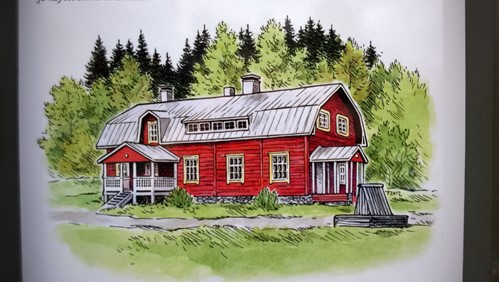
An 18th-century Finnish farmhouse
An Expanded Search
 Despite some diligent research, my attempt to identify my German 2nd great-grandmother, Katherine Stillenbaugh, has gone nowhere this week. I need to broaden the search.
Family lore tells me that this woman immigrated at the age of 8, gave birth to my great-grandmother, Anna Petronellia Sherman, at Indianapolis in 1865, and died shortly thereafter. I have not found a marriage record for her. With no birth and death records kept that early in Indiana, I must use other means to pinpoint this little family of Thomas, Katherine, and Anna P. Sherman. An Indiana census record would have been nice.
As far as I know, Indiana did not conduct a census in 1865 so I am out of luck for that year. Because Katherine had died by the time of the 1870 U. S. census, her name would not appear there. Indeed, by 1870 little Anna Petronellia lived with her paternal grandmother, Rebecca Sherman, in Illinois.
That leaves me looking back before the Civil War to the 1860 U. S. census. Did Katherine live in Indiana in 1860? No family named Stillenbaugh lived there, or anywhere else, for that matter. Stillenbaugh must be a corruption of her family’s true German name.
I discovered a clue to what it might have been by following the movements of the husband, Thomas Sherman. In 1860, he was a single man living in his parents’ household in Kentucky, not Indiana. However, his older brother Anderson did live in Indiana by then, in Hamblen Township, Brown County, just south of Indianapolis. And Anderson was surrounded by German neighbors named Stillabower.
Were these my Katherine’s people? None of the six families had a daughter Katherine/Catharine in 1860 although Michael P. had an 8-year-old Mary C. Family information found on FindAGrave.com tells me that these families, all related, included three immigrant brothers, Jacob, Adam, and Michael, and three of their sons, Michael C., Michael P., and John. The FindAGrave site also tells me that the Stillabower family had many more members than just these. In fact, the original German name was Stilgenbauer, and they were Lutherans from Bavaria. Some settled first in Ohio and later moved on to Indiana.
Looking beyond the 1860 census, I know that by 1863, Anderson Sherman had moved out of Brown County and into neighboring Johnson County, also just south of Indianapolis. Thomas lived there, too. Another younger Jacob Stillgenbauer lived nearby. Unfortunately, in 1860 he did not have a daughter named Katherine/Catherine either, but he did have a 10-year-old girl named Caroline. Caroline? Catharine? It is a possibility, but she would have been just 15 in 1865. I cannot presume that she was my girl. Still, her later whereabouts are worth a look.
And that is where my search ended this week.
Armed with the information uncovered so far, I plan to do some more investigation of this German Stilgenbauer family, both elsewhere in Indiana and in other states where family members may have resided before landing in Indiana. The Civil War disrupted people’s lives, and folks moved around during those years. My Katherine could have lived anywhere in 1860.
I also hope to learn whether any Lutheran church records for the 1860’s Indianapolis area survive. I have found no county marriage record for Thomas and Katherine in Indiana. If the Stilgenbauers were Lutheran, perhaps this couple married in the Lutheran church even though Thomas probably was not Lutheran himself. He did not seem averse to a church wedding because a Methodist minister officiated at his second marriage to Mary Scott in 1872.
My other research possibility is to look for Stilgenbauers on the 1850 U.S. census. The difficulty with this is that I do not know what year Katherine was born or what year she immigrated. A young woman married to a 23-year-old man (Thomas) by 1865 was likely born in the 1840’s. My family says Katherine left Germany at the age of eight, so perhaps she was in America by 1850. From the FindAGrave information I cannot tell with any precision when the Brown County Stillabowers immigrated. The older Adam was said to have come over in 1836, while Jacob’s son Adam was born in Germany in 1838. If this was my family, other relatives, including mine, may have followed in the 1840’s and 1850’s.
This leaves me with so many people to sort through. The time-consuming search for my Katherine continues. Stay tuned.
52 Stories–Goals
 Family Search has suggested that we genealogists should write 52 stories about ourselves this year. In this, my third story, I am to discuss my goals—which ones I actively pursue and which ones I have trouble achieving because something gets in the way.
Do I even have specific goals? I guess I do, but I have not formalized them. In general terms, my goal is to stay well-rounded and find fulfillment is various aspects of my life:
- Genealogy. In an earlier post, I discussed my genealogy goals for the year. I try to work on those every day. Recently, I decided to stretch myself and took on the additional responsibility of judging this year’s writing contest for the Colorado Genealogical Society.
- Life in the community. I try to stay engaged, so I find volunteer projects to do. I currently serve as my neighborhood’s representative to our civic association. I am the Musician for my local Sons of Norway lodge.
- Spiritual life. I sing in my church choir, and this year we will tour in Germany to commemorate the 500th anniversary of the Reformation. This trip satisfies a lifetime goal for this cradle Lutheran to see the land of Luther. In preparation, I am reading Luther’s biography this winter.
- Home life. I meet my goal of knowing my grandchildren by taking care of them whenever I can. I am working on making my home more livable by taking on a huge home remodeling project this spring—the goal is to complete it before my choir trip.
I avoid making goals any more specific than these. Instead, I tend to work more on a To Do list of scheduled tasks. The tasks sort themselves by what has the earliest deadline, hopefully set by me and not by someone else. I work on big, open-ended projects as time allows.
I know, I know. We are supposed to sort work by our A, B, and C priorities and then create timelines and work on the A priorities first. But for me the C priorities often take over my life. I find it more comfortable to do those first to get them out of the way. I avoid developing timelines because I have never figured out how to do it effectively.
When I worked for the local library many years ago, I had a boss who wanted to quantify all our work into goals with timelines she set, but this seemed impossible to me. Too many extraneous matters and circumstances beyond my control affected my ability to meet goals at specified times. This created so much stress. It drove me crazy, and I finally left that job.
Now I have no boss, and I work at a comfortable pace. I do not accomplish all that I wish I could on some goals because I have many family responsibilities that come up. They get in the way of my other goals. Then again, taking care of my family is one of my goals, too. Some of the other goals will just have to wait.
It boils down to what goals I can accomplish in my real life as opposed to what I would like to accomplish in my fantasy life. I must live in the here and now, and my goals must align with my real-life responsibilities.
A Step-By-Step Plan for Finding Katherine
 I am on the hunt for any information available on my 2nd great-grandmother. So far I have turned up almost nothing, but I am not discouraged yet. I am pursuing a research plan, step-by-step.
The search began at home with tales of family lore. My dad’s cousins and aunts told me that the elusive woman’s name was Katherine Stillenbaugh/Stanabaugh, and she immigrated from Germany when she was eight years old. She died at Indianapolis shortly after giving birth to my great-grandmother, Anna Petronellia Sherman, in 1865.
I have done an exhaustive search on Katherine’s reported husband, my second great-grandfather Thomas Sherman. I have had no luck connecting him to this alleged first wife or her family. He did live south of Indianapolis during the Civil War, so at least that much of the story matches.
Armed with these bits of information, I began my search for Katherine in earnest earlier this month. My steps:
- Thomas Sherman and his brother actually resided in Johnson County, Indiana, not Indianapolis, so I looked at the county histories for that location. I found no mention of the Sherman family or any German family with a name similar to the one I seek. I did not find an Indiana marriage record for my Thomas Sherman in the 1860’s.
- A search of the 1860 U.S. census for Johnson and surrounding counties turned up an extended German family named Stilgenbauer or Stillabower. This family name sounds promising, and I decided to do some research on them to find out whether anyone had a likely daughter named Katherine.
- On FindAGrave.com, I found memorials for many members of this Stilgenbauer family. Each contained links to the others. This family descends from three brothers (Jacob, Adam, and Johan Michael) who immigrated from Bavaria—a German state. Interestingly, these southern Germans seemed to be Lutheran, not Catholic. This information fits, too, because Thomas Sherman was Protestant, not Catholic, and it is unlikely he would have married into a Catholic family. Thank you to Mike E. Wirey who created all these memorials in 2007.
- I spent a considerable amount of time this week reviewing Wirey’s information and reconstructing the Stilgenbauer family relationships on a white board. Catherine seems to be a common name with them, but I did not spot a girl who fit the profile of my Katherine. They all either died quite young or had married names other than Sherman.
Still more digging remains to be done. The FindAGrave information is not a complete family tree. What will I do next?
- I can try to contact Mike E. Wirey to find out if he has any additional Stilgenbauer information, particularly on girls named Katherine.
- I can look at the 1860 U.S. census for Johnson and all the surrounding counties for more members of the Stilgenbauer family to see if I can find another Catherine who seems a better match for my ancestor.
- I can take a DNA test to find out if I am match for any Stilgenbauers or their descendants who might have taken a test.
- I know where Thomas Sherman lived in 1863, and I can reconstruct his neighborhood, looking for clues.
- I can work to identify pertinent records at the Johnson County Museum, the Johnson County Historical Society, and other repositories. Did Thomas Sherman associate with the Stilgenbauers, or did the families have associates in common? Thomas had a German sister-in-law named Mishler, so I know his family associated to some extent with their German neighbors.
This search promises to take a long time. I probably will never find a single piece of paper proving the identity of my ancestor. But I can pursue my research plan in the hopes of identifying a likely candidate and then building enough circumstantial evidence to prove a case.
52 Stories #2—Teaching Myself Hardanger Embroidery
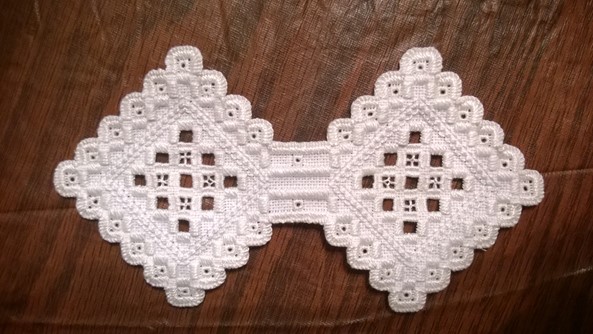 I have some Norwegian ancestry. Because of this, I have sought to learn a bit about Norwegian culture. One aspect of Norwegian life that I have found appealing is their love and pursuit of artistic crafts. Many years ago, I became interested in Norwegian Hardanger embroidery, a type of needlework unique to them. I resolved to teach myself to do it.
Hardanger is a specialized technique of cut and drawn stitchwork, historically done with white thread on white evenweave cloth. It has its roots in ancient Persia, and perhaps the Vikings took embroidered pieces home with them. Back in Norway, the local women adapted the stitches to the materials at hand—linen fabric and thread. The stitchery used today originated in the Hardanger area of Norway, hence its name. By the 1800’s, all young Norwegian girls learned to used Hardanger embroidery to decorate the linens in their hope chests as well as the cuffs of shirts they made for their eventual husbands.
My Norwegian great-grandmother, Sofie Sivertsdatter Bentsen, learned Hardanger when she grew up in Norway. I do not know whether she taught embroidery to her own daughters, one born in Norway and two born in the U. S., or whether any of them pursued Hardanger as a hobby. I do know that family members still have some of the pieces Sofie worked although I was not fortunate enough to receive any myself. I guess that comes from being descended from a son instead of a daughter.
My own mother, who was half Norwegian, knew how to embroider, but she never embroidered anything with Hardanger. I doubt she knew how. She and her Finnish mother both loved to embroider with the more familiar colorful stitches like cross stitch, and we had many pieces around the house that they had worked. They made dresser scarves, table clothes, pillow cases, framed pictures, etc.
When I was about 9 or 10 years old, my mother taught me the basic decorative embroidery stitches that she knew. Over the next twenty years or so, I happily stitched up many pieces that I used around my own house. Then one day I heard about Hardanger embroidery and its Norwegian roots. I was curious to learn more about it and to try it.
About that time, a woman from the Embroiderer’s Guild offered an afternoon session on Hardanger at the local community college. I took her class and received an introduction to the required materials and stitches. I loved it!
I purchased a couple of stitching guides, some Hardanger cloth, and some perle cotton at the local sewing store and embarked on a mission to teach myself how to embroider this way. I learned increasingly complicated stitches and made bookmarks, wall hangings, and doilies. At one point, I even spent about two years making a window valance that now hangs in my office.
When I joined the Sons of Norway a couple of years ago, I found that members can earn pins for learning Norwegian cultural skills. To earn the first level pin for Hardanger, one must research the history of the craft and then complete three pieces using the basis stitches. I did this and earned my Level I pin last year.
Teaching myself Hardanger embroidery has brought much joy and satisfaction into my life and has really given me a sense of accomplishment. I feel connected to my roots when I work on a piece. When I am finished, I have something to keep that I know I made myself. Mastering Hardanger embroidery has really enriched my life.
52 Ancestors in 52 Weeks nos. 53 & 54—Hans Pedersen and Maren Andersdatter
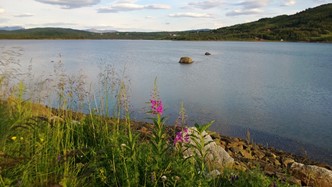 Hans Enok Pedersen, my third great-grandfather, lived to be 84 years old. At the time of his death, he had a headful of thick hair with very little gray in it. Descendants, including my own mother, inherited this characteristic.
Hans was born to Peder Andersen and Martha Johnsdatter on July 18, 1813 on the island of Øksnes, Vesterålen, Nordland in the Kingdom of Danmark-Norge. He was baptized at Øksnes parish the following autumn on the 28th of September.
When he was twenty-three years old Hans married Maren Anna Serina Andersdatter who was born at Malnes in the Bø Municipality of Vesterålen, Nordland. We do not know her birth date, but she was baptized on March 14, 1813 in Bø parish. The wedding of Hans and Maren took place at the Øksnes church, and Hans worked on the Fjeldgrimstad farm in Øksnes at the time.
Hans and Maren had at least two children:
- Martha Karoline Dorthea (my 2nd great grandmother), born March 20, 1841,
- Enok Andreas, born about 1850.
Eventually, the young family settled on the Dungan farm in Øksnes where Hans worked as a tenant farmer. In 1868, Maren served as godmother for her ill-fated granddaughter, Anna Marie Birgitte Sivertsdatter. Anna Marie was Martha’s third child, and she lived to be only a year old.
Maren passed away at about the age of 74, on July 5, 1886. She was buried in the Øksnes parish a couple of weeks later, on July 19, 1886.
Hans died several years later, on January 16, 1898. He was buried the following summer on July 11, 1898. His daughter Martha outlived him by only a couple of years.
How About a DNA Test?
 This month I find myself learning more about DNA and genealogy and trying to decide whether to take a DNA test.
Twice this month I have had the opportunity to hear a good speaker on this topic, Deena Coutant of DigiDeena Consulting (digideena.com). She presented sessions on the basics of DNA testing to both our local Highlands Ranch Genealogical Association and our Norwegian genealogy study group at the Sons of Norway. When she speaks, she even brings along DNA test kits in case her listeners want to test their DNA on the spot.
I also recently acquired the new book in the National Genealogical Society’s Special Topics Series, Genetic Genealogy in Practice by Blaine T. Bettinger and Debbie Parker Wayne. Going through this workbook should give me a better education on how I could apply DNA test results in my own genealogical research.
Over the years I have been reluctant, for privacy reason, to take a DNA test for genealogy. But as Deena points out, DNA results have now become an essential piece of evidence for conducting the exhaustive research demanded to prove a case. So I am thinking about it.
I can identify three situations where a DNA test could provide some benefit in my research:
- I have an unknown great-grandfather. My grandmother Grace Riddle Reed was born to Laura Riddle in 1896 at Palisade, Nebraska. Twelve and a half percent of my DNA comes from Grace’s father, and I would like to know who he was.
- My family says that one of my great-great grandmothers was Katherine Stillenbaugh/Stanabaugh, mother of Anna Petronellia Sherman, born near Indianapolis in 1865. I have never found any record of this woman, and 6.25% of my DNA comes from her. I would like to identify her and her family.
- My direct maternal line comes from eastern Finland. I believe these people were Karelians who lived around Lake Ladoga. An mtDNA test would satisfy my curiosity about my maternal deep ancestry.
Should I take the test? The one I would want (autosomal + mtDNA) costs quite a bit. If I do it, I would then need to devote the time necessary to communicate with those who match my DNA. This translates into overcoming my reluctance to give up my privacy as well as committing a good deal of money and time.
I need to make a decision on whether I want to use this means to move ahead in the quest to identify my mysterious ancestors.
52 Stories #1–Achievements
 Welcome to a new series for 2017. This year I plan a series of posts in response to a challenge by the folks at Family Search for the genealogy community. They want to encourage us to document our own lives in addition to of those of our ancestors. They named the project 52 Stories.
They asked us to write down what we want remembered about our own lives and then preserve it for posterity. Completing this project will make genealogical research easier for our descendants. The January topic is Goals & Achievements.
Writing about myself on this subject seems a lot like bragging—something we Scandinavians are loathe to do—but I will do my best to complete the task with some modesty. First up, lifetime achievements:
- Early on, it became apparent that I had a good head for what my family called book-learning. I took Honors classes in school, earned a couple of scholarships, was graduated with Honor from the University of Wyoming, and was admitted to the highly selective University of Texas School of Law.
- Post-graduation, I landed a job as a petroleum landman with Gulf Oil Company. Very few women worked in this profession at that time, and I was one of the first.
- Years later, after I had left the oil business, I put that law degree to work in the civic arena and the genealogy profession. I have served several terms in elective offices including political party Precinct Leader, Delegate to the civic associations in two communities, and Vice-President of the Colorado Genealogical Society. I am not a politician or a born leader, so I have not aspired to higher elective office.
- At home, I am proud of a number of successes. My husband/tech advisor and I raised two fine boys—one a creative architect and the other a graduate of the U.S. Military Academy at West Point who now serves as a Major in the Army Reserve. Over the years, I guided our sons and helped them along the way by serving as a Scout leader, a Sunday School teacher, and a volunteer parent for swimming, hockey, and lacrosse teams. I saw to it that both boys had years of music lessons. Now I work hard to provide as many enrichment activities as I can for my six grandchildren.
- Surprisingly, late in life I have found some success as a musician. The piano lessons I took and the choral training I had as a child are both getting renewed life. A year ago, I was elected as Musician for my local Sons of Norway lodge. In addition to resuming the piano, I also took up singing again. I had the opportunity to join one of the premier church choirs in the Denver area, and later this year we will go on tour in Europe to mark the 500th anniversary of the Reformation.
So what has been my greatest achievement? I cannot really say. Of course, I am proud of my sons, but so much of that credit belongs not to me, but to their dad and to them. I am proud of the beautiful civic park I helped develop for the City of Centennial. Mostly, I am proud of whatever I can do to help make my family and my community better.
Genealogy Goals for 2017
Happy New Year to everyone! Are we all ready to begin another exciting chapter of Reed/Bentsen family research? I know I am. I hope to accomplish a number of things in 2017:
- My German third great-grandmother, Katherine Stillenbaugh/Stanabaugh (d. abt. 1865), remains a mystery to me, and I would love to break through this brick wall. I have developed a research plan to see if I can find any clues about her. This week I began by reading through the published histories of Johnson County, Indiana where I suspect she lived. Unfortunately, I found nothing that shed any light on her. My next step will be to identify families in Johnson and surrounding counties with surnames similar to hers and reconstruct those family groups to see if I can identify a possible candidate for her family. Anyone missing a daughter Katherine/Catherine/Catharina who might belong to me?!
- Technically, I finished up my series 52 Ancestors in 52 Weeks in 2016. One year did not allow me enough weeks to complete the stories of all my third great-grandparents. Notably, I did not get to my Finnish line (ha, ha). I intend to do a few more posts on this topic so that I have something written about that entire generation.
- I plan to take up the challenge presented by Family Search and do a series on 52 Stories. The project involves writing a post every week about my own life. Family Search provides a year’s worth of prompts to inspire good material for this. First up, Goals & Achievements. When I am finished, I will have a nice memoir that I can pass along to my descendants.
- Later this year I will take a fabulous trip to Germany and the Czech Republic. My Lutheran church choir will go on tour to celebrate the 500th anniversary of the Reformation, and we will visit all the historic Luther sites. My maternal family has been Lutheran since the Reformation, so it means a lot to me to have the opportunity to explore my spiritual roots. My husband/tech advisor and I will tack a few days on to the trip to visit his ancestral villages in Germany and the Netherlands. If I could find out where my mystery ancestor originated in the German lands, perhaps I could visit her villages, too.
- I still have an unviewed box of material and several notebooks inherited from my Dad’s cousin awaiting curating. I would like to complete this project this year. Many of her materials concern her maternal line, which is not related to me. I would like to identify and donate these items to the Denver Public Library for the benefit of other genealogists.
These goals should keep me busy through the year. Wish me luck!