Prairie Housing Yesterday and Today
 October 3rd, 2013 |
  Author:
  Not much to report this week because we had new flooring installed on the main floor of our house. We spent a lot of time moving furniture around.
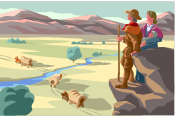
My beautiful new floors got me to thinking about the housing my ancestors inhabited when they came to the western United States over 100 years ago. Certainly they did not start out with multi-level homes and lovely oak floors. They lived in sod houses, or soddies.
I wonder how they felt about that. My great-grandmothers Laura Riddle and Petronellia Reed had lived in nice homes in Michigan and Illinois. It must have been difficult for them to get used to living in a house made of dirt. Laura eventually worked her way up to a nicer frame house in Palisade, Nebraska. Petronellia hated her life on the Wyoming prairie, sold her homestead, and moved to Missouri. There she also lived in a frame house.
And what about my other homesteading family, my Norwegian ancestors, Ole and Sofie Bentsen? They had lived in fishing villages in Norway. Last summer I visited a fisherman’s cottage at the Helgeland Museum in Dønna, Norway. It would have been similar to the housing the Bentsens left behind when they immigrated. Similar in size to a soddy on the American plains, it even had a grass roof. Perhaps life in a soddy did not seem so strange to them.
Yet the Bentsens, too, eventually upgraded to a frame house on their farm near Redstone, Montana. Even if they did not mind the soddy as much as Laura and Petronellia did, they weren’t satisfied to stay in one forever. Like the rest of us, they continued to upgrade their housing.
 Posted in
Using Parish Records to Locate Previously-Unknown Children
 Genealogists get excited when they discover a previously-unknown child in a family tree. Often we do not know about those babies who were born and passed away between takings of the census. This week, I found two such unknown children.
According to my Norwegian great-aunt Signe, my ancestors Sivert Knudsen and Martha Hansdatter of Nordland, Norway had twelve children of whom only four survived to adulthood. Signe had no information about the eight who had died, so I set out to find them. I knew that the online birth and death records of the Norwegian Lutheran Church http://arkivverket.no/eng/content/view/full/629 likely contained this information. But these records are not indexed, so I needed a research plan.
I took these steps:
- Time Line–I placed the birth dates of the known surviving children on a timeline to establish a range of dates to search. The mother was unwed and 20 years old when her first surviving child was born in 1861. She was 37 at the birth of the last in 1878. Large gaps existed between the births, so I found I needed to search all her theoretical child-bearing years, say, 1857 when Martha was 15 until 1891 when Martha would have been 50 years old.
- Location–I identified the likely parishes where the unknown children would have been recorded. Early in their marriage, Sivert and Martha lived in Øksnes parish, Nordland. By the time the third surviving child was born, they had moved to Hadsel parish. I needed to search the records of both parishes. I could begin in Øksnes and search from 1857 until 1870 when the third survivor was baptized in Hadsel. I would then search Hadsel records from 1870 to 1891.
- Search–I examined the birth and death records of these parishes year-by-year, looking for any previously-unknown children born to Sivert and Martha. On the first pass, I discovered three, born in 1868, 1872, and 1882.
- Search Again–This week I searched the Norwegian index that is coming online at Family Search for any records mentioning the parents Martha Hansdatter or Sivert Knudsen. There I found references to two stillborn children in Hadsel in 1874 and 1876. I had missed them earlier because I had not realized the parish death form used in those years listed stillbirths in a separate column from the other deaths. Lesson learned. Thanks, husband/tech advisor for pointing this out to me.
I still do not have the information on all twelve of the reported children in this family. But I have made progress by adding two more this week. So far, I know of nine of the Sivertsen children:
- 1861 Johan Andreas Martinsen
- 1866 Kaspara Helmine Sivertsdatter
- 1868 Anna Marie Birgitte Siversdatter ( died in 1869)
- 1870 Hans Edvard Sivertsen
- 1872 Karl Nordal Sivertsen (died in 1872)
- 1874 unnamed Sivertsdatter (stillborn)
- 1876 unnamed Sivertsen (stillborn)
- 1878 Sofie Marie Sivertsdatter—my great-grandmother who looks like a “miracle baby”
- 1882 unnamed Sivertsdatter (stillborn)
The Good, the Bad, and the Very Ugly Facts on Moving to the New Family Tree
Last week I wrote about my wish to enable a smooth transfer of data from the genealogical software I use, The Master Genealogist, to the cloud site offered by Family Search. Here is a guest post from someone who knows a whole lot more about this complex issue than I do, my husband/tech advisor:
Many of us are looking for a place to save our research in case none of our relatives wants it. Most of us use a Genealogy program of some sort but many have already “taken the plunge” and gone to online programs.
Those of us who haven’t gone to an online program, and even some of those that have, face the issue of what’s going to happen to our hard work when we can’t do it anymore. If we don’t migrate ourselves, our research is subject to the vagaries of a family member taking it over or performing the migration plan we might have left behind. Web sites we’ve built with our research will go away when the contract is up, causing the data to be lost.
The only solutions:
· to plan on a transfer to a repository and hope the heirs will do it and will be able to do it,
· to have a family member who will take it over,
· to identify a repository and synchronize to it,
· to identify a repository and switch to using their on-line software.
I can hope that a family member will continue the work – but unlikely at this point – or that enough peripheral people are working in my areas to take my work and run with it, but the reality is that it most likely will fade away as the paid web site expires or the software it’s based on becomes unusable unless I start ensuring continuity now.
Because I don’t like making other people pay someone else to see my hard-won research, I’ve chosen the LDS New Family Tree (NFT) as my repository and would like to synchronize to it. I currently use The Master Genealogist (TMG) version 8. Oops, based on both past experience and asking questions, I don’t think synchronization is coming soon.
Basically, I’d love to stay with TMG as I like the program and know how to use it. But if there aren’t plans to start doing what all the other major Genealogy programs are doing – synchronizing to NFT. Rather than enter more data into a dead end program, I’ll have to move to a program that is keeping up with the Joneses. And I have about 300 Norwegian and Danish relatives and over 500 sources to enter – a very productive summer.
Two programs are “certified” for synchronization with NFT – RootsMagic (RM) and Ancestral Quest (AQ). However, there are different levels of certification. You can also upload GEDCOMs to NFT regularly to synchronize – but I’m giving away the plot. I guess I’ll consider moving to RM or AQ.
There are several good web blogs about the pain and anguish and advantages of moving from TMG to each. The bottom line is that both do a decent job of importing from TMG via GEDCOM. But, from what the blogs say, RM, AQ, and – it turns out – NFT do not “nicely move sources from TMG. NFT requires sources and if no sources are attached to a person, that person is not considered to be a “good” record. When a GEDCOM from TMG is uploaded to NFT, the TMG sources are treated as notes rather than sources. When other major Genealogy programs use their “direct” link, sources remain attached – but according to bloggers, I can expect problems here.
I’ve done some investigation into what Synchronization really means. Say I have grandpa, and so does NFT. NFT doesn’t have grandma or grandpa’s parents. For grandpa, I have 4 sources and NFT has 2.
· If I use TMG and GEDCOM – each record is added to FamilySearch and none are put in my NFT Tree. When I add a person to my Tree, the sources come as details. The details can’t be converted to sources. No siblings, parents, spouses, or children come along – even if they are there in the Person Record – I have to manually find and attach each one – just because they are on the Person Record doesn’t mean I can attach them from there. Basically entirely manual after a painful process to upload the GEDCOM – requires matching checking and verification and adding the record to FamilySearch one by one.
· While on GEDCOM to NFT – most FAM tags seem to be ignored after the first generation.
· If I move from TMG to RM or AQ and do a Synchronize – the only difference is that once I have the person in my Tree, source and details placed in RM or AQ will then be placed into the Person Record which is available to NFT. New siblings, parents, spouses, or children are not attached – I must Find them and attach them.
Basically, to use NFT requires me to start over and completely re-enter my tree and all my sources.
Of course when asked about this, they tell me that should only take an hour or so. [Insert here Words that can’t be printed.] I’m looking at a minimum of ½ hour for every source. 95% of my sources are not in FamilySearch. My grandfather born in 1877 in Norway and who came to the US at 14 months has two census records that FamilySearch has. I have 26 sources, of which 6 are “governmental”. There’s 12 hours of data entry. An afternoon, my left foot.
One good reason not to use Family Tree directly is that they don’t really support PDFs, and they don’t like “active” PDFs. All of my Norwegian documents from Arkivverket are active PDFs – if you click anywhere on the PDF, it takes you to the real original image location. A nice touch and one that TMG handles very nicely. Too bad Arkivverket doesn’t advertise it so other archives will start doing this..
Basically, since I’ve spent the summer getting all these source documents, I have to make a choice – hope that there will be a way to get them in Family Tree, give up on TMG and use a program that will put them in Family Tree, or just use Family Tree directly.
But I’d rather stay on TMG.
TONY HJELMSTAD
Preserving Your Genealogy
 Every genealogist works with a lot of death information. We review death certificates and wills. We visit cemeteries. All this drives home the point that none of us will get off the Earth alive. We, too, will pass away. What will become of all our research once we are gone?
In my early years of genealogy, everyone sought to compile a volume of family history to preserve their information. Colleagues published beautiful books telling their family stories in text and photographs. A distant cousin of mine even prepared such a book as part of his PhD work. I thought that I, too, would write genealogies someday. I even did a trial run on my Riddle family during the Millennium, Olive Dunbar Riddle and Her Descendants.
After that, the Digital Age took center stage in the genealogy world. We embraced it by using ever-more-complicated genealogy software programs and using newly-available genealogy databases. We created a website to display our family tree.
The website got us thinking. Why put in the effort and expense of preparing a book when all our data is already available in real time on the website? We delayed plans for any books and concentrated on doing more research instead. Our web tree now holds thousands of names and sources.
Maintaining the web tree, however, requires, well, maintenance. Who will do that when we are gone? Not my kids! Knowing this, should I begin a book right away to preserve my family information?
Another choice exists. This week we learned about it at the monthly meeting of the Computer Interest Group of the Colorado Genealogical Society. The tireless Barb Price gave a presentation on the Family Tree feature now available on Family Search (http://www.familysearch.org). The creators of this site envision collecting research information, organizing it into one world family tree, and maintaining it in perpetuity.
This idea appeals to us, and my husband/tech advisor was all set to submit his data right away. Then he realized that unlike several other genealogy programs, The Master Genealogist (TMG) software we use cannot export to Family Tree. He contacted TMG and was disappointed to learn they have no plans for an upgrade.
What to do? We have not decided yet. We could undertake the huge job of re-entering all our data into Family Tree. We could purchase a new software program that does export to Family Tree, and then use a GedCom to transport our data from TMG into the new program and finally upload it from there. Both of these options would take a lot of time.
Maybe we will wait to see if the folks at TMG change their minds about enabling a data transfer. Are there any other TMG users out there who wish they could preserve their data on Family Tree? Maybe if more of us contacted the company, they would take some action.
Fifty Photos
 I am nearing the end of my cemetery marker project. Now I ask myself, was it worth the time it took away from my research? Was it helpful to anyone?
For myself, I can say I am glad I took the time to do this. Once I had a box of photos that I had to sift through every time I wanted to look at one. Now I have all the cemetery marker snapshots neatly arranged in an archival-quality album. I also have digital images of all these and more, both in a Picasa album and as exhibits in The Master Genealogist. It will be simple for me to maintain this system.
For the greater genealogical community, I have posted over 50 new photos on the FindAGrave site, http://www.findagrave.com. This free site contains memorials and family links for decedents worldwide. Memorials for many of my ancestors already existed, especially in heavily-researched states like Massachusetts. But I posted numerous photos and built pages for 50 or so residents of rural communities in Illinois, Missouri, and Montana.
I have just a few photos left to do. We have some people buried in Nevada, Virginia, and Wyoming. When I finish those, I will have time yet this year to process more of the information I gathered in Norway this summer. Too bad we found no family gravesites there. My cemetery marker database will remain all-American.
Cemetery Marker Photos Posted At Last
 At the beginning of the year, I stated my goal of getting all my photos of cemetery markers under control. After a huge segue trip to Norway this summer that took me away from my original task for weeks, I am finally working on the photos again. My project had four steps:
- Design a process for filing, digitizing, and publishing my pictures. I attended a couple of informative sessions offered by the Computer Interest Group of the Colorado Genealogical Society to learn ways to do this.
- Scan all my photos and place them in digital folders organized by state, cemetery, and name. Put the prints into an archival album.
- Copy all the cemetery marker images and store them as exhibits in my genealogy database, The Master Genealogist.
- Upload my images and build memorials on http://www.findagrave.com.
This week I began the fourth step. I uploaded all my Colorado photos and built memorials for Ruth Anna Hansen Reed Brown and Ralph Willard Odom, both buried at Boulder’s Green Mountain Cemetery. Someone else had already built memorials for my other family members in that cemetery, Dean Reed and the Towers–Hazel, Walter, and Josephine. Memorials for family members at Ft. Logan (Robert Lloyd Reed) and Fountain (Robert H. Reed) had already been created as well. I had earlier put up a memorial for Thomas and Henrietta Reed, buried in Cañon City, right after I visited that cemetery a couple of years ago.
Now I am moving ahead to my Illinois photos. My father took these many years ago at Ashmore, Enon, and Reed cemeteries in Coles County. Our family pioneered in Illinois in the 1820’s, so there are a lot of these photos, and they will take some time.
I hope to finish uploading the photos and building memorials by the end of October. It feels good to know that whenever I visit another cemetery, I have a system in place for saving the images of the cemetery markers.
Norwegian Property Marks Identified
 Earlier this week, I wrote of mysterious symbols we found in a 1771 Norwegian marriage record from Hordaland. I vowed to find out more about them. I soon learned that they are known as Bumerker.
Norwegians used these family symbols to identify and mark their property. Those who could not read and write also used them to sign documents. The markings may have been derived from runic alphabets or pagan symbols, but by 1771 they had no such meaning. Instead, they were more like the cattle brands used in the American West.
How did I get my answer so quickly? I felt that someone in the genealogical community must know about these symbols, so I just put my question “out there” via my blog, Twitter, and the Hordaland message board on Ancestry. By the next morning, I received responses to my question. One pointed me to a good article about Bumerker on the Norway Heritage website (http://www.norwayheritage.com/Property-Marks-in-Rural-Norway.htm).
In the end, nothing mysterious was going on here. Instead, I learned something new and took another step in my ongoing genealogical education. Thanks to everyone who helped me along.
Pagan-like Symbols on a Norwegian Marriage Record
 Imagine our surprise when we unearthed a Church of Norway (Lutheran) marriage record decorated with pagan-like symbols. The record comes from the Voss, Hordaland Ministerialbok, 1731-1773. On page 148 we found my ancestors, Mons Eriksen and Brita Christoffersdatter, wed in 1771. Every entry on the page includes a couple of tiny, mysterious drawings.
In the words of Martin Luther, “What Does This Mean?” We do not really know, but we would love to find out. Do the symbols apply to the bride and groom? Their families or best men? The farms where they lived?
I have learned that the Voss area was Christianized late and forcibly so by St. Olaf. Perhaps these symbols date from Norway’s pagan era. But why add them to a Christian marriage record? Someone must have an answer, and I need to begin searching for the person who can explain.

Honoring Colorado Ancestors on Colorado Day
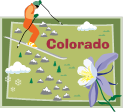 The State of Colorado celebrates its birthday today—Colorado Day. The Centennial State achieved statehood 137 years ago on August 1, 1876.
None of my family lived here then. The Reeds came later, well into the twentieth century. But came they did. These folks made their way into the same state where I, too, settled. Today I am thinking of my Reed predecessors who came to Colorado:
- Robert Morton Reed, my great-uncle, worked as a railroad telegrapher in Denver in 1917. He registered for the WWI draft there. He had a long career with the railroad, serving in both Colorado and Wyoming. The Broomfield [CO] Depot Museum is currently documenting the service of all the men, including Robert Morton Reed, who served as station agents there. Uncle Mort, as we knew him, retired to Delta, CO. He and his wife Alta are buried in Delta.
- Grace Reed, my grandmother, moved her family to Loveland from Wyoming in 1936. My grandfather, a truck driver, had died in an accident near Brighton, CO the previous year. Wyoming had virtually no benefits for widows and orphans during those Depression years, but Colorado was more generous. Uncle Mort found a place for my grandfather’s family to live. Grandma is buried in the Loveland cemetery. Her second son, named Robert after Uncle Mort, is buried at Ft. Logan National Cemetery in Denver.
- Dean Reed, the American Rebel and my third cousin, was born in Denver in 1938. After a colorful singing career in Hollywood and behind the Iron Curtain, Dean died under mysterious circumstances in East Germany. His is buried in Green Mountain Cemetery in Boulder.
- Thomas Aaron Reed was my great-uncle and younger brother of Robert Morton Reed. He retired to Cañon City in the 1960’s. He and his wife Hettie are buried there.
Today many of their descendants call Colorado home. We enjoy living in the beautiful Centennial State. Happy birthday, Colorado!
What is the Outlook for Genealogists?
 People used to joke about when they would be “done” with their genealogy. The historical answer was “never” because you never run out of ancestors. Recently, though, I have found myself thinking about all the changes in the genealogy and family history world in recent years. Where will this technology-driven environment take us? Could genealogy be “done” in my lifetime?
I learned to do genealogy the old way. We joined local societies to learn how to do genealogical research. We kept voluminous notebooks of family group sheets and exhorted ourselves to write at least a letter per week soliciting information from relatives and vital records offices. We ordered microfilmed records from the Family History Center and occasionally drove over to Salt Lake City to use the huge genealogy library there. I felt blessed to live in the greater Denver area with its easy access to the wonderful Denver Public Library and branches of the BLM and the National Archives. Our goal was to produce a beautifully-bound book on our lineage. It took a lifetime to gather the information.
Nowadays, I keep my genealogical records electronically, and probably I will never write that book. I rarely visit the local repositories because I can find so much information online. The same goes for genealogy meetings. Instead of gleaning tips from speakers at the monthly meeting, I learn to do genealogy by attending seminars and conferences, or using the helpful materials on the LDS website https://familysearch.org/.
A huge genealogy industry has sprung up in recent years. Professional speakers traverse the country and vast websites offer valuable collections online. We even have genealogy television shows. Anyone willing to pay all the fees can reap a bonanza of records, educational materials and DNA results. Instead of compiling genealogy books, thousands of people use this largesse to add family lines to the collective world family tree.
So what happens when the world family tree is more or less done? What becomes of the genealogy hobby then? Will new genealogists spend most of their time verifying the work of others or collaborating to break down the remaining brick walls? Will people do genealogy at all if it means simply plugging oneself into the world tree developed by others?
Digitization of records and sharing of family information continues at breakneck speed. Most people can look at the compiled world tree and find some of their ancestors already listed. I think I will see the day when we have a complete database, at least for Americans. Will the world still need genealogists then?