Life Gets In the Way Sometimes
 February 18th, 2016 |
  Author:
  A have had a week without genealogy. My life keeps getting in the way of any serious research.
It goes this way:
- Sunday, being Valentine’s Day, I spent enjoying some leisure time with my husband/tech advisor,
- Monday, being President’s Day, I spent shopping at all the great sales,
- Tuesday, I took care of my three-year-old granddaughter, and she is not very interested in genealogy, yet,
- Wednesday, I spent catching up on all the correspondence I had neglected earlier in the week. I did sneak in some time to read the newest issue of the NGS Quarterly.
Here I am now on Thursday with nothing to show in the way of genealogical progress. I do plan to work on some genealogy today. I have a stack of Sherman family documents on my desk that I need to analyze. I also have on online webinar that I want to hear.
I also discovered a little gem among some genealogy material I inherited last year. Our cousin Alta Kaessinger had a membership in the Coles County, Illinois genealogy society for many years, and she saved all their newsletters. I want to go through them to see if I can find any Reed or Sherman-related information. Of course, I could take a short cut and just look this up on PERSI, the Periodical Source Index for genealogy publications, but I would get a better sense of place if I read the newsletters.
So, I have big plans, just not big amounts of time. I will do what I can.
 Posted in
52 Ancestors in 52 Weeks no. 5–Bjarne Kaurin Bentsen (1906-1986)
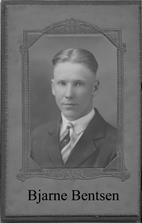 My grandfather Bjarne occupied the slot of the first child in his family born in America. He took that role very seriously, and when he grew up he promptly anglicized his name to Barney.
His parents, grandparents, and older sister Riborg had emigrated from Bø in the far northern reaches of Norway in 1904 and 1905. Upon their arrival in the United States, they settled temporarily in Lake Park, Minnesota. Bjarne’s father and grandfather went to work for the railroad to earn enough money to homestead in the West. While the family lived in Lake Park, Bjarne was born on 26 August 1906.
By 1907 the family had saved enough to begin homesteading. Bjarne travelled on the train with his family to Culbertson, Montana. From there they headed north to the Medicine Lake area and acquired homesteads among other Norwegian settlers. A few years later, Bjarne’s parents moved on to a larger homestead in Sheridan County near Redstone, Montana, just south of the Canadian border.
On the new homestead, Bjarne helped his dad build a sturdy barn that still stands on the property over a hundred years later. They spoke Norwegian at home, and Bjarne did not begin to learn English until his sister Riborg started school. During his youth, he learned to hunt and fish, a pastime that became a life-long pursuit.
Bjarne and his siblings Riborg, Signe, Jennie, and Otto attended the Two Tree School about a mile from their home. Their father had built the structure.
Long after Bjarne had finished the eighth grade at Two Tree, a pert, new teacher arrived from Minnesota to take over instruction at the school. Martha Mattila lived with surrounding farmers, including the Bentsens, during the school year. Bjarne took a shine to her, and they were married on 2 June 1928 in Plentywood, the county seat. For unknown reasons, they wed at the Congregational Church even though both were Lutheran.
They welcomed their first child, my mother Joyce, the next year. The local paper reported that “Mother and daughter are getting along nicely and Mr. Bentsen is wearing the smile that won’t come off.”
Once he started his family, Bjarne no longer wanted to help with the farming; he seemed ready to try something new. He and Martha left Montana to return to her old neighborhood in Hibbing, Minnesota. By 1930 they had moved into a house next door to her parents, and Bjarne went to work as an electrician for the local iron mine.
During the Depression, Bjarne and Martha added a son and another daughter to their family. Bjarne changed lines of work again, leaving the mines to become a police officer.
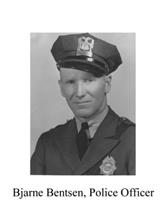 His family recalled encountering him in his official capacity during those years. He occasionally had to pick up his disorderly brothers-in-law at the taverns. Sometimes he stopped in at home in the evenings to tell his children it was time for lights out. His worst experience was identifying the body of his father-in-law after Alex Mattila was killed by a train in 1945.
Martha’s mother Ada Mattila died in 1948. By then, after 18 years in Minnesota, Bjarne was missing the West. He and Martha sold all their belongings and went to Wyoming with their three children to make a new start. At some point he had taken a correspondence course in electrical work, and he put that to use in Powell. Over the next few years they bounced from one Wyoming town to another, living in Basin, Worland, and Casper, as he gained experience in the field.
They finally ended up in Rapid City, South Dakota in 1951. There he owned the Interstate Electrical Company and joined the International Brotherhood of Electrical Workers and the National Electrical Contractors Association. He acquired a four-placer Navin plane, and joined the air patrol. In 1960 he created quite a stir in Riverdale, North Dakota when he arrived in his plane for his son’s wedding.
Bjarne also joined the Rushmore Masonic Lodge #220 during these years. He liked to participate in parades by riding a motorcycle with the Shriner’s group.
Over the years, the Bentsen marriage unraveled, and the couple divorced in 1960. Bjarne married Evelyn Nickerson after his divorce was final. With this marriage, he acquired four step-children—3 girls and a boy.
By 1965, Bjarne’s health was breaking down. He gave up the electrical shop and worked only occasionally as an electrician. At one point he took a short-term job at the Dave Johnston Power plant in Glenrock, Wyoming. When he was home in Rapid City, he helped his wife by collecting the rents for the office building she owned. He fully retired in 1981 due to ill health.
He and Evelyn continued to live in their family home until he was hospitalized in 1986. He passed away on 13 February 1986. The Masonic rites were performed at his funeral, and he was buried at Mountain View Cemetery in Rapid City. His cemetery marker reads, “Loving Bapa, Grower of Trees.”
What Will Happen To Our Heirlooms?
 Yesterday I attended my usual monthly lunch with ladies from my neighborhood. We enjoy our time together as we swap news and talk about neighborhood issues. This month our conversation turned to our plans for our various family heirlooms.
Most of us have found that our Millennial children do not care to learn about what we have. They probably do not want most of it. So the members of the group began to compare notes on what to do with the antiques, scrapbooks, historic documents, etc. that we have collected.
I like the solution that one neighbor offered. She has taken photographs of everything of family importance in her possession and written summaries of the significance of each item. She placed an album with all this information and her Last Will and Testament in her safe. When she is gone and her family must dispose of her things, they can use the notebook as a guide for what they want to keep.
I think that I would like to do this with my own things. We have a few heirlooms I hope my family will want. I know their provenance, but perhaps my sons do not. Certainly my daughters-in-law and grandchildren have no idea of where I acquired certain items and why I keep them.
After talking this over with the ladies at lunch yesterday, I have come up with a plan. When my oldest granddaughter gets a little bigger (she is in the second grade), I think I will hire her for the summer to help me with this project. Taking the photographs, writing the descriptions, and putting them together in a notebook would be fun for both of us. She could gain an appreciation for the mementos documenting her family heritage. Best of all, someone in the next generation would have the necessary background for knowing what to keep and what to let go.
The Shermans Made the Papers
 Have you ever used newspapers in your genealogical research? Most of us routinely look for obituaries, but newspapers often include other information about our ancestors. These great resources can really flesh out their stories, if we can locate them.
During my early years of genealogy, our large local genealogy library carried reference books that spelled out the names and dates of historic newspapers for most locales. For my research, I found that I usually needed to make a trip to view a relevant newspaper for the mostly-rural locations of my ancestors. This, of course, was an expensive undertaking, and I did it only a couple of times. One of those trips, to the Nebraska Historical Society in search of newspapers from southwestern Nebraska, yielded nothing useful.
As time went by, more papers were microfilmed. In theory, one could get these films on interlibrary loan. This was less expensive, but still awkward. Sometimes the process did not work very well.
One year, I tried to get the newspaper from Charleston, Illinois via inter-library loan. Imagine my amazement when it came in for me—8 rolls of microfilm for a newspaper from that small town! Unfortunately, I soon realized they had sent me the newspaper from Charleston, South Carolina, not Charleston, Illinois.
Last year, I decided to take another chance on finding newspaper articles. A more modern tool has become available to me. I subscribed to Newspapers.com. When I looked at it, I was delighted to find that it has databases for papers from rural areas in Illinois and Indiana where my ancestors lived.
These papers are searchable, and I have found several articles of interest about my ancestor, Thomas Sherman, and his family:
- Accounts of marriages of his nieces Cynthia and Mary Sherman in Ninevah, Indiana,
- Reports of out-of-town travel and letters waiting for another niece, Laura Sherman, also of Ninevah,
- A story about a shower of gifts for local widows in Ninevah, including Thomas’ sister-in-law, Sarah Jane Sherman,
- Notice of an Illinois court order requiring Thomas’ sons George and Claude to each contribute $1.50 a week to the support of their elderly father,
- Week-by-week updates about the health of elderly residents of Coles County, Illinois, including Thomas Sherman.
Another surprising article from Mattoon, Coles County, Illinois contains the story of one Thomas Sherman who had confessed to counterfeiting and had been jailed. The article says the authorities searched the man’s shop and found metal ready for casting. My ancestor was a blacksmith, had a shop, and certainly worked with metal. Was the counterfeiter my ancestor? More than one man named Thomas Sherman resided in Illinois at the time, so this merits further investigation.
Obviously, local newspapers contained all sorts of interesting information. If you are persistent, you will have the opportunity to search one and discover something new about your ancestors.
52 Ancestors in 52 Weeks No. 4, Grace Riddle/Evert (1896-1976)
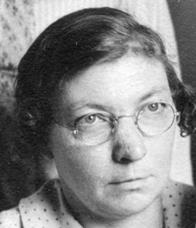 You talk about a hard life; my grandmother Grace lived it. She never talked about it, though, so details are a little sketchy.
Grace was born on her mother’s homestead near Palisade, Nebraska on August 30, 1896. The mother, Laura Riddle, had settled there with her three sons, Frank, Lewis, and Joseph, several years earlier. Riddle was the mother’s maiden name, and the boys sometimes used that as their own. At other times they used the Edmonds surname which was that of their father back in Michigan. The boys were 16, 18, and 20 when Grace was born, and she did not like them much. She never knew her father, and to this day we do not know who he was.
Laura struggled to make a living on the homestead. Eventually, her older sister Theodocia Evert traveled from her ranch near Hyannis, Nebraska to visit Laura. She took Grace back to the ranch with her while Grace was still a small child. Grace never talked about how she felt that day. She did, however, develop a strong attachment to Theodocia, whom everyone remembered as a loving, kind woman.
Grace Riddle became known as Grace Evert even though the Everts did not formally adopt her. Grace grew up among the extended Evert family and went to school through the 8th grade. Her best playmate was her cousin Rowena’s daughter, Ida. They stayed in touch throughout their lives, even after Rowena’s family emigrated to Alberta, Canada in the 1920’s.
As some family left the Hyannis area, others arrived. During World War I, Grace’s cousin Henry Evert acquired a new ranch hand, his wife Bertha’s younger brother Owen Herbert Reed from Huggins, Missouri. Grace and Herbert married on April 18, 1918.
The young family had three children while they lived in Nebraska. Grace went home to her mother, now at Haigler, Nebraska, to have her first child, Hazel Margaret. The next two boys, Owen Howell, and Robert Lloyd were born at Hyannis.
During the mid-1920’s, Herbert left the ranch life and moved his family to Wheatland, Wyoming. He and Grace rented a house in town, and he went to work at the railroad station. They settled into small-town life, and had three more sons, Harold Howard, Earl Eugene, and Donald Raymond.
Life became harder in the 1930’s. Grace missed her family in Nebraska. One summer when she took Harold and Eugene back to visit, she received a disturbing letter from Herbert. He was having a hard time with the older kids, and one of them had even set the house on fire. Another time, illness struck. Grace came down with smallpox, and the family was quarantined. Luckily, she survived, and no one else contracted it.
Times were hard economically, too. Herbert lost the job with the railroad and took up truck driving. He was probably gone a lot, leaving Grace to manage six children on her own.
Then came the terrible day, July 6, 1935, when Herbert was killed on the job in Colorado. Grace was widowed at the age of 38. She never remarried.
How was she to support the family? Her brother-in-law Morton Reed stepped in to help. He found a house for them in Loveland, Colorado where they could get widow’s and orphan’s benefits. He helped Grace file a Workman’s Compensation claim.
Hazel Reed was 18 by then, and she went back to Nebraska to get married. Grace moved to Colorado with the boys. They muddled through the remaining years of the Depression. The oldest son, Owen, joined the CCC to help support the family.
When World War II began, they boys in turn joined the military once they graduated from high school. They all sent money home to their mom. They were proud to have reached maturity with the family intact and no one in trouble.
Military life was not for Harold. After a stint in Korea, he returned to Loveland, the only one of the boys to do so. He spent a career working at the sugar factory there. He and his mom lived together in the same house where he had grown up.
Grace made Loveland her home for the rest of her life. She enjoyed activities with the Presbyterian Church and the local War Mothers chapter. During the early 1970’s she and her neighbor Mrs. Hepner traveled with them to visit Washington, D. C.
One day, Harold came home from work to find his 79-year-old mother on the ground in the back yard, unable to get up. He took her to the hospital where he learned she suffered from a heart-related problem. The doctors recommended a nursing home.
Grace hated that idea, but there was no other choice. She lasted only a week there, and passed away on June 19, 1976.
Grace is buried in the Loveland Cemetery. She was survived by her five sons, five grandchildren, and six great-grandchildren.
Time To Look Beyond the Census
 Despite spending quite a bit of time this week on census records for my current research project, I did not discover anything new about my subject, Thomas Sherman of Coles County, Illinois.
Several men named Thomas Sherman lived in Illinois during the life span of my Thomas. If I have identified the correct man, he lived from 1841 to 1912. He resided in Kentucky as a boy, but he had settled in Illinois by 1870. The census records for 1870-1910 tell me this:
- His birthplace is uncertain, having variously been reported as Indiana, Kentucky, and Ohio.
- He worked as a blacksmith in every census year and usually owned a shop.
- His middle initial was A.
- He was married three times. Two of the wives were named Mary and Alice.
- He was a natural-born citizen.
Unfortunately, these records do not tell me what I want to know. The big questions:
- Did Thomas serve in the Civil War as the family claims?
- Who was the first wife, the woman who was my great-great grandmother?
- Why was my great-grandmother, the daughter of Thomas and the unknown woman, omitted from Thomas’ obituary?
I must keep digging if I ever hope to answer these questions. I have done all I can with census records and county histories. Now I must move on to locate other records.
52 Ancestors in 52 Weeks, No. 3, Owen Herbert Reed (1896-1935)
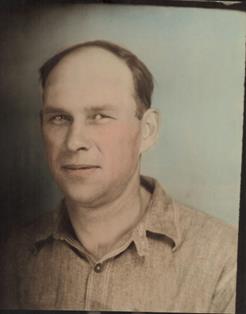 My grandfather died all too soon, and I never knew him. During the Depression, he left behind a wife, a daughter, and five young sons. Even today, I find the sad story hard to tell.
Owen Herbert Reed began life on December 6, 1896 on a farm in the Ozarks. He was the eleventh and last child of his father Samuel. His mother Anna Petronellia was the second wife. Like all his older brothers, my grandfather was always known by his middle name.
His family lived near Mansfield, Missouri, not too far from Laura Ingalls Wilder. They farmed and raised hogs until Herbert reached the age of seven. Then his parents divorced. The father left the area, the mother remarried briefly, and the boys all went out to the neighboring farms to work. No more schooling for them.
Despite this hard beginning, Herbert grew into a tall, happy young man with a cheery, friendly manner. By the time he reached young adulthood, he decided to follow his siblings away from southern Missouri. His father had taken up work as a ranch hand near Hyannis, Nebraska, and two of his brothers, Carter and Aaron, homesteaded together nearby. A sister, Bertha, had married a local Nebraska rancher named Henry Evert. Herbert joined the Everts in western Nebraska and married the rancher’s niece, my grandmother Grace, in 1918.
Together they had six children. The eldest was a daughter, Hazel, and the rest were boys named Owen, Robert, Harold, Earl, and Donald. Herbert worked for his sister and brother-in-law on the Evert ranch until about 1925.
By then, another of his brothers, Morton, had become the railroad station agent in Wheatland, Wyoming. Herbert relocated his young family there to take a job working as the freight agent at the station. All went well as long as the economy hummed along. In 1929 the family even traveled back to Missouri to visit Herbert’s mother.
As the Depression of the 1930’s worsened, the railroad finally had to cut back. Herbert lost the freight agent job. Luckily, his brother Morton helped him secure new employment as a truck driver. He liked to drive and owned a car.
On Independence Day weekend in 1935, Herbert drove to Denver, Colorado to pick up a load of fruit. His boys looked forward to his return on July 6 because he had promised them some of that fruit. To pass the time as they waited, they went off to spend the afternoon at the movies. My dad was seven years old.
Part way through the movie, a neighbor lady came into the theater to tell them they were needed at home. There they learned the sad news that their father’s truck had gone off the road near Brighton, Colorado. The load in the truck had shifted, killing him instantly at the age of thirty-eight.
His funeral took place at the Congregational Church in Wheatland, and he was buried in the Wheatland Cemetery. Family members from Nebraska attended. They were stunned at the loss of their baby brother.
Herbert’s older children remembered him as a playful father. He would swing them by his bent, stiffened ring finger, injured in childhood when his brother Aaron swung at him with a hatchet. The younger boys regretted that they had no real memory of their dad.
I, too, regret that I never had the chance to know him. My own father has often wondered how different his life would have been if his father, and the family breadwinner, had not died so young.
The Bentsen Clan Loses Two of Its Own
This week I received word that my extended Bentsen family has lost not one, but two, of our patriarchs. They were first cousins to one another, Ron Bentsen and Floyd Fleming. Both were grandsons of our Norwegian immigrant, Ole Bentsen.
Ronald Bentsen (1931-2016)
My uncle Ron took care of me a lot in my younger years as he pursued his college studies. He even lived in our basement for a while, so I knew him quite well back then.
When he finished school, he married and moved away, so I seldom saw him. Still, we kept in touch. He often sent me family photos or tidbits of newly-discovered family information. The last time he visited, we had a great time reminiscing about the old days.
He had a long career as a civil engineer for the Army Corps of Engineers, serving in Japan and West Germany. He ultimately settled in the Atlanta area. He spent his retirement years enjoying his family and fighting kudzu.
You can find his obituary here: http://www.legacy.com/obituaries/atlanta/obituary.aspx?n=ronald-bentsen&pid=177332981&fhid=5328
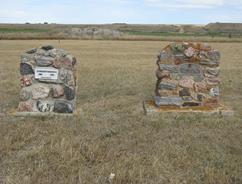 Floyd Fleming (1938-2015)
I met our cousin Floyd only once. As he was quite a bit older than me, he took little notice of his cousin’s kid that day. Still, he seemed to have an appreciation for family.
Floyd left behind a wonderful testament to his mother and the baby sister who died in infancy. He created beautiful cemetery markers for them in the Redstone, Montana cemetery.
You can read Floyd’s obituary here: http://www.sheridanmedia.com/obituary/floyd-fleming
52 Ancestors in 52 weeks No. 2, Joyce Beverly Bentsen
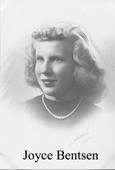 The second person on my ancestral chart, my mother Joyce Beverly Bentsen, lived from 1929-2000. Several years before she died, she wrote about herself for a family history compiled by one of her aunts. She contributed this to the Bentsen-Sivertsen History, 1800-1988 by Signe Bentsen Fleming:
[I] was born April 8, 1929 in Plentywood, Montana. [I] attended Brooklyn Elementary School and Lincoln Junior High School in Hibbing, Minnesota and graduated from Hibbing High School in 1947. [I] then attended the Duluth Branch of the University of Minnesota and Northwest Community College in Powell, Wyoming and graduated from the University of Wyoming in Laramie in 1951 with a degree in Business Education.
[I] taught commercial subjects at Douglas High School in Douglas, Wyoming from 1951 to 1953 and worked summers at Mammoth Hot Springs in Yellowstone Park, Pahaska Tepee at the east entrance to Yellowstone, and the Virginia Café in Rapid City, South Dakota. [I] also taught business subjects at the University of Wyoming and Adult Night School in Laramie. [I later] worked at H&R Block Income Tax Service in Casper, [Wyoming].
[I] lived in Butte, Montana; Laramie, Wyoming; Bismarck, North Dakota; Sidney, Nebraska; Casper, Wyoming; and Cody, Wyoming. [I] am the [mother] of four children.
Mom did not mention that she was Valedictorian of her high school class. She was accomplished in other ways, too, including playing the piano.
Mom died on July 3, 2000 in Casper after a long illness. At that time, she lived in her dream house, and my Dad took care of her. The home was filled with clothes she had made, needlework she had created, and milk glass she had collected. She loved gardening and had beautiful flower beds—quite a challenge in cold, windy Wyoming.
Still, Mom did not like Wyoming much and always wished she could move somewhere with more trees. Perhaps she takes some satisfaction that only one of her children stayed in the state. We hope she approves that her final resting place, Highland Cemetery in Casper, has beautiful old trees and green lawns.
The Curse of A Common Name
 Sherman. The 422nd most-common last name on a list of 5000 American surnames. A lot of people share the Sherman name, including my great-grandmother Anna Petronellia Sherman. Because she always went by her middle name, Petronellia, I usually have had an easy time locating her in the records.
Her father Thomas Sherman presents a more difficult case. Still, I thought I had him culled from the list of other Thomas Shermans who populated late 19th-century Illinois. Then I looked for his family tree on Family Search. There I found him with his daughter Anna Petronellia—and two sets of parents. Uh-oh. Something needs sorting out.
To which family does he belong? Thomas, born in 1841 to Rebecca and Daniel, with siblings Polly, Anderson, Evalyn, Emily, Eliza, Gilla Ann, John, and Jasper? Or Thomas, born in Indiana in 1844 to Maria and Lewis, with siblings Mary, Chapel, James, Benjamin, Delilah, Greenlee, and Tilchman?
For the last ten years I have thought my Thomas belonged to Rebecca and Daniel. I have the following evidence:
- According to The Reeds of Ashmore [Illinois] published in 1988 by Dr. Michael Hayden (another descendant of Petronellia), our Thomas Sherman was an Illinois blacksmith. Hayden relates that after Petronellia’s mother died, Thomas married Alice Farris and had several more children.
- U.S. census records for Illinois in 1880, 1900, and 1910, confirm that Thomas the husband of Alice did work as a blacksmith. Daniel Sherman was also a blacksmith as were Daniel’s sons Anderson, Thomas, John, and Jasper.
- The 1912 obituary for Thomas Sherman, husband of Alice, states he was born in 1841 in Ohio. It lists surviving siblings as John, Anderson, Evaline, and Gil.
This evidence points to Daniel and Rebecca Sherman as the true parents of Thomas, the father of Petronellia. What could link him to the other family? The Family Search tree placing him in the Lewis Sherman family has no attached sources.
Someone submitted that family tree to Family Search in 2014. Fortunately, she provided e-mail contact information. I will follow up with this researcher to see what additional evidence she can offer. We may be researching a common name, but we need to get it right.