52 Ancestors in 52 Weeks no. 6—Martha Louise Mattila (1906-1977)
 February 22nd, 2016 |
  Author:
 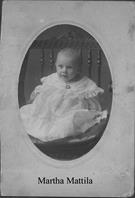 My maternal grandmother Martha had a multicultural upbringing. Her parents Alexander and Ada had immigrated from Viipuri, Finland in 1905, the year before she was born. They settled on the Iron Range of Minnesota, near Hibbing. Martha was their first child, and they spoke Finnish at home.
At that time, Hibbing was still getting settled after its founding in 1892. The mining companies heavily recruited in eastern and southern Europe to find workers. Martha grew up among various ethnic groups including Poles, Bohemians, and Italians. She also had an extended Finnish family nearby, because three of her father’s sisters immigrated, too. She met her life-long friend Melia when she started school.
Martha’s own family attended the Lutheran Church, but many of the neighbors were Roman Catholic. She spoke of the time when she was about five years old, and she heard a Catholic bishop was coming to town. There must have been some anxious preparation in the community for this occasion because Martha was so afraid that she hid under the bed. “And I wasn’t even Catholic,” she laughed later.
Martha spent her early years believing she would be an only child. Not until she was 10 did another sister, Aida, arrive in 1916. Two brothers followed: Hugo in 1918, and Peter in 1919. Martha suddenly found herself in the role of mother’s helper.
She was a smart girl, and despite her household duties, she finished high school early. She went on to college at the Duluth branch of the University of Minnesota. There she earned a two-year certificate in elementary education. Martha became a teacher.
She sought adventure and applied for a job far away in Montana. With her ability to mingle easily among other ethnic groups, she was hired to teach in a Norwegian community near Redstone, Montana. She taught at a one-room schoolhouse and lived with local farm families.
On 2 June 1928 she married Bjarne Bentsen, the older brother of two of her students, Jennie and Otto. For a year or so, until the birth of their daughter Joyce, Martha and Bjarne stayed in Montana. Sometime in 1929 they decided to relocate to Martha’s hometown, Hibbing.
They settled into a house that her father had built, right next door to her parents and younger siblings. Martha focused on raising Joyce and eventually had two more children, a son Ronald (“Sonny”) and another daughter. She had a somewhat fractious relationship with her mother but also enjoyed gossiping with her in their native Finnish language. Her children felt as much at home in their grandparents’ house as they did in their own.
The family remained in Hibbing, except for a short-lived move to a larger house, until Martha’s parents had both died. Then Bjarne got the itch to return to the West. He hoped to become an electrician to capitalize on the post-War building boom.
They uprooted their family and drove to Wyoming. Bjarne worked as an electrician here and there for the next few years while Martha supplemented the family income by teaching school. They finally landed in Rapid City, South Dakota, where he set up an electrical shop. Their youngest child graduated from high school and got married. But these happy events could not outweigh the stress of constant moves and uncertain income. Their marriage fell apart.
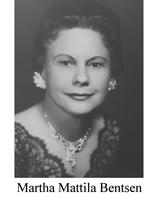 Bjarne and Martha divorced in 1960, and Martha remained in their little house. At first she enjoyed life by socializing with the neighbors and participating in veteran’s groups. She served as President of local chapters of both the VFW Auxiliary and the American Legion Auxiliary. Martha loved to dance and faithfully attended the weekly dances at Ellsworth Air Force Base in Rapid City. She really liked dancing with all the young airmen.
Yet her carefree life as a divorcee did not last long. Bjarne was not good at paying his alimony, so Martha continually scrambled for money. For a few semesters, she offered room and board to students from the South Dakota School of Mines. She continued to teach school off and on, first at the Bergquist School in Rapid City. After the school district began requiring teachers to have a 4-year degree, she began commuting to teach at the rural Fairburn school where her 2-year diploma still sufficed.
When it came time to collect Social Security, she found she did not have enough work credits to qualify. Martha found a job in a local bakery where she worked until she could receive benefits.
Eventually the time came when she needed to sell her house. The upkeep had become strenuous, and she wanted to unlock the equity in the home. She hated leaving the neighborhood she had known for over twenty years, but she made friends quickly in her new apartment complex.
She lived there until 1977 when her health began to fail. Her daughter Joyce took Martha into her home in Casper, Wyoming. After a short time, it became apparent that Martha needed a nursing home. She hated it there and lasted only three months. On the 26th of August 1977 (Bjarne’s birthday) she passed away after a stroke.
Martha was not particularly religious, and she did not have a church funeral. The family held a simple memorial service for her in a funeral home chapel. She was buried in the Highland Cemetery in Casper.
Martha liked pretty things, and she did beautiful crochet work. Her family still has her china, silver service, and many afghans and doilies that she made.
 Posted in 52 Ancestors