Archive for the ‘Genealogy’ Category
I Create a System
 September 22nd, 2022 |
  Author:
  More and more often I find myself searching my DNA matches for clues to my brick wall ancestors. I run cluster reports and try to construct family trees for my matches, hoping to find a familiar surname. I jot down information as I run across it, but these stacks of notes and trees were getting out of control. I needed a new system.
This week I worked on the record-keeping problem.
First, I found some space in a file cabinet drawer. I know, I know, I am a Luddite who likes to work with paper files. For me an electronic file is a file lost. The file cabinet works best for me.
I began by creating folders for DNA related information:
- I have attended numerous presentations and webinars on DNA research. I gathered the notes from these in a folder.
- I have run several auto cluster reports for my Dad. I put them all in a folder.
- The testing companies periodically update our ethnicity reports, and I print out this helpful information. Monitoring these has already assisted in identifying one unknown ancestor. For example, when the companies began separating English and Irish ancestry, I realized my mystery great-grandfather must have been Irish. Ethnicity reports went into another folder.
- I made folders for printouts of match lists from each of the companies we have used for DNA testing.
In the cabinet behind these folders, I placed alphabetical dividers. As I work on a particular match, I can alphabetically file the notes and trees for that person.
Organizing my work this way accomplishes two things:
- I can retrieve information with ease.
- I have less office clutter with everything in neat files.
As work evolves, so must organizational systems. My DNA research was overdue for a re-do. I should have done it a long time ago.
 Posted in
Honoring Patriot Ancestors on FindAGrave.com
The Daughters of the American Revolution (DAR) take patriotism seriously. One way they do this is through a partnership with www.FindAGrave.com to mark the memorials of Patriot ancestors. A Betsy Ross symbol and a Patriot profile can be added to the memorial.
This week I am taking a look at the sites for my own proven ancestors to see if this has been done. Both graves have military headstones provided by the Department of Veteran’s Affairs (VA):
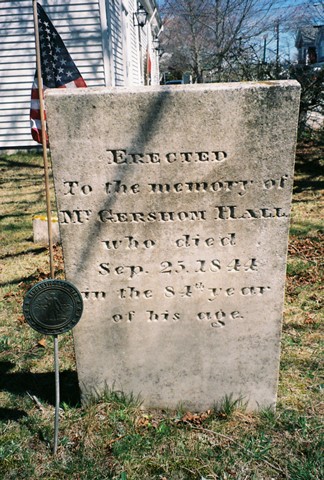
- Gershom Hall (1760-1844). He is buried in the First Congregational Church Cemetery in Harwich, Barnstable County, Massachusetts. His grave is marked with an American flag and a Revolutionary War medallion. FindAGrave has no mention of his Revolutionary War service, and there is no Betsy Ross symbol on the site. https://www.findagrave.com/memorial/95947092/gershom-hall
- Robert Kirkham (1754-1819). He is buried in the Kirkham Cemetery near New Middletown, Harrison County, Indiana. The grave is marked with an American flag but no medallion. A Daughter (perhaps a distant cousin of mine!) has already placed a description of his War service and the Betsy Ross symbol on this site. https://www.findagrave.com/memorial/20513563/robert-kirkham
Since Robert Kirkham has been taken care of, I will turn my effort to updating the memorial for Gershom Hall.
I know of no other descendant of Gershom Hall who is a current member of DAR. A DAR application from nearly 100 years ago was approved based on descent from his daughter, Thankful (1785-1863). If a current Daughter descends from Thankful, she has not yet updated the FindAGrave memorial.
I descend from Gershom’s eldest daughter, Rhoda (1784-1850), and no one else has applied on her line. I had to prove my descent back 6 generations through her to join DAR.
I suspect I am the only person who would see that the upgrade to Gershom Hall’s memorial gets done. I need to do a little research to learn how to do this.
I want to see Gershom Hall’s service honored this way.
The Search for the Ryan Branch
 Every week I look at my dad’s DNA matches. I focus on his line because that lineage holds all the brick walls in our family tree. I look for new matches, and I try to identify the most recent common ancestor for any relatives I do not recognize. This summer, I am focusing on the Ryan branch of my family.
We have numerous Irish DNA matches, many with Ryans in their family trees. These people must fit on my tree somewhere. Yet I have not found a single common ancestor for my dad and his Irish-surnamed matches. The one I worked on last week turned out to be related to us through an English line, the Carters.
We descend from Daniel Ryan (1829-1863) who was born in Ireland, immigrated to Illinois, and died of disease while serving in the Union Army at New Orleans. On a marriage record, he reported that his father’s name was Edmund Ryan.
None of our DNA matches descend from Edmund Ryan.
Yesterday I worked on the puzzle again. I traced most of the Ryan matches back to Denis Leonard and Mary Ryan who were born in County Limerick (or perhaps County Clare) in the early 1800’s. Dates vary, and I suspect researchers may have merged two couples into one.
Our DNA matches living in Ireland today almost uniformly reside in Limerick or nearby Tipperary. I believe this area, not County Clare, must be where my roots lie.
One Ancestry family tree for Mary Ryan and Denis Leonard offers tantalizing clues. It extends back in time much further than other posted trees. Family names include Daniel and Edmund, the same names I have in my tree. They resided in Limerick, where I think my family may have originated.
Could these people be my family? I have half a dozen other matches to work through to see if I can make sense of it all.
This Ryan ancestry provides me with quite a challenge. I would like to resolve the mystery this year in time to write it up and distribute it to the family for Christmas.
DNA Clues
 We have had our DNA tested at several of the companies hoping to identify my dad’s maternal grandfather. Last summer we found success when my sister’s test revealed the name that had been elusive for 125 years.
I began research into this man’s line only to encounter a brick wall the next generation back. Now I hope to use our DNA matches to more distant cousins in the same line to learn more about this Irish family.
Many of our matches have Irish surnames. Is one of them the link to breaking down the brick wall? I am going through them, one by one, to look for common ancestors in hopes of creating a family tree.
The DNA research experts who speak to my local genealogical societies have suggested a process for this:
- Knowing that many DNA test takers are “of a certain age”, one can often locate their names on the 1940 and 1950 U.S. census records. Use this information to begin building family trees for matches of interest.
- If you cannot find the match’s name on these census records, try searching on sites like Facebook for family tree clues.
- Look for online obituaries where the match is either the decedent or is named as a survivor. These articles often list previous generations.
- Use the contemporary information to locate the family on the public trees found on genealogy web sites such as Family Search and Ancestry.
- Keep working back in time on the match’s tree to look for your own surnames. In my case, these are Hamill, Junk, Lawless, and Ryan.
This week I tried this approach with a 23andMe match to a man in his 80’s who has an Irish surname. His paternal family came from Illinois, the same state where my Irish family lived. This match looked promising. I began to build out his family tree, looking for an overlap to my own.
I learned his father’s full name and his mother’s first name from U. S. census records. Then I found the father’s family tree posted on Ancestry.
Working the lines back to the early 1800’s, I found none of my surnames.
Perhaps the match was related to us through his mother’s family? Was she Irish, too? Again, I checked the posted family trees. Her maiden name was Carter. Uh-oh.
I have Carter ancestors, but they were not part of my unknown Irish line. A family tree comparison showed that the DNA match and I both descend from my English 3rd great-grandparents, John Carter (1790-1841) and Mary Templeton (1792-1857) of Ashmore, Illinois.
I can check this fourth cousin with an Irish surname off my list.
On to Tipperary?
 Pinpointing my Irish Ryan family is proving quite a challenge. I do not know when they arrived in America, but I suspect it was during the Potato Famine.
I began my search last week by making a list of all my ancestor Richard Ryan’s associates who were also named Ryan. I looked for a family connection. No luck.
These men had either lived near Richard or their names appeared on legal documents with him. They all proved difficult to trace in the genealogical record. I could not find a blood relationship amongst any of them.
What should I do next?
I can move back a generation to Richard’s father, Daniel Ryan (1829-1863) to look for any associates named Ryan. I found none.
My earliest record for Daniel is his marriage to Jane Lawless in Peoria County, Illinois in 1851. This was a Catholic marriage, but the diocese will not allow access to their record. I have only a civil record which provides just names. I do not know whether a Ryan served as a witness to this marriage.
A year later, Daniel and Jane had a son baptized at the Kickapoo church in Peoria County. Again, the Catholic church will not provide the record. Again, I do not know whether any Ryans served as godparents.
The Kickapoo location provides me with one last clue. The church there has a parish cemetery. Several Ryans were buried therein around the same time Daniel and Jane were married and had their baby baptized.
I wonder whether these Ryans were related to Daniel:
- John A. Ryan (1806-1871) and his wife Ann (1793-1855). They had a son Dennis (1837-1857) who was buried alongside them. His gravestone says he was born at Emly in County Tipperary.
- James Ryan’s wife Margaret (1821-1868) and six of their children. She was also from Tipperary, coming from the parish of Ballengarry. James Ryan himself must have been buried elsewhere.
I do not believe John and Ann Ryan were Daniel’s parents although they were of the right age. Daniel’s second marriage record to Bridget Murphy in 1854 names his parents as Edmond and May. The Kickapoo Ryans could have been cousins.
I have little familiarity with Irish records, but I will look next to see whether I can connect Daniel or Edmond Ryan to Emly, Tipperary.
My dad’s ethnicity estimates with the DNA testing companies posit that his Irish relatives came from Tipperary. These Ryan immigrants from Emly are now the best clue I have.
Oh, Those Ryans!
 Last summer a DNA test revealed a Ryan ancestral line I had known nothing about. This presented me with a new world of genealogical research, Irish Catholic ancestors. I began looking for information on my second great-grandparents, Daniel Ryan (abt. 1825-1863) and Jane Lawless (1826-1853).
As is often the case in my family, the wife proved easy to trace. The Lawless family originated in Haggardstown, County Louth, Ireland and immigrated in 1849. They settled in Illinois, at Peoria for a few years before they moved on to La Salle County.
The Ryans, on the other hand, pose a difficult research problem. Ryan is quite a common name in Ireland, and Daniel left behind few clues about himself or his family.
The Catholic church refused to open its records of Daniel and Jane’s marriage and their son Richard’s baptism. The names of witnesses to these events, who may have been family members, remain inaccessible to me.
Daniel died in the Civil War, and his second wife Bridget applied for a pension. An investigation into her life yielded no further information about Daniel and his origins.
With no more records of Daniel’s life to search right now, this week I turned to a list of his son’s known Ryan associates. Were any of them relatives?
- Although he was born in Peoria County, Richard Ryan grew up amongst his Lawless relatives in La Salle County, Illinois. A large Ryan family lived in the same county.
- William Ryan served as a witness to the minor Richard Ryan’s request for a pension based on his father’s Civil War service.
- Richard Ryan eventually homesteaded in Hayes County, Nebraska. At least one other Ryan family lived in Hayes County during that era—John Ryan who settled there in 1881; J. E. Ryan, a farmer listed in the county 1890-91 directory; and John R. Ryan who received a land patent in 1891. Other Ryans lived in adjacent counties.
- A cousin C. J. Ryan was named in Richard Ryan’s obituary in 1925.
Working back in time this week, I looked at census records created during Richard’s lifetime for Hayes and surrounding Nebraska counties. I found no enumeration in 1880, 1900, or 1910 for the John Ryan who had settled in Hayes County. No C. J. Ryan lived in the area.
From this search I still do not know whether I am related to the settler John Ryan. I learned nothing more about C. J. Ryan.
Although these Nebraska census records have yielded no further information about my Ryan family, they did provide me with a list of several Ryan families who lived in southwest Nebraska during Richard’s time there. Following up on them will take a while.
Perhaps there is nothing to find there. Some of Richard’s Lawless relatives settled in Nebraska, and his move to the state may have had nothing to do with his father’s family. Still, I must either prove or rule out the relationships.
Sightseeing
 My dad’s family lived all over the Old Northwest. For the past two weeks, we took a driving tour of several of those states. During that time, we visited courthouses, libraries, cemeteries, and historic sites.
Many of the historic places on our itinerary were off the beaten track. We found these quite interesting:
- Tallgrass Prairie National Preserve in the Kansas Flint Hills.
The National Park Service protects a remnant of the once vast tallgrass prairie ecosystem at the Spring Hill Farm and Stock Ranch. This opulent ranch with its limestone ranch house was much different from the homes of my 19th century ancestors on the Kansas prairie. The ranch house and outbuildings are all open to visitors who can see the surrounding prairie, too. - Lincoln Log Cabin State Historic Site in Coles County, Illinois. This place preserves the 19th-century home of Thomas Lincoln and Sarah Bush Lincoln, father and stepmother of President Abraham Lincoln. Sited on a working, living history farm, it includes a reproduction of the two-room Lincoln cabin. My family settled in Coles County about the same time the Lincolns arrived there. I imagine they lived as subsistence farmers just as the Lincolns did.
- The John Hay Center in Salem, Indiana. This Washington County museum honors the statesman John Hay who served as secretary to Abraham Lincoln and held posts, including Secretary of State, under four other Presidents. He was born in this county, and my Reed forebears lived there, too. The Center has a fine genealogy library where the kind staff assisted us with some research.
- Cuyahoga Valley Scenic Railroad in Summit County, Ohio. This train runs along the Cuyahoga River, not far from where my Dunbar ancestors settled in 1831. The ride showed me the local wildlife, glimpses of the Ohio & Erie Canal, and traces of the area’s industrial history.
- Ronald Reagan Boyhood Home in Lee County, Illinois. My husband/tech advisor had German ancestors who settled in this county, and we drove through the farmland where they worked. When we realized that Reagan’s boyhood home was in nearby Dixon, we had to stop in. The docent provided us a wonderful tour of the house the Reagans lived in from 1920-1924. We could picture our grandparents living the same modest way the Reagans did.
These stops were just part of our trip. They provided a diversion from doing genealogy every day and helped us learn the history of the places where our ancestors lived. We enjoyed every minute.
Preparation for My Next Research Trip
 Both my Reed and Riddle ancestors lived in the Midwestern states during the 19th century. I have an upcoming trip to tour Illinois, Indiana, Ohio, and Michigan to visit their locations and do some research in regional repositories. Preparing for a trip of this scale takes some preparation.
We are doing several things to get ready:
- I gave my husband/tech advisor a list of towns, farm locations, and research stops. He plotted out a route and schedule, taking into account the days and times various places will be open.
- I reviewed the online catalogs for the two libraries I want to visit. We will spend two days at the Allen County library in Ft. Wayne, IN and one day at the library in Akron, OH. I made a list of sources to see at each one. Doing this in advance will allow us to use the precious library time pulling materials and doing research instead of paging through a catalog.
- I prepared a timeline for each ancestor I plan to investigate. This lets us see at a glance what information is missing for that person.
- I formulated a list of focused research questions for these ancestors. We will focus our research on searching for clues to answer these questions. For example, who were the parents of John Davis Riddle (1821-1896)? Did Daniel Sherman (abt. 1800-aft. 1863) die in Indiana? Illinois? When?
- I placed these reference materials in folders, one for each research stop.
With so much information online these days, I already have a lot of information for all but brick wall ancestors. They will be the focus of research on this trip. I may not come home with any new information. These ancestors have been pesky about revealing their secrets so far.
Still, as one seasoned genealogist liked to say, “Until you look, you don’t know what you will find”. We are taking off to do some looking.
Mining the Past
 No one can beat the Palatines to America organization for educating genealogists on the ins and outs of German research. I have learned so much at their twice-yearly seminars in Denver over the past twenty years. Now another great opportunity to learn from them is coming up next week.
The Colorado chapter of the Palatines will host a 3-day national conference in Denver on June 16-18. I am looking forward to all they have to offer at this conference:
- First up on Thursday will be a bus tour of local German heritage sites. This includes a stop for lunch at a German restaurant.
- On Friday, Daniel Jones, the German and Swiss research specialist at the Family History Library in Salt Lake, will speak on four topics. These will cover beginning Swiss research, tools for reading German documents, German military records, and a case study.
- Dr. Wolfgang Grams of Oldenburg, Germany will lecture on Saturday about German migration and German resources to be found in repositories and online.
- In between events, translation and research consultations will be available.
- Scheduled social times will be a Thursday evening no-host get acquainted event, and a Friday night cocktail hour and banquet.
We have never before attended a Palatines national convention. This one in our own back yard will give us the chance for an enjoyable long weekend coupled with the chance to add to our genealogical know-how.
A bonus will be meeting German researchers from other parts of the country. My husband/tech advisor and I took over as newsletter editors for the Colorado Chapter of Palatines earlier this year. We are already on the hunt for news and articles to print in this twice-yearly publication. Getting networked into the national organization will help us with this. Attending the national conference will be a great way to begin.
The theme for this year’s national conference is Mining the Past. I am hoping to find some nuggets of inspiration for our German research during the inviting conference ahead.
Mary C. Scott of Edgar County
 We have a road trip coming up this summer, and I plan to visit some courthouses and repositories along the way. I am looking forward to a stop in Edgar County, Illinois to learn more about the life of my second great-grandfather, Thomas Sherman (1841-1912), who lived there in the 1870’s.
According to census records, Thomas was married three times. I descend from the first wife. She disappeared from the scene shortly after my great-grandmother Anna Sherman was born in 1865. Anna then lived with her paternal grandmother Rebecca Sherman until Thomas remarried in 1872.
This marriage to this second wife will be the focus of my courthouse visit in Edgar County. She had disappeared from our family lore. From previous research, I knew a bit about about her:
- Her name was Mary. She was listed as the wife of Thomas Sherman on the 1880 census for Edgar County.
- Thomas Sherman and Mary Scott were married in the Methodist Church in Edgar County in 1872. His residence was Logan P. O., Brouiletts Creek Township.
- Mary Scott Sherman was my great-grandmother’s stepmother during Anna’s coming of age. Anna became a devout Methodist, influenced perhaps by the woman who raised her.
- Mary had disappeared from Thomas’ life by September 1881 when he married his third wife, Alice Farris (1862-1931).
Thomas and Mary’s 12-year marriage produced no children. What had happened to her?
Hoping to find more about her and her family, I resumed the search last week in the Edgar County records that are found online:
- Because she had married Thomas in Edgar County in 1872, I hoped she had resided there in 1870. If she did, I should be able to find her there on the 1870 U. S. census. I located five women with that name in the county that year. Three of them I could eliminate because they were already married in both 1870 and 1880. That left Mary Scott of Elbridge who was married to John Scott by 1870 but was not listed in the county in 1880, and Mary C. Scott (b. abt. 1849) of Logan P. O. Brouiletts Creek Township who lived with her parents Harriet and Matthew R. Scott. The last Mary was a single woman residing in the same community with Thomas Sherman, and I hypothesized she was his bride in 1872.
- In 1873, a year after the marriage, Matthew R. Scott conveyed 10 acres of land in Edgar County to Mary Sherman. It seems likely that he granted this land to his daughter Mary who was now Mary Sherman.
- On 15 February 1894, Mary Caroline Scott (b. abt 1849) married Franklin Nathaniel Horsley in Edgar County. It was her second marriage.
- In 1900, Mary Horsley of Edgar County was living apart from her husband.
- By 1910 and 1920, Mary Scott was single and had resumed using her maiden name.
- Mary Caroline Scott (1849-1921) passed away in Bruiletts Township, Edgar County. She was buried in the Scott family cemetery.
This evidence seems to indicate that Mary Caroline Scott, daughter of Matthew R. Scott, married first Thomas Sherman and second Franklin Horsley. Did both marriages end in divorce?
I will stop in the Edgar County courthouse in hopes of finding out. Divorce records for the county are not online. The Handybook for Genealogists says that the County Clerk has divorce records, but it does not specify years. A courthouse visit will allow me to search for Mary Caroline Scott’s divorce records, if any, and any other court cases involving her.