Archive for the ‘Genealogy’ Category
The Widow Carter
 February 5th, 2015 |
  Author:
  In American research, we have a notoriously difficult time documenting the lives of our women ancestors. They obscured their birth families by taking a married name, and they left few footprints in the records available to us.
This week I have encountered a problem with one of my female ancestors. Her name was Mary/Polly Templeton Carter, and at least I know her maiden name.
She and her husband John left Wayne County, Kentucky to become pioneer settlers in Coles County, Illinois about 1830. John died eleven years later, in 1841. She lived on until 1857. Both are buried in the Ashmore, Illinois cemetery.
By my calculation, Mary/Polly lived for sixteen years in widowhood with several minor children. Yet I cannot find them on the 1850 U.S. census. Where were they, and how did the family earn a living?
I know that three of the young daughters, Thenia, Jane, and Elizabeth, married and set up households in Coles County during the 1840’s. Thenia and Elizabeth died before 1850, and Jane (my ancestor) is listed on that census with her husband Caleb Reed. Two other daughters, Nancy and Catherine, were still young enough in 1850 to be living with their mother. Because Mary/Polly was buried at Ashmore, it seems likely they would have remained in that area. But I find no record there of any of the three.
I have a few options as I research this question of what happened to them:
- Look at the 1850 households of Mary/Polly’s married children for a parent and nieces. I already know they were not living with Jane and Caleb Reed.
- Search for Mary/Polly on the Illinois State census for 1855.
- Search for a probate record for John Carter for clues.
- Search the Coles County land records for clues.
I enjoy working on these genealogical puzzles. Surely Mary Carter generated some records during the years between her husband’s death and her own. I just have to find them.
 Posted in
A Successful Approach to Foreign Research
 This weekend I will attend a meeting of Norwegian genealogy researchers. As I prepare for the meeting, I began thinking about what a great opportunity it is.
Here in the melting pot of America, many genealogists descend from more than one ethnic heritage. Once you “jump the pond” you must learn to do research in foreign countries. Unless your family was British, these records are not in English. What do you do?
Aside from hiring someone else to do your research, you must learn to do it yourself. My husband/tech advisor and I have encountered this challenge with our Danish, Dutch, English, Finnish, German, Norwegian, and Scottish lines. We have followed several strategies for learning to do our foreign research:
- We join local groups that focus on a specific ethnicity. Our Sons of Norway lodge includes a genealogy club (the one we will attend this weekend) for pursuing our mutual interest. WISE (Wales, Ireland, Scotland, England) and a Germanic research group both meet monthly at the Denver Public Library. A local Finnish club offers one-on-one help with document translation.
- We attend genealogy conferences targeting an ethnic audience. Our local Palatines to America chapter holds twice-yearly seminars that educate us on Germanic research. The National Genealogical Society annual conference in the states often includes a research track for some ethnic group.
- We consult the research wiki on the Family Search website (https://familysearch.org/learn/wiki/en/Main_Page).
- We take advantage of opportunities for collaboration with genealogists in our countries of interest. For example, we have found Norwegian research help and other researchers via the DIS-Norge website (www.disnorge.no).
People will tell me that I also should be on Facebook to find like-minded researchers. This resource probably helps a great many people, but to me it looks like quite an eater of time. Not appealing to me.
Instead, I will trot over to the Sons of Norway research group on Saturday and interact face-to-face with other researchers. We will trade research tips, tell a Norwegian joke or two, and enjoy some Norwegian-style fellowship. This is my type of social network, and I know it will help me along with my own research.
A Grave Beginning
 This week I am spending my time in a virtual graveyard. Although it sounds morbid, a genealogist usually loves a place like this.
It began as I sorted through the information I had gathered on my Carter family of Coles County, Illinois. I came across a list of family members buried in the Ashmore and Enon cemeteries of that county.
My distant cousin Dr. Michael Hayden, author of The Reeds of Ashmore, had walked these cemeteries in the 1980’s. He transcribed the cemetery markers for all our Reed and Carter family members buried there. I counted over 150 names on his list. The burial dates begin shortly after the settling of Ashmore Township around 1830.
This week I am putting the names and dates for all the Carter descendants into my database. Many of these graves do not appear on the FindAGrave website. Maybe someday I will build online memorials to these people.
For now, getting the data onto my own website publishes the information and provides a jumping-off spot for further Carter research. I am off to a grave, er great, start.
Gone To America
 For the past three years I have focused my genealogical research on my mother’s family from Finland and Norway. This year, because I am planning a summer trip to Virginia, I plan to study my dad’s American lines. Some of these ancestors lived in colonial Virginia. First up, the Carters.
My Carter line begins with my great-great grandmother, Jane Carter Reed. I have not done any research on her or her family, but I have inherited some things that pertain to them. Thus, I have this information on Jane for a start:
- Born 15 December 1824 in Wayne County, Kentucky to John Carter and Mary Templeton.
- Married Caleb Reed on 22 February 1844 in Coles County, Illinois.
- Had 11 children (Samuel, Mary, Martha, George, Thomas B., Emma, John, Thomas L., James, Ida, and Albert).
- Died 30 April 1907 at the home of her daughter Martha in Ashmore, Illinois.
- Buried 2 May 1907 at Ashmore Cemetery.
I do not have evidence to support all this information. I do have a pile of papers pertaining to the Carters, though, that I have gathered over the years. Last night I began poking through it and putting it in chronological order.
In there I found a photocopy of Jane’s funeral card. It confirmed the birth and death dates I had received from other family members. It also gave me an additional piece of information. Jane’s funeral service was held at the “family residence”.
Where was that? Daughter Martha’s house in Ashmore? Or the big white house where Jane raised her family on the Reed farm in rural Coles County? I wish I knew, but I probably have no way of finding out. Fleshing out Jane’s story will provide a challenge.
As I begin this research on Jane and her family, the journey promises to be quite different from my Bentsen and Mattila research over the past three years. Instead of spending most of my time with Lutheran church records, I am eager to do family history the American way again.
Virginia Ancestors: Carters and Days
 The new year has arrived, and with it I begin research on a different family line. For the past three years I have studied my Nordic ancestors. I have documented my Norwegian and Finnish ancestors on my mother’s side for several generations. I even took trips to those countries to see where my people lived.
Now I plan to turn the page and return to uncovering more information on my father’s forebears. They have lived in this country since forever, but I still do not know all their stories. I want to learn more about these people.
A great opportunity has arisen .I have a niece planning to get married in Virginia in August. It just so happens that some of my ancestors lived in Virginia during colonial times. Already we are working on plans to visit sites and repositories in Virginia to learn more about these people:
- Caleb Carter, my 4th great-grandfather. He reportedly served in the Revolutionary War from Pittsylvania County, received bounty land near Knoxville, Tennessee, and relocated there where he fathered my ancestor John Carter.
- Daniel Day, my 4th great-grandfather of Montgomery County, Virginia. Son of John Day and Rebecca Howe, both also of Virginia. The family moved on to Morgan County, Kentucky sometime after the Revolutionary War.
This information comes to me from fellow researchers. I have not verified any of it, but beginning today I plan to dig right in. I will spend the early months of this year finding as much information as I can on these people from here in Colorado. I also hope to identify good research spots to visit in Virginia for additional information, perhaps the DAR library and the Library of Virginia. We will plan a research trip around our travel for the wedding.
I can hardly wait to see what I can find. This promises to be an exciting genealogical year.
Almost Done
 Every year I set a due date for myself—November 30. I write a genealogical report or character sketch on some ancestor and distribute it to relatives for Christmas. Seriously, I need to finish the writing by November 30. I need December for general Christmas craziness.
Did I meet this year’s deadline? With everything else that came up this fall, including a huge hailstorm that totaled our car, our roof, and so much more, I was not even close. Here it is, 10 days before Christmas, and I still have not finished. But I am making progress.
Last night I completed the draft of the narrative. Now I just need to polish it up a bit and add some graphics. Then I will assemble my story, some photos, and Christmas cards into manila envelopes and take a trip to the Post Office. I can hardly wait to go stand in line for two hours to get everything mailed.
I know, I know I could do all this electronically. Yet, I cannot help but think that people are more likely to keep and treasure hard copies of these stories and ancestral photos. Digital copies keep only so long as someone pays to store them—where? And what happens to everything when they die? I hope I am creating an heirloom, so I do it this way.
Only 15 days late, I am almost done with the 2014 installment of my family history.
Fattigmand Time
 Christmas baking season has arrived again. I plan to make some different types of cookies, but then everyone does that. For something different, my husband and I always try to make one traditional Scandinavian food.
The food we make most years, from Norway, is fattigmand bakkelse. More of a fried bread than a cookie, these resemble the Mexican sopapilla we find in Colorado.
Norwegians love to have fattigmand for Christmas. My Norwegian grandfather, Bjarne Bentsen (1906-1986) insisted that his Finnish wife Martha Mattila (1906-1977) learn to make these treats when they first married. My husband remembers his Norwegian grandmother Anna Nelson Hjelmstad (1890-1976) making them, too, but his own mom, a German, never tried it.
My mother and father used to work together to make fattigmand every year. We kids needed to do our part to help, too. It takes a lot of rolling and cutting the stiff dough. Then someone deep fries each piece. Some folks dust them with powdered sugar, but we never did.
To be honest, I never liked fattigmand all that much as I grew up. I usually gave my share to my brother. But my husband liked fattigmand, so early in our marriage I made the effort at Christmas to make some. Now I find that I like to eat them as much as he does.
One of these days before Christmas we will invite our grandchildren over to learn how to make fattigmand, too. Here is our recipe, brought from Norway by my great-grandmother Sofie Bentsen (1878-1966):
Fattigmand Bakkelse
8 whole eggs + 4 egg yolks
12 level Tbsp. sugar
12 level Tbsp. sweet cream
4 Tbsp. brandy
½ tsp. baking powder
½ cup melted butter
1 rounded tsp. ground cardamom
1 level tsp. cinnamon
Mix in order given. Add enough flour (about 6 cups) to make a soft dough. Put in a cold place for 2-3 hours. Roll out very thin. Cut in diamond shapes, make a slit in center of each, and pull one end through slit. Fry in deep lard until golden brown. Use medium heat.
Lingonberries
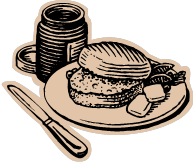 Last night I made some scones for today’s breakfast. I served them with a lesser-known topping, lingonberry jam. I enjoy eating lingonberries now and then because they are really good, and they remind me of my Norwegian heritage.
According to Wikipedia, lingonberry jam is a staple of Scandinavian cuisine. The berries grow abundantly in the inland forests there. People often gather them and prepare a fresh jam using just the berries, sugar, and a small amount of water. They put it on everything from pancakes to meatballs.
I used to have a hard time finding the jam here in the Denver area. Sometimes I made the long drive to the Sons of Norway lodge in Lakewood to buy it from their gift shop. When I did, we savored every bite of this rare treat.
In recent years, lingonberry jam has appeared more often on the shelves of my local supermarket. The IKEA stores sell it, too. Consequently, people are becoming more familiar with this Scandinavian delicacy.
We have begun keeping a jar of lingonberry jam on our pantry shelf. You never know when one of us will get a craving for it, just like I did this morning.
Write Now
 This week I am supposed to be writing the biographical sketch of my four Finnish great-great grandparents. Yet like many genealogists I know, I cannot resist doing that one little bit more of research.
Consequently, this week I have not written one word about these ancestors, but I have done more research on them. In the Finnish records I located and documented a birth family for my great-great grandfather Anders Abelson Mattila.
Earlier this year we found that his family came from the Lapinjärvi parish in southern Finland. They lived in the Mattila house in the Kimoböle village. From the parish register, I now know that his parents Abel Andersson and Greta Caspersdatter had at least five children:
- Eva, born 17 March 1824
- Anders, born 4 November 1826
- Abel, born 26 August 1829
- Anna, born 16 December 1832
- Johannes, born 8 February 1842
The large gap between the births of Anna and Johannes suggests to me that I am missing some children. Did the family live and register births in another parish for a while? Was there a string of miscarriages and stillbirths? Did Abel and Greta live apart for some reason?
I would love to dive into these questions, but I really, really need to get started with my writing so I can send it out for Christmas. As a wise genealogist told me once, at some point you just need to get busy with the story and tell yourself, “NO MORE RESEARCH.” For me the time has arrived for me to write. Now.
Seminars, Anyone?
 Last weekend we went to the fall seminar put on by our local Palatines to America (PalAm) group. They host these twice a year, and I have regularly attended these learning opportunities.
I began going several years ago when the Palatines leadership made the decision to bring in nationally-known speakers for these seminars. They put on great, fun events with good attendance. They would meet in a local hotel, sell German research materials, serve a German lunch, and once a year would stay late for a German dinner. We all learned a lot from these wonderful speakers as we enjoyed our ethnic food and fellowship.
Things started to change a couple of years ago. The group could not find a hotel to take their business. Apparently a bunch of sober Germans does not provide the bar revenue a hotel can get for a wedding reception on a Saturday. The PalAm events moved to the Denver Public Library.
Of course we could not enjoy all our German cuisine at the library, so meals turned into an on-you-own affair. The library does not provide tables for attendees to use. We also have to pay to park while visiting the library. I have not enjoyed these events as much as I used to.
Now this year, the group engaged a little-known speaker. I signed up anyway because the seminar topics looked good. I am sorry to say, I came away disappointed. I prefer to have seminar topics discussed in some depth. This time around, everything sounded pretty dumbed down and repetitive to me. I have been at this genealogy game for a long time, and I wish this seminar had been advertised as appropriate primarily for beginners.
Will I go to the PalAm seminer next time? It depends. I still like the opportunity to see my genealogy friends, and the PalAm group always has an awesome book table at their seminars. But the fun is gone from this event, and there is no reason for me to go if the speaker gives just an entry-level presentation.
I have attended a lot of genealogy seminars over the years. I usually attend most of them in the Denver area in an effort to learn more and to support the local genealogy community. But I cannot afford to waste my time sitting through a presentation on things I already know. When the next seminar rolls around, I plan to be more discriminating in my decision on whether to attend. One size cannot fit all.