Author Archive
52 Ancestors in 52 Weeks no. 36—Rebecca Howe Day (1808-1876)
 October 16th, 2016 |
  Author:
  A search for the Day family in central Kentucky during the 1800’s reveals a large extended family, difficult to sort. My 3rd great-grandmother Rebecca was born into this clan on the 5th of June, 1808. She was named for her maternal grandmother, Rebecca Howe. Her parents were Daniel Day and Rhoda Hoskins. Young Rebecca actually was born in Tennessee, but the family soon moved on to Kentucky.
Rebecca’s father died when she was young, and she became the ward of her grandfather, John Day, a Revolutionary War veteran from Virginia. The family had settled in Morgan County when they reached Kentucky. There, Rebecca met a blacksmith, Daniel Sherman, and they decided to marry. The marriage took place on September 4, 1826 when Rebecca was eighteen years old.
Over the next years, Rebecca and Daniel traveled around central Kentucky and southern Ohio, wherever Daniel found work. Together they raised a large family of about ten children. By the time the Civil War broke out, they resided in Madison County, Kentucky.
At some point as the war progressed, they made the decision to move north. On April 29, 1863, they sold their small holding in Madison County. After that, Daniel disappears from the record. They may have relocated to Johnson County, Indiana where their eldest son, Anderson Sherman, lived.
By 1870, Rebecca, by then a widow, had moved again, following some of her children to Edgar County, Illinois. That year her household included her third son, John, and a granddaughter Anna Petronellia, the daughter of Rebecca’s second son, Thomas. Other Sherman children (Thomas Sherman, Evaline Sherman Alvey, and Jasper Sherman) lived in the same county.
Rebecca died in Edgar County on September 28, 1876. She was buried in the Swango Cemetery in Symmes Township although her grave is unmarked.
Much research remains to do on Rebecca and her birth family. Sources conflict on when and where her father died. Some family members claim her mother lived to be over 100 years old, although we have no proof of that. Some researchers claim Rebecca descended from the illustrious Howe family of Revolutionary War fame with connections to the English royal family.
Rebecca Howe Day will make a fascinating research subject when time permits.
 Posted in
The Glover Boys: Bad Men
 Genealogist like to talk about their Black Sheep ancestors. This week I found a few as I read some historic newspapers.
Members of my family became original pioneers of Coles County, Illinois around 1830. The locals kept good records, and I have quite a bit of success learning about the lives of those who lived in that area during the nineteenth century. The newspapers from Mattoon, Illinois provide an especially rich source. There I found many mentions of “Bad Man” Frank Glover and his siblings.
My second great-grandfather Thomas Sherman’s sister had married a Glover, and this is my connection to the Glover family. Frank was one of her sons. He and some of his brothers often ran afoul of the law. The Mattoon newspapers documented it all. They labeled Frank with the epithet, “Bad Man”.
What did he and his brothers do?
According to the papers, Frank had no occupation. Over a fifteen-year period, he robbed a man at gunpoint, shot a Sheriff’s deputy who attempted to repossess some property, and stabbed the village Marshal during a fight. He served time for these crimes.
Frank’s brother Henry Glover was a counterfeiter. The paper described Henry as a Republican who favored the unlimited coinage of silver and home-made dollars. Henry liked physical fights and even faced charges once for beating up Frank’s wife. Henry died a violent death when he mysteriously was shot in his home one Saturday night. He made a dying declaration naming his assailant, but no one believed him.
Another brother, Edward, ran a grocery story. He was indicted on occasion for selling tobacco to minors. His store seemed to suffer no end of criminal activity including burglary, robbery, and mysterious fires.
These guys definitely qualify as the Black Sheep of my family. Their cousin, my great-grandmother Anna Petronellia Sherman, was said to dislike her family. Perhaps these fellow’s activities contributed to her opinion. A staunch Methodist, Petronellia most certainly would have considered her Glover relatives to be bad men.
52 Ancestors in 52 Weeks no. 35—Daniel Sherman (abt. 1800-?)
 As we work further back in time, the details on our ancestors’ lives become murkier. Eventually, we find little or no information about them.
For many years now, one of my 3rd great-grandfathers, Daniel Sherman, has been what genealogists call a “brick wall” ancestor. He seemingly appeared out of nowhere, raised a large family, and then disappeared again. I know nothing about his birth family.
According to U.S. census records for Kentucky in 1850 and 1860, Daniel originally came from New York. He was born around 1800. He worked as a blacksmith, but he also had some education. In the 1850’s he wrote out permission slips for his daughters to marry.
Daniel began appearing in the Kentucky records in the late 1820’s. He married Rebecca Howe Day on September 4, 1826 in Morgan County. The next year, his name came up a couple of times in the Morgan County court minutes. The first time, he was appointed to take his turn to keep the state road in good repair. The second time, he was ordered to pay 37 ½ cents to a member of his wife’s family in a case involving horse feed. In 1828, he received payment of $2 when he resigned as county jailor.
That same year, Daniel and Rebecca started their family. They had at least ten children:
- Polly Ann, born about 1828
- Unknown daughter, born about 1829
- Anderson O., born 22 Aug. 1832
- Evaline, born 5 Aug. 1834
- Emily Elizabeth, born about 1836
- Eliza/Louisa Jane, born about 1838
- Thomas, my 2nd great-grandfather, born 23 Nov. 1841
- Gilla Ann, born 26 Mar. 1843
- John, born Dec. 1845
- Jasper, born 30 Oct 1849
During these years, Daniel and his wife moved around a lot. Their children were born in various Kentucky counties (Morgan, Bath, Clark, Madison, Estill) as well as in Scioto County, Ohio. The couple never seemed to own much land. Apparently, they followed the work he could get.
By 1853, Daniel finally appeared more ready to settle down in one place. On September 25 that year, he gave permission for his teenage daughter Eliza/Louisa to marry in Madison County. Several years later, on 4 January 1858, he purchased an acre of land on Clear Creek in the same county. Perhaps they intended to remain there with grown children nearby.
Then, during the course of the Civil War, for some reason Daniel and Rebecca changed their minds and decided to leave Madison County. They sold their land on 29 April 1863.
After that, Daniel disappears from the records. By 1870, Rebecca lived with relatives in Edgar County, Illinois. Daniel’s name has not been found on the 1870 census, so he probably died before then.
Before he died, Daniel passed some of his learning on to his sons. All of them picked up the blacksmith trade. That is how the family continued to earn its living into the next generation, well into the twentieth century.
So, who were Daniel’s people? When did his Sherman family come to America? Where did he end his days? The answers to these questions about the life of Daniel Sherman await discovery.
Narrowing Down a Birthplace
 Nearly fifteen years ago I began searching for information on my great-great grandfather, Thomas Sherman (1841-1912). I began with only the family story. He served in the Civil War, and then he married a German girl who died at Indianapolis shortly after their daughter Anna Petronellia was born in 1865. Later in life he worked as a blacksmith in Coles County, Illinois. During the 1880’s he married Alice Farris, a woman the same age as his daughter, and had several more children.
I began my research into his life by reviewing his obituary. It identified some of his siblings but did not provided a birthplace. I then turned to the U. S. census records. I found that most of the Sherman siblings had been born in Kentucky. But Thomas himself and one sister, both middle children, consistently had Ohio listed as their birthplace.
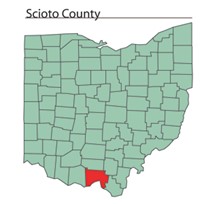
Where in Ohio? I could find no record that even listed a county, much less an actual town or post office. Ohio has 88 counties, and that proved to be too many to search without some additional information.
This week a new clue turned up. I came across the Kentucky marriage record for Thomas’ sister, E. E., to John Glover. I had located their Madison County marriage bond and consent many years ago, but I could not find a marriage record. This week on Family Search, I looked at a Kentucky-wide database and at long last found their marriage record in nearby Estill County, not Madison. And there was the clue I needed. This sister, also born in Ohio, provided her birthplace county, Scioto, for the record.
Scioto county lies on Ohio’s southern border just across the Ohio River from Kentucky. Perhaps Thomas was born there, too. The Sherman-Glover marriage information may really narrow down my search for Thomas’ birthplace.
Of course I immediately looked for the father’s name, Daniel Sherman, on the 1840 U.S. census for Scioto County. There he was on the index! But when I looked at the image of the actual record, the name does not look like Sherman to me. Still, the indexer thinks otherwise. To settle this in my mind, I need some corroborating evidence.
If the name truly is Sherman, the larger question of whether the Daniel Sherman in Scioto County in 1840 is the same man as my Daniel, father of Thomas, also remains. I intend to create a research plan for this question. At least now I have an idea of a location where I can begin to find an answer.
52 Ancestors in 52 Weeks no. 34—Mary (Polly) Templeton (1792-1857)
 My family does not have much information (yet!) about our ancestor Polly Templeton Carter. For all I know, data on her may be just a few steps away in my office. A couple of years ago I inherited the genealogical work of my dad’s cousin, and perhaps she documented some of Polly’s life. If so, the information still sits in notebooks and file drawers I have not yet had a chance to review.
For my own part, I have not done any work on the Templeton family.
Mary Templeton, known to us as Polly, was born in 1792 in eastern Tennessee. I do not know the identity of her parents.
Polly grew up in Tennessee, and there she married John Carter on the ninth of February, 1815. After their first child, Susan, was born later that year, they moved on to Wayne County, Kentucky. Between 1816 and 1829, they had seven more children, including my second great-grandmother, Jane.
We do not know how Polly and John learned that new lands had come available for settlement in southeastern Illinois. We do not know why they decided to uproot their large family and make the move. We just know that they became “Pioneers of 1830” who settled near Ashmore, Coles County, Illinois.
Their last child, Catharine, was born there in 1832.
The family settled into pioneer life, and all went along well until John became ill. He passed away in 1841, and Polly was widowed at age 49. She never remarried.
She seemed to have moved around some after that. In 1855, she lived alone in Edgar County (next to Coles County), and she kept $180 worth of livestock.
Over the next couple of years, she performed acts that left the only records we have of her life. She presented an inscribed Bible to her daughter Jane in 1856. In 1857, she executed a Bounty Land Claim for her husband’s long-ago service in the War of 1812.
Polly passed away on 11 November 1857 in Coles County at the age of sixty-four. She was buried next to John in the Ashmore, Illinois cemetery.
Polly died intestate, but she did leave an estate that needed to be administered. Her son Joseph was named Administrator in 1858. Her monies were distributed to her heirs with $39.57 going to each:
- Susan Austin (daughter)
- Catharine Young (daughter)
- Solomon Collins (son of deceased daughter Thena)
- Nancy Boyd (daughter)
- Shelton Carter (son)
- Jane Reed (daughter)
- Joseph Carter (son)
- John Carter, minor (son of deceased son Bailey)
Genealogy Eyewear
 Do you have trouble seeing a computer screen? I do.
I spend many hours a week in front of the computer in my genealogy pursuit. My eyesight is not great. For several years I have worn either bifocal contact lenses or progressive lens glasses. The sweet spot in the lenses for the middle distance needed for computer viewing is quite small. Increasingly, I have found myself with my head tilted up and back as I worked. Only from there could I focus on the screen. At the end of a session, my neck and back hurt.
It finally dawned on me this summer that optometrists have devised a solution for this problem. Computer glasses! My husband/tech adviser has had them for years, but I never before realized that I needed them, too. He urged me to get some.
When I went in for my annual vision checkup this month, I asked about getting a pair. Not only did my doctor think it a good idea, he also told me that I had a choice of two different types.
He asked whether I worked in a business office where I would sometimes need to walk around to meetings, etc. Or did I work in a Just-Me-And-The-Computer setting? The answer to this question would influence how much of the lens on the glasses could be devoted to the computer-viewing distance.
Of course I work in my home office, so I do not need glasses suitable for a large work setting. Based on that information my optometrist wrote up a prescription. Soon I was off to the frame showroom to select the style for my new eyewear.
I picked them up yesterday. What an improvement! I am hoping neck strain will be a thing of the past for me. I just need to remember the technician’s parting instructions, “Do not use these for driving!” I got it—computer only.
52 Ancestors in 52 Weeks no. 33—John Carter (ca. 1790-1841)
 John Carter, my 3rd great-grandfather, came from a prolific Carter clan. We do not really know the identities of his parents, but his father may have been named Caleb Carter.
John hailed from Greene County, Tennessee, one of numerous Carters in the county. Various sources report his birth date as 19 July in 1783, 1784, 1790, or 1793. His daughter Jane’s family Bible provides the 1790 date.
According to his widow’s claim for bounty land, John was drafted for the War of 1812 in February 1813 for the term of three months. He continued in actual service for six months. Her claim states he served as a private in the company of Captain Hyle under the command of Colonel Gibbs. At the time, his residence was Greenville, Tennessee.
After the war, John wanted to marry a neighbor girl, Polly Templeton. On 9 February, 1815 in Greene County, he executed an affidavit saying in part: on the 7 day of this instant he obtained a lacence (sic) of clerk of sd county to marry him the said Carter to Polly Templeton and further states that he lost them.” John signed the document with a mark, indicating that he could not write.
John did marry Polly that same day at Greenville, Tennessee. The first of their nine children arrived later that year:
- Susan (1815-1884)
- Shelton (1816-1890)
- Nancy (1818-1901)
- Bailey (abt. 1820-1847)
- Thena (1823-1855)
- Janete or Jane (1824-1907)
- Joseph (1827-1903)
- Elizabeth (1829-1848)
- Catharine (1832-1885)
After Susan’s birth, the family moved on to Wayne County, Kentucky. They lived in that state a number of years. When some lands opened up for settlement in Illinois, the Carters pulled up stakes and moved again. They became “Pioneers of 1830” in the about-to-be-formed Coles County, arriving on April 10 of that year. They settled east of the village of Ashmore.
Initially, John worked sometimes as a blacksmith in addition to farming. When other blacksmiths moved into the area, he gave up that trade and focused on his farm.
By 1841, John had become ill and knew he was dying. He asked that his funeral service be conducted on the Sabbath after his death. He requested the Scripture from the second Epistle of Paul to Timothy: 6-8. He said, “For I am now ready to be offered, and the time of my departure is at hand. I have fought a good fight. I have finished my course. I have kept the Faith. Henceforth there is laid up for me a crown of righteousness which the Lord, the righteous judge, shall give me at that day, and not to me only but unto all those also that love his appearing.” He instructed his children to “do the best you can and try and meet me in heaven.”
John passed away on July 19, 1841. He was buried in the Ashmore Cemetery, Coles County, Illinois.
Differentiating Emily and Eliza
 My ancestor Daniel Sherman (abt. 1800-bef. 1870), a blacksmith who lived in central Kentucky, had several children. Among his daughters enumerated on the 1850 census we find two girls named Emily E. and Eliza J.
Later that decade, we find Daniel giving consent for his daughters to marry. This time, their names appear as Elizabeth (E. E.) and Louisa Jane. Same girls? If so, how do we reconcile these differences in their names?
I do not feel I have yet sorted this out, but so far I have assembled this evidence for the daughters:
Emily E. Elizabeth (E. E.) Eliza J. Louisa Jane
b. abt. 1836 (1850 census) b. abt. 1836 (marriage) b. abt. 1838 (1850 census)
b. Kentucky (1850 census) b. Scioto Co., OH (marriage) b. Ohio (1850 census)
b. 1836 KY (1880 census)
m. John H. Glover (marriage) b. KY (1860-70 census) m. Stephen Dykes (marriage)
John H. Glover has not been found on the 1860 or 1870 census records. His wife Elizabeth, born in Kentucky, is named on the 1880 census, the last record of her.
Stephen Dyke appears on the census in 1860 and 1870 with his wife Eliza and Eliza Jane. By 1880 he was a widower. His wife’s birthplace was reported as Kentucky in both instances.
I find it so tempting to conclude that the Emily E. of the 1850 census is the E. E. or Elizabeth who married John Glover. It’s also tantalizingly easy to assume that Eliza J. and Louisa Jane are the same girl because the names are phonetically close. Yet the evidence does not quite match up. Was one of the daughters born in Ohio? If so, which one? Why would the marriage record and permission slip of one daughter clearly say her name was Louisa Jane if her name was really Eliza, as it always appears on the census records? Did Daniel Sherman have more than two daughter born during this time frame? If so, where were they when the 1850 census was taken?
As is always the case on these family puzzles, I need some more evidence.
52 Ancestors in 52 Weeks, no. 32—Ann Kirkham (1782?-1869)
 Ann Kirkham, my 3rd great-grandmother, pursued the hard life of a pioneer but lived to a ripe, old age nevertheless. She must have been made of tough stuff.
Her actual birth place, date, and year have not been proven as far as I know. Records agree that she was born during the month of August, but the date varies as 1782 or 1783. Some sources say she was born in Kentucky; others report her birthplace as Pennsylvania.
By 1806 she lived in Nelson County, Kentucky when she married Thomas Reed. They wed on November 24 and then relocated to live near Thomas’ family in Spencer County. There the couple had five children: Robertson Mitchell (1808), Eliza (1810), Jane (1817), Caleb (1818), and William (1822). Given the long spaces between Eliza and Jane, and again between Caleb and William, perhaps there were other children who died young.
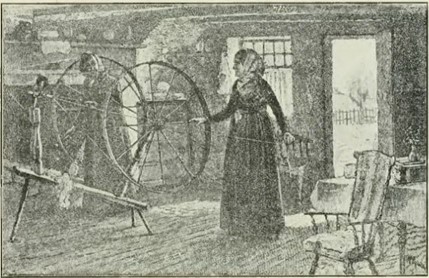
In 1829, Thomas Reed sold his Kentucky holdings. He and other family members struck out for newly opened lands in Indiana and Illinois. Thomas and Ann chose the latter, settling in Coles County, Illinois after the new year in 1830. They took along as much of their household goods as they could, including Ann’s spinning wheel.
Early Coles County families faced a primitive life. They built cabins of unhewn logs with puncheon floors. Chimneys were made of sticks and clay. Perhaps Ann could enjoy some time quilting or sewing with nearby women-folk while Thomas and the other men constructed the first homes.
The couple built a financially successful life in Illinois, but personal tragedy struck periodically. Ann made the trip to the fresh graves of family members many times over the years:
- In 1836, her son-in-law John Mitchell McAlister (Eliza’s husband), died,
- In 1845 her son William passed away,
- In 1852 her husband Thomas died, leaving her a widow,
- In 1853 her daughter-in-law Nancy McAlister Reed, who was Robertson’s wife, died,
- In 1854, her grandson and Caleb’s third son, Thomas B. Reed, died in infancy,
- In 1855, her granddaughter and Caleb’s oldest daughter, Mary C. Reed, died at the age of eight,
- In 1856, her granddaughter Susan McAlister Galbreath (Eliza’s daughter) died from complications of childbirth,
- In 1864, another grandson, Caleb’s son James N. Reed, died in infancy.
During her latter years, after Thomas’ death, Ann made her home with her son Caleb and his family. When she reached her mid-80’s her life was drawing to a close. Ann passed away on 3 February 1869. She was buried beside Thomas in the Reed-McAlister Cemetery in Coles County, Illinois.
We’re Going to Germany
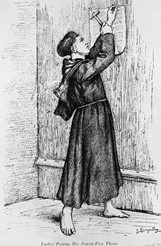 This month we began some serious preparation for an upcoming trip to Germany. Next year will be the 500th anniversary of the Protestant Reformation, and my church choir (http://www.blc-denver2.org/ministries/music/adult-choirs/chancel-choir/) has decided to mark the occasion by taking a tour. We will travel through the area associated with Martin Luther, the seminal theologian whose questioning of Roman Catholic dogma led to the breach of Christian denominations. During this tour, we plan to visit the historic sites associated with Luther and to perform in cities including Berlin, Leipzig, and Prague.
Because my husband/tech advisor has much German and Dutch heritage while I might have a little of the same, we plan to tack a few days onto this trip to explore the areas of our roots. So far we have done these things to get ready for this trip:
- My husband/tech advisor continues to document his German and Dutch lines (Dols, Flottemesch, Kirchner, Walz, Wohrman) as best as he can to identify villages we should visit.
- We booked a flight to Hamburg on Icelandair, and from there we will rent a car and drive through the areas of our origins.
- We paid our first installment for the choir tour.
- At my local library’s used book sale last weekend, I picked up a book on conversational German and a German/English dictionary.
Now I am raring to go. Next spring seems a long way away, but anticipation is half the fun. While we wait we have more time to work on our German genealogy and to study up on some key German phrases.
Tschüss!