Reading, Genealogically Speaking
 July 7th, 2016 |
  Author:
  Often when I hear a program by a professional genealogist, I learn that I should try to familiarize myself with the history of a place before I begin doing research for that locality. This is good advice.
The study of what we consider history was current events for our ancestors. They lived in a time and place affected by the politics and economics going on around them. Events such as wars, natural disasters, and financial panics can explain their actions.
Nearly every day I make time to do some genealogy reading. This summer I am enjoying a well-told tale about the peopling of British North America by Edward Bailyn, The Barbarous Years: the Conflict of Civilizations 1600-1675,. I have numerous Colonial lines, so I need to know about the relationships between colonists and Native Americans and about the relationship of the colonies with England. I need to know about the laws of the time for things like licensing and indentures. I need to know about the importance and activities of religious groups. Bailyn describes it all.
I often take notes as I read. Anecdotes from specific times or places can add interest to my family stories.
I also update a handy timeline of American economic crises. From this I can tell at a glance whether a sudden move could be explained by widespread financial trouble. The list includes:
- 1764, England prevented the colonies from making paper money,
- 1819, a recession after the War of 1812,
- 1837-43, a prolonged recession,
- 1873, a banking collapse,
- 1893, a railroad collapse,
- 1907, the panic of 1907,
- 1929, stock market crash and beginning of the Great Depression.
Reading enhances my understanding of the time periods when my ancestors lived. Good background knowledge makes me a better researcher. Those genealogists who advise us to do this have the right idea.
 Posted in
52 Ancestors in 52 Weeks, nos. 19 & 20
 I wish I knew the identity of my ancestors no. 19 & 20. I wonder if they ever knew they had a little granddaughter named Grace born on the Nebraska prairie in August, 1896.
Their son, my mystery great-grandfather, would have spent time with my great-grandmother, Laura Riddle, during the holiday season of 1895. Who was he? How well did they know one another? Did he know about his little girl?
Other than his whereabouts at the end of 1895, my only other information about this man consists of a guess as to his heritage. The clue comes from an autosomal DNA test.
My dad, one of the man’s grandsons, took a DNA test and learned that nearly a third of his DNA comes from northern Europe. Because all his known ancestors immigrated from the British Isles, the man who contributed 25% of his DNA must have been the source of most of the European heritage. German, perhaps?
I keep hoping for an unexplained DNA match that points to a relative of my mystery man. If a close match to an unknown line ever turns up, I hope to discover his identity, and that of his parents. Until then, I will know them only by their numbers, 19 & 20.
Searching (and Not Finding) Illinois Death Records
 What is it with my family? They seem to have had an aversion to getting their vital statistics recorded.
Take my second great-grandparents’ generation, the Shermans. I can look in vain for their death information. Some examples:
- Thomas Sherman (1841-1912). His obituary says he died at Charleston, Coles County, Illinois. The county kept a death register at the time of his death, but is his name on it? No. Nor is his name on the cemetery listing for Mound Cemetery where he reportedly was buried.
- John Sherman (1845-?)l He was Thomas’ brother, and he was still living at the age of 85 in 1930 in Madison County, Illinois. Yet his name does not appear on the Illinois list of deaths for the period 1916-1947. Is his name just missing, or did he live to be older than 102?
- Jasper Sherman (1849-1878). Another of Thomas’ brothers, he died in Edgar County, and he was buried in Swango Cemetery. Unfortunately, his name does not appear on the Edgar County death register.
- Mary Scott Sherman (ca. 1845-?) Thomas’ second wife who disappears from the record after 1880 when the couple lived in Edgar County. Thomas remarried in 1881, so I hypothesize that Mary died 1880-1881.
Why are all these people missing from the Illinois death registers? I can understand one, or maybe two going unreported. But everyone? This seems to be a familial pattern of noncompliance.
To get my family tree filled in, I need to turn to some other records. Land records come to mind, but these folks were blacksmiths without a lot of money. They did not purchase much land, and they often left no wills.
I find this line very difficult line to document, a good mental challenge. The vital records can offer a nice place to start, but they do not provide a lot of answers for this family.
52 Ancestors in 52 Weeks No. 18—Katherine S.
 Katherine, Katherine. Who were you and where did you come from?
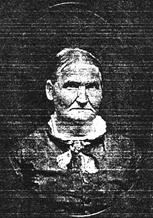
This ancestor of mine reportedly died in Indiana right after the Civil War. My family knows virtually nothing about her. All the information I have came from my great-aunt, Bertha Reed Evert, who was our ancestor’s granddaughter. Bertha was born twenty years after her grandmother died, so anything she knew was hearsay.
She told this story: Katherine Staninbaugh/Stanabaugh/Stillenbaugh Sherman was a German girl who immigrated to the U.S. when she was eight years old. She married Thomas Sherman during the Civil War. She died in Indianapolis shortly after the 1865 birth of her daughter and only child, Anna Petronellia, Bertha’s mother.
That’s all we know. No record of her marriage, death, or burial has been found. Nothing is known of her birth family or where they may have lived besides Indianapolis.
We do know that the Shermans resided for a time during the 1860’s in a small community south of Indianapolis, in Johnson County, Indiana. They had German neighbors named Stilgenbauer. Was Katherine one of them?
Several cousins and I have spent years trying to unravel this mystery. Despite our diligent efforts, we have found no clues as the identity of our mysterious Katherine. My Dad’s DNA test tells us he has some northern European ancestry although he is mostly English, so some German ancestry for him would make sense. He received 1/8 of his DNA from our mystery woman.
I find this search for Katherine long and frustrating because we never seem to make any headway. Still, I would really like to locate a family for her, so I will keep working on it.
A Gathering of Norwegians in Colorado
 This week I have had a chance to get in touch with my Norwegian roots. I served as a delegate from my Fjelldalen Lodge #162 to the District Six Sons of Norway biennial convention in Loveland, Colorado. In a nod to our state’s mining heritage, we used the theme, Mining Our Heritage.
What a great opportunity to meet with fellow Americans of Norwegian descent and to engage in the fraternal aspect of our organization! Folks came from Arizona, California, Nevada, Utah, and all over Colorado. We enjoyed these activities even as we conducted the business of the convention:
- A heritage night where many delegates donned their traditional native costumes, or bunads, and modeled them for the group,
- A folk art competition where members submitted their Norwegian craft work, including hardanger embroidery, wood carving, and rosmaling for competitive evaluation, and
- Daily snacks of cookies made from traditional Norwegian recipes.
I do not have a bunad, so I wore my Norwegian sweater (the hotel was really cold although it was nearly 100 degrees outside) for the heritage night. I contributed some cookies for the snack table. Perhaps I should have entered some of my hardanger embroidery for the competition, but I did not take the time to prepare anything. Those who did earned ribbons for their efforts.
When I returned home, I had a letter from the Sons of Norway waiting for me. It informed me that I have earned the Level I Cultural Skills pin for proficiency in Hardanger embroidery. Earlier this spring, I had submitted to the national organization photos of three Hardanger embroidery pieces I stitched over the winter—a sugar and cream doily, a hexagon-shaped doily, and a bookmark. The pins tells me that I have mastered the basic Hardanger stitches. Maybe I should take the time to prepare and embroidered piece for competition at the next biennial convention.
The Sherman Family on FindAGrave
 Over the past couple of weeks, I have spent time on the Find A Grave site (http://www.findagrave.com/cgi-bin/fg.cgi?page=gs&) to document burials and family links for my Sherman family. I looked for my ancestor Daniel Sherman, his wife Rebecca Howe Day, and their children, including my great-great grandfather, Thomas Sherman. Things did not go smoothly. So far, my results look like this:
- Daniel Sherman, about 1800- ? I do not know when or where he died, and no likely candidate comes up in a Find A Grave search.
- Rebecca Howe Day, 1808-1876. She was buried in the Swango Cemetery, Symmes Township, Edgar County, Illinois. I have requested a photo of her cemetery marker.
- Polly Sherman, about 1828 – ? I know only that she was born in Kentucky, not enough information to do a Find A Grave search.
- Anderson Sherman, 1852-1910. Oddly, he has two burial monuments on Find A Grave. I believe he was buried in the Antioch Baptist Cemetery in Saline County, MO in 1910. I contributed a photo of that cemetery marker to Find A Grave. Someone, however, created a monument for him in the Nineveh Cemetery in Johnson County, Indiana alleging a burial thirty years earlier in 1880. This week a Find A Grave volunteer could not find a record or marker for Anderson at that place. The person who created the Indiana monument has been asked to either provide some evidence for his burial there or take down the Find A Grave memorial.
- Evaline Sherman Alvey, 1834-1922. Her obituary states she was buried in the Mound Cemetery, Coles County, Illinois. The cemetery has a record of her burial but there is no marker on the plot.
- Emily Sherman, about 1836 – ? and Eliza Sherman, about 1838 – ? I do not have enough information about these girls to do a Find A Grave search.
- Thomas Sherman, 1841-1912. His obituary states he was buried in the Mound Cemetery in Coles County, Illinois. The cemetery has no record of his burial, and no marker has been found.
- Gilla Sherman Cobb, 1843-1923. She was buried in the Lake Cemetery, Barton County, Missouri. I have requested a photo of her cemetery marker.
- John Sherman, 1845- after 1930. I do not when or where he died. In 1930, he was living with his son Frank in Madison County, Illinois.
- Jasper Sherman, 1849-1878. He was buried in the same cemetery as his mother in Edgar County, IL. I have requested a photo of his cemetery marker.
In summary, I have three outstanding requests for cemetery marker photos (Rebecca, Gilla, and Jasper), two that were not found (Evaline and Thomas), and one person who purportedly died and was buried twice (Anderson). I need to do more research on five others for whom I have not located any death information (Daniel, Polly, Emily, Eliza, and John). No one has a complete record.
Find A Grave is a wonderful tool, and I contribute to it whenever I can. So many volunteers have answered my call for photos of cemetery markers. The site provides a great way for us to lend a genealogical helping hand.
52 Ancestors in 52 Weeks no. 17: Thomas Sherman (1841-1912)
 Thomas (Lane?) Sherman always reported on the census records that he was born in Ohio on November 23, 1841, but most of his siblings hailed from the state of Kentucky. The family lived in various Kentucky counties, including Bath, Clark and Madison before and after his birth. His father Daniel worked as a blacksmith, and the sons, including Thomas, all followed him into this profession. Thomas’ precise birthplace in Ohio has not been found, nor is it known why the family briefly resided in Ohio around 1840.
The first record of Thomas outside of the census records appears during the Civil War when his name appears as plaintiff on a court record in Madison County, KY in the case of Sherman v. Raines. Thomas alleged that in September, 1862, Deft Raines had taken a grey horse for use in the Confederate Army. Thomas sued for the value of the horse, $240.
Shortly after this case, the Shermans left Kentucky and relocated to Johnson County, Indiana. There Thomas and his brother Anderson registered for the Civil War draft in June, 1863. Whether Thomas actually served remains unclear. According to his obituary, he had enlisted in Louisville in 1861. No record of his service has been found, nor did he or his third wife apply for a pension based on his service.
Family tradition says that Thomas married for the first time during the Civil War. His bride was said to have been a German girl named Katherine Stillenbaugh or Stanabaugh, but no record of this marriage has been found. Their daughter Anna Petronellia came into the world at Indianapolis in 1865, and Katherine died shortly afterwards.
Thomas’ obituary says he lived at St. Louis after the war, but by 1870 he resided in Hunter Township, Edgar County, Illinois. His four-year-old daughter Anna lived nearby with his mother Rebecca while he worked as a blacksmith in the Fawcett Keyes household. His siblings John, Evaline, and Jasper also lived in Edgar County at the time.
On March 21, 1872, Thomas remarried. His second wife was Mary Scott. They lived with his daughter Anna in Edgar County in 1880 where he continued working as a blacksmith. Mary Scott Sherman disappears from the record after that.
Thomas married for a third time a year later on September 8, 1881 in Moultrie County, Illinois. His wife, Alice Farris, was half his age. The couple appears to have relocated to Missouri after the wedding, and their oldest son Charles Frederick Sherman was born there in 1882.
Afterwards, they returned to Illinois and lived there for the rest of their lives. They had four more children:
- George Raymond, born in Coles County in 1884,
- Ethel, born in Coles County in 1887,
- Claude, born in Cumberland County in 1889, and
- James Walter, born in Cumberland County in 1891.
By 1900, the family had returned to Coles County where Thomas worked as a blacksmith in Seven Hickory and Morgan Townships. Sometime in 1910 he suffered a work-related accident when he was hit in the head with a hammer. This head injury brought on acute insanity, and in May of that year his son George petitioned for his commitment to the Illinois Eastern Hospital for the insane. Thomas was released five months later. When he returned home, the court ordered George and Claude to each contribute $1.50 a week toward the support of their father.
Thomas lived for another year and a half in poor health. He passed away at his home in Charleston, Illinois at the age of seventy on February 3, 1912. He reportedly was buried in the Mound Cemetery in Charleston but the cemetery office there has no record of his interment .
Oddly, his obituary does not name his eldest daughter Anna Petronellia as a survivor. Who provided the information for the obituary? Anna and Thomas’ third wife Alice were said to dislike one another. Was the snub deliberate?
If one of the other children prepared the obituary, perhaps her half-siblings did not really know her and forgot to include her name. Anna had lived far away in southern Missouri since the time of Thomas’ marriage to Alice. Their obituaries did not list Anna as a survivor, either, and they may have lost touch. Yet she seems to have remembered the connection, always keeping photos of them. And she outlived them all.
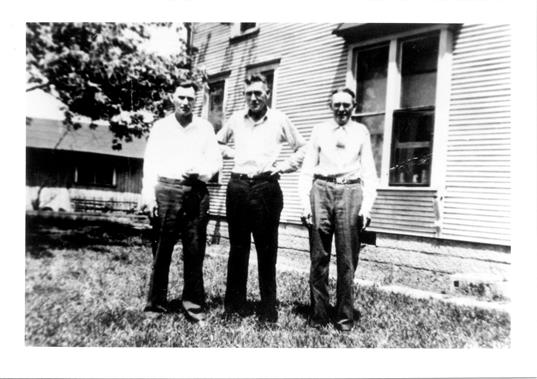
We have no photos of Thomas, but there may be cousins out there who do. I would love to see them! In the meantime, I do have this photo of three of Thomas’ sons (George, Claude, and Walter) that gives me a clue as to what he may have looked like.
A DNA Test Pays Off
 Some time ago I asked my dad to take a DNA test. All my brick wall ancestors lurk in his side of the family, so I keep hoping a DNA match will turn up to help resolve questions on these family lines. Dad does not use a computer, so I manage his DNA accounts for him.
Over time, we have worked with a few of our identified matches trying to figure out how we are related. Generally we have identified a common ancestor and then gone our separate ways. Most of these people seem to have done DNA testing mostly to learn about their ethnic heritage, not because they have a deep interest in genealogy.
That changed a few weeks ago. A third cousin contacted us because her DNA test identified a match to us. We exchanged some information via e-mail. Then we agreed to a phone call to talk over our mutual family history. We learned that we live within driving distance of each other, and we both know a local professional genealogist. We decided to meet for lunch.
Yesterday we shared a meal and spent two hours exchanging more family information. We agreed to work together in our research on our Reed and Carter family lines.
I am thrilled to have a new research partner for this branch. For years I had worked with a couple of my dad’s cousins on these same lines, but both of them have passed away now.
Advice I received years ago has paid off again. Vern Tomkins, a former President of the Colorado Genealogical Society always said, “Keep contacting your cousins. You never know what they may have.” And then there is the corollary stated by Terry Quirk, a former Vice President of the Society, “Contact the oldest and sickest ones first.”
My newly-identified cousin and I are not particularly old or sick, but I am sure glad she contacted me.
52 Ancestors in 52 Weeks no. 16—Jane Carter Reed (1824-1907)
Jane Carter, also known sometimes as Janete, was born on December 15, 1824 in southern Kentucky. Her parents John Carter and Mary (Polly) Templeton lived along Harmon’s Creek in Wayne County. Jane had 8 surviving siblings: Susan (b.1815), Shelton (b. 1816), Nancy (b. 1818), Bailey (b. 1820), Thena (b. 1823), Joseph (b. 1827), Elizabeth (b. 1829), and Catharine (b. 1832). Her parents moved the family to Ashmore, Coles County, Illinois in 1829 when Jane was still a small child. Her father lived only a few years after arriving in Illinois, passing away in 1841 when Jane was sixteen.
 During Jane’s youth, the Presbyterians held a revival in Ashmore and organized the Cumberland Presbyterian Church. Jane joined that church at the age of 18 and remained a member for 65 years. Perhaps she acquired some of her religious devotion from her mother Mary who on April 15, 1856 presented her daughter with a Bible containing the following inscription: Presented to Jane Reed by Mary Carter, her mother. Daughter this I present to you as the gift of God. And I hope you and Family will read and ponder well the truths contained in it.
In some ways this was a strange gift because according to census records, none of Mary’s children could read or write. When Mary died a year after presenting the Bible, Jane inherited $39.57, the equivalent of about $1100 today.
Jane married Caleb Reed in Coles County on February 22, 1844. Together they ran a farm and had a family of eleven children. They knew tragedy as three of their young children passed away: Thomas B. at one year in 1854, Mary at age 8 in 1855, and James at age 2 in 1864. Twenty years later they lost two more children: Emma Jane and George both died in 1886. A few years later, one more child predeceased the parents. Albert died in 1890.
At some point, Jane and Caleb retired from the farm and moved into the town of Ashmore. Their daughter Martha lived nearby, and they visited often. After Caleb died in 1903,  Jane lived another couple of years alone. Often after supper, Martha would send her youngest son Hugh Wright over to carry in wood and do other chores for her. He would sometimes spend the night if Jane wished. This went on until he overheard an uncle tell her it was unnecessary to feed Hugh. He promptly left and refused to go back.
Jane spent her last days at the home of Martha and Jim Wright where Martha cared for her. During her final illness no one tried to keep her from knowing that the end was near. She made all her own last arrangements. She asked Mrs. Brown, who lived nearby, to help with her laying out. She wanted the promise that after she was dressed, Mrs. Brown would run her hand beneath her and smooth her dress because “I can’t abide a wrinkle”.
As she breathed her last breaths, she asked her son-in-law Jim Wright and granddaughter Amanda Pearl Wright to sing a hymn. They chose When Our Ships Come Sailing Home. When they thought she was no longer breathing, they stopped, but she roused and commanded them to continue. After a while longer, she died from inanition due to influenza.
After her mother died, Martha wrote this in a letter to one of her daughters: Jane Reed died April 30, 1907 at 15 minutes after 7 o’clock [aged 82 years, 4 months, 15 days]. Her children: Sam, John, Tom, Ida, and Martha were all there. Funeral was at two o’clock May 2, 1907. Her casket cost $130 and the flowers were ten dollars.
Funeral services were held from the family residence, the Rev. Jonathan Williams officiating. She was buried at Ashmore Cemetery next to Caleb.
Where Are the Records?
 My research into my Sherman ancestors remains pretty much stuck in the mid-19th century. I need to find some additional records to learn more about them.
Current information on their movements boils down to this:
- The Daniel Sherman family lived in various central Kentucky counties from the late 1820’s on. Daniel and his wife Rebecca sold their place in Madison County in 1863, and he disappears from the record after that.
- The oldest son, Anderson Sherman, relocated to Brown County, Indiana sometime before 1860. He and his family eventually moved on to nearby Johnson County.
- Daniel’s sons Anderson and Thomas registered for the Civil War draft in 1863 in Johnson County, Indiana.
- Daniel’s daughter Gilla Ann married John Cobb in Johnson County in 1864.
- By 1870, numerous members of the family including the wife (widow?) Rebecca; sons Thomas, John, and Jasper; daughter Evaline Sherman Alvey; and 4-year-old granddaughter Anna Petronellia Sherman all lived in Edgar County, Illinois.
Now I have these questions:
- When and where did Daniel Sherman die?
- When and where did Thomas Sherman marry Anna Petronellia’s mother? Who was she? Her granddaughter’s report that she was Katherine Stillenbaugh from Germany has not been verified.
- Did Thomas serve in the Civil War? His family claimed he enlisted at Louisville, KY, but so far I have found no service record or pension application. His brother Anderson filed for a Civil War pension, but it was denied due to lack of evidence of his service.
I intend to develop a research plan for each of these questions. They have plagued me for years, and I would love to answer any or all of them.