Leif Erikson Day
 October 8th, 2020 |
  Author:
 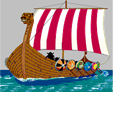 All the proud Scandinavians like to remember Leif Erikson Day every year on October 9.
The day honors the Viking explorer who is thought to have been the first person from the old world to set foot in the new. Five hundred years before Columbus, Leif the Lucky, as he was known, was perhaps blown off course while sailing from Norway to Greenland. Or maybe he traveled there deliberately after hearing of lands to the west from an Icelandic trader. The Norse sagas tell conflicting tales.
When Leif and his crew landed in North American, they noted the vast forests. They also spotted abundant grapes growing so they named the new land Vinland (Land of Wine).
Unfortunately, the sagas do not tell us the coastal location of Vinland. It remained a mystery until archaeologists found Viking-type ruins in northern Newfoundland at a place called L’Anse aux Meadows. Perhaps this is where Leif Erikson stopped.
Americans began observing Leif Erikson Day in 1964. President Lyndon Johnson began the tradition of issuing an annual proclamation to remember the Viking and to honor the contributions of Americans of Nordic descent.
October 9 has no connection to Leif Erikson himself. The day was chosen because the wave of Norwegian immigration to America began on October 9, 1825 when the ship Restauration from Stavanger, Norway arrived in New York.
How will I celebrate Leif Erikson Day and my Viking heritage tomorrow? One of the Sons of Norway lodges in California is hosting an online talk about the explorer, and I may tune in for that.
Leif Erikson Day calls for Nordic refreshments, too. My husband/tech advisor and I plan to bring out the aquavit as we honor the Viking spirit of discovery. Skål!
 Posted in
NGS-FGS Merger Party Today
 The wheel is about to turn.
Two genealogy societies officially merge today. A little over a year ago, the National Genealogical Society (NGS) and the Federation of Genealogical Societies (FGS) announced their intention to combine into one organization. The consolidated group will operate as the National Genealogical Society.
The new NGS plans to continue its mission of supporting individual members. It will also take on the FGS role of supporting local genealogical societies and family organizations. The FGS work of advocating for the preservation of records and running digitization projects will continue.
I have long belonged to NGS, probably since 1996 or so. My local societies, The Colorado and the Highlands Ranch Genealogical Societies, both belong to FGS.
My NGS membership has enriched my genealogy career over the years. They publish a superb quarterly journal, the scholarly National Genealogical Society Quarterly. Any serious genealogist should read this publication to see the results of well-executed research projects.
NGS also puts out a quarterly magazine, the NGS Magazine, which is packed with Society news and how-to articles.
Another benefit of NGS membership is the annual conference. I have attended two of these multi-day events over the years—I volunteered at the 1998 conference in Denver, and we drove to Kansas City for the 2008 conference. FGS has hosted conferences, too, although I have not been to one.
This evening the new NGS will celebrate the merger with an online party hosted by well-known blogger, Judy Russell. I plan to tune in.
I do not know whether they are serious in their request to wear party hats and bring noisemakers. Perhaps I will dig into my New Year’s Eve box for these accessories. It will not hurt to be prepared.
This merger represents a big change for the genealogy world. Now we will have one-stop shopping for excellent publications, educational offerings, and research guidance. We will have an expanded opportunity for interacting with other genealogists and volunteering on record preservation projects.
The architects of this union hope it will better serve the genealogy community by creating a larger organization with more resources. It all starts tonight.
I Triangulate
 In my quest to connect my ancestor Lucy Snow Hall to her parents Thomas Snow and Hannah Lincoln, I have yet to find a primary source document that spells out this relationship. The paper trail still hinges on an entry for the Hall family line in The Encyclopedia of Massachusetts. I continue to search for additional sources that could verify this relationship.
In the meantime, I can tinker with analyzing DNA results to search for clues. After listening to a presentation by local DNA detective Greg Liverman, I decided to modify the cluster approach he suggested for identifying unknown ancestors. He described how to use online family trees and the 1940 census to fill in the family lines of matches back to a common ancestor.
As I perused my dad’s match lists on the sites where he tested his DNA, I looked for people with New England ancestry. I focused on those with surnames that appear in my own tree, but I did not find much of interest.
I did notice a couple of matches who claimed Nickerson forebears. My ancestor Lucy had two close relatives, a sister and a daughter, who married into the Nickerson family. I spent a couple of days trying to put together the family trees for these Nickerson descendants, and I think they also descend from my Thomas and Hannah:
Thomas Snow and Hannah Lincoln descendants
Lucy Snow Hall Bethia Snow Nickerson
Rhoda Hall Dunbar Thomas Nickerson VI
Olive Dunbar Riddle Thomas Snow Nickerson
Laura Riddle Annie Nickerson Mills Alva Nickerson
Grace Riddle Reed Mildred Mills Cushman Maude N. Kaliher
Earl Reed Alta Cushman Brodie Private
Private Private
The last two people in the threads of the Bethia Snow Nickerson line, Dad’s predicted 5th cousins, both match him on the 13th chromosome. They match each other in the same place.
This is called triangulation. It means people who are not closely related match one other, indicating a common ancestral couple.
In this case, I think the couple must be Thomas Snow and Hannah Lincoln although it is possible there is a different common ancestor. If Thomas and Hannah are the common ancestors, Dad descends from their suspected daughter Lucy. The two men who match his DNA descend from their suspected daughter Bethia.
Thomas and Hannah did have daughters Lucy and Bethia who were baptized at the Brewster, MA church in the 1760’s. Are these the same girls who married into the Hall and Nickerson families?
I still do not have a paper trail proving these relationships, but the DNA result adds weight to my hypothesis.
Genealogists and Home Libraries
 I am in the 5%.
Every week the New England Historic Genealogical Society sends around an electronic newsletter called The Weekly Genealogist. It always contains a survey, and last week’s question asked how many books are in personal genealogy libraries.
I answered that I have 251-1000 genealogy books, and only 5% of the respondents fell into that category. The largest group, 20%, had 26-50 books.
Luckily for me, I did not have to purchase all my books, although my husband/tech advisor still grumbles that he had to buy and install bookcases for them. I inherited most of what I have from my dad’s cousin.
I rarely use most of them, but I like having them around for when I need them. I do keep a few, well-thumbed references on my desk that I consult regularly:
- Black’s Law Dictionary. I received a copy of the 1891 first edition for Christmas one year, and it really helps for finding definitions of unfamiliar words in old legal documents.
- Evidence Explained by Elizabeth Shown Mills. I regularly turn to this reference when creating source citations.
- The Handybook for Genealogists, ninth edition. I won this as a door prize once, and it provides a quick reference for county information across the United States.
- Historical and Genealogical Atlas and Guide to Barnstable County, Massachusetts. This gem has great, detailed maps of the towns on Cape Cod.
- A Primer for The Master Genealogist by Terry Reigel. I still use the no-longer-available TMG for my genealogical database, and this wonderful handbook gives clear instructions for using all its intricacies.
- Rand McNally Road Atlas. My ancestors lived all over the United States, and I find it useful to consult the maps of their states.
- The Reeds of Ashmore by Michael Hayden. My distant cousin Michael put this together in 1988 as part of his doctoral dissertation. It traces our Reed lineage from colonial times. I use his book to determine how modern-day descendants fit into my family tree. In recent years, it has become helpful in determining my relationship to DNA matches.
- A Research Guide for Norwegian Genealogy, sixth edition by Carol A. Culbertson and Jerry Paulson, editors. This book is packed with information about Norway, Norwegians, and how to do Norwegian genealogy. It includes a useful glossary of Norwegian genealogical terms.
I like having print resources available. In seconds I can use these familiar tools to lay my hands on the information I need without having to take time to scour the internet for it.
Most of the people who responded to The Weekly Genealogist survey had fewer than 50 books. I would fall into that category, too, if it were not for the inheritance from Dad’s cousin.
Few of the newsletter readers have the large library I do. I am glad to have it during these months of the pandemic when I cannot visit libraries in person to find sources that have not been digitized.
I enjoyed taking this survey to see where I fall on the spectrum of researchers and their books.
I Discover a DNA Cluster Tool
 This week I had the opportunity to hear a genealogy presentation by a local DNA expert. Dr. Greg Liverman of Pinewood Genealogy addressed the first meeting of the Highlands Ranch Genealogical Society’s 2020-2021 season via Zoom.
He showed us how to use DNA clusters to identify unknown ancestors in recent generations. I have such an ancestor—my dad’s maternal grandfather. According to Greg, this is just the sort of research problem that cluster analysis can solve.
The task of sorting all of Dad’s DNA matches by hand was overwhelming. I learned from Greg that I do not have to do that. There are tools available that will do the sorting for you. He mentioned several.
I decided to try the Auto Clustering feature on the My Heritage (www.myheritage.com) online genealogy platform. It is free to use when you have an account, and my husband/tech advisor had already uploaded my dad’s DNA data to the site. All I had to do was run a report.
To my surprise, what takes hours to do by hand required only a few minutes with the sorting tool. I soon had a color-coded report that put my dad’s DNA matches into relationship groups, or clusters.
To find relatives of an unknown ancestor, Greg told us to look for a cluster of matches who are not related to any family members whose family tree you already know. Locate the names of people in that cluster who are most closely related to you, who match you at the level of 50 cM or more. Then look at the family trees provided by these people for their common ancestor. This ancestor is probably yours, too.
This seems a simple enough process. I needed to search for people not related to anyone in Dad’s paternal line or his direct maternal line.
The report came back with twenty clusters of matches, some including only a couple of people who are quite distantly related to us. I set those small, remote clusters aside for now and began with the first, larger clusters to see if I could recognize anyone:
- Cluster 1 had three people who matched at over 50cM. Two I do not know, and they have no family trees on My Heritage. The third is a descendant of my Dad’s paternal cousin. I assume the others belong to the same paternal line.
- Cluster 2 included two people closely related to us. Both had family trees on the site, and both are descended from Dad’s paternal grandmother’s family.
- Cluster 3 had two close relatives, both descended from another of Dad’s paternal cousins.
- Cluster 5 included Dad’s double cousins, who descend from both his father’s family and his direct maternal line.
- Clusters 6-20 included either no close relatives or else relatives who barely met the 50cM threshold. Many of them also matched someone in Clusters 1, 2, 3, and 5.
That left cluster 4. It contains just 5 people, none of whom reach the 50cM match level. But these people do not match those in the other clusters, all of whom descend from the families of Dad’s three known grandparents.
If Greg is right, these people in Cluster 4 should belong to the family of my unknown great-grandfather. If I can identify their common ancestor, I can learn who his family was.
I was disappointed when I found that none of these people has placed a family tree on My Heritage. Learning about their families will take more legwork. That is the next step.
Perhaps with the tool of cluster analysis I have at last found the key to discovering the identity of my unknown great-grandfather. He has hidden himself from us for over 100 years. I hope his DNA trail can now force him to step out from behind the curtain.
Celebrating Labor Day
 Labor Day weekend approaches. As we take this holiday to visit the outdoors or enjoy picnics, we see little mention of why we have this holiday in the first place.
President Grover Cleveland signed Labor Day into law as a federal holiday in 1894 to acknowledge the role of the organized labor movement in our society. We owe them our 8-hour workday, among other things.
Yet Labor Day never meant much in my family except as a paid day off. Few of us entered a trade. We were originally farmers and ranchers whose children left the homesteads and often went to college or joined the military.
As I grew up, I was oblivious to any labor activities that may have taken place around me. Unions had little clout. I lived in a right-to-work state where an employee need not join a union even if the workplace is unionized.
I my later years, I have wondered whether any of my ancestors ever belonged to a labor union. I can think of only a handful who may have had the opportunity:
- My maternal grandfather, Bjarne Bentsen (1906-1986) worked in a couple of industries that are often unionized today. He was an electrician for an iron mine and later at a power plant. Between these jobs, he worked as a police officer for several years. He never mentioned union membership to me.
- My mother, Joyce Bentsen (1929-2000), and her mother, Martha Mattila Bentsen (1906-1977) both taught school. They served in small town and rural communities, and neither belonged to a teacher’s union as far as I know.
- My paternal grandfather, Owen Herbert Reed (1896-1935), worked as a railroad freight agent and later as a trucker. He died long before I was born, and no one ever mentioned any unions in relation to him.
- My dad, Earl Reed (1927-2017), worked briefly for the railroad while he was in college. I do not know whether he joined the union during that time.
If any of these people did belong to a labor union, they paid their dues but did not engage in union activities or rhetoric. I never heard of any of them going on strike to get better working conditions or benefits.
Only one relative by marriage was an outlier to this pattern. My grandmother’s brother-in-law, John Kerzie (1915-2012) worked as a mechanic in the U.S. Steel Sherman iron mine near Hibbing, Minnesota. He was a labor leader there and became Vice President of the U.S. Steel Workers Union.
In my family today, no one engages in unionized work. But we owe gratitude to those people who did organize, for they brought us reasonable hours, paid vacations, and safer working conditions. We can be thankful for all those things as we enjoy our barbeques this weekend.
A 90th Birthday
 We just returned from Wyoming where we joined in the celebration of my mother-in-law’s 90th birthday. In these days of Covid-19, we could not throw the party we would have liked, but we all enjoyed our time together despite the need for social distancing.
As the woman we all know as Grandma reached this milestone, I thought about my own family members who reached their nineties. There have not been many.
In my own generation, we are all years away from our nineties. We cannot tell who among us might reach this age although we know one who will not. My brother James Reed (1959-2017) has already passed away.
Of my parents and those in their generation, only my father Earl Reed (1927-2017) reached ninety. My mother did not, and neither have any of their siblings. One still has a chance, though. My maternal aunt is eighty-one.
None of my grandparents lived to be ninety. My grandmothers’ siblings did not, either. My grandfathers’ families had more longevity:
- Annie Reed McDavitt (1870-1967) was my paternal grandfather’s half-sister.
- Bertha Reed Richards Evert (1884-1981) was my paternal grandfather’s eldest full sister.
- Viola Mae Reed Gwinn (1889-1983) was another of the same grandfather’s full sisters.
- Otto Sigurd Bentsen (1918-2013) was my maternal grandfather’s younger brother.
We had some nonagenarians in my great-grandparents’ generation as well:
- Ida May Reed Bovell Thompson (1864-1954) was my paternal great-grandfather’s youngest sister.
- Anna Petronellia Sherman Reed (1865-1961) was my paternal great-grandmother.
- Ole Jørgen Bentsen (1880-1976) was my maternal great-grandfather.
- Olga Mattila Silberg (1874-1969) was another maternal great-grandfather’s older sister.
My father always claimed that people normally do not live into their nineties and that only occasional outliers actually do. He may have been right about that, at least in our family. In three generations, only eight of my own family members, out of 90 people, have reached this age.
It was somewhat ironic, then, that he would reach ninety himself. My mother-in-law, too, has lived this rare, long life. We were glad to join in with other family members to celebrate this achievement yesterday. The drive to another state for the day was worth it.
While I Wait
 As I wait for the verdict on my application to the General Society of Mayflower Descendants, I continue to work on this lineage.
I have collected several documents that flesh out the lives of the people in this line. Now I have time to enter this information into my genealogy database.
For example:
- Rhoda (Hall) Dunbar [generation 8] conveyed land to her children during her lifetime. They, in turn, disposed of it, and I need to put those deeds into the database.
- Lucy (Snow) Hall [generation 7] was the subject of a 1916 biographical entry in The Encyclopedia of Massachusetts. I can transcribe her story and add it to our family information.
- Hannah (Lincoln) Snow [generation 6] paid the Massachusetts and Maine Direct Tax in 1798. I can add this document to my records.
I am sure that if I look into my To-Do bin for the Dunbar family, I can find other material I have not yet entered into my database.
Tempting as it would be to do more research now, I think cleaning up what I already have would be a better use of my time. Who knows what additional clues I might discover?
If I analyze and organize what I already have, I will have a better idea of where to turn next for more information on this family. My year is devoted to them, and I want to learn as much as I can.
Going through my stack of Dunbar material should not take more than a few days. By then I hope to have an answer from the Mayflower Society. That will give me a better idea of where to turn my attention next.
Genealogists always have something to do, even as they wait for responses.
Another Step Taken
 In my quest to join the General Society of Mayflower Descendants (GSMD), I have completed another step.
The Colorado Historian has reviewed and accepted the supporting documentation I provided for my Mayflower line. This week she sent me an official application form which I promptly executed and returned to her.
Now my application will be forwarded to the GSMD Historian General in Plymouth, Massachusetts. It will be reviewed in that office to verify I have provided sufficient documentation for membership.
I have no idea how long this will take. Nor do I know whether my paperwork will meet their standards of proof.
I do know that they prefer primary sources like vital records or wills to prove dates and relationships. I was able to gather those for most generations.
Yet for one generation I could not find a primary source proving the relationship. The only document I could uncover that shows my ancestor Lucy Snow Hall (1760-1795) is the same person as Lucy, daughter of Thomas Snow and Hannah Lincoln, is genealogy for the Hall family in The Encyclopedia of Massachusetts, published in 1916. Will this be enough?
So far, I have uncovered no other proof. Since no one else who descends from Lucy has joined the GSMD, the Society files contain nothing to help me.
One person who descended from Lucy’s brother Edward Snow (1763-bet. 1829 and 1832) has joined. That application was made years ago and gives no hint on how they connected Edward Snow, son of Thomas and Hannah, to Edward Snow, husband of Catharine Mayo. Perhaps standards were looser then, and they offered no proof.
I can only wait and see what they decide. Regardless of whether my application gets approved or not, I have satisfied myself that I have found the correct lineage.
Mayflower Application Round 2
 As I have recounted before, I recently submitted my application to the Colorado chapter of the Mayflower Society. They reviewed my lineage paperwork and asked for some supplemental information.
My initial submittal included birth, marriage, and death information for each ancestor in my direct line going back to proven Mayflower descendants Thomas Snow and Hannah Lincoln. In four of the seven generations I provided, these vital records and their substitutes did not clearly show that the child of one generation was the same person as the parent in the succeeding generation. The Society wanted additional evidence.
I gathered documents like obituaries, wills, and deeds and sent them in earlier this week. Already I have a reply, and it is a favorable one. All seven generations between me and the Snows link up. Once I sign the now-complete-and-vetted application, it will be ready for review by the national office.
This puts me another step closer to being accepted into the Society. Early in my career as a genealogist, I had never envisioned myself joining any of these lineage societies. I came to learn that they offer more than bragging rights.
I applied foremost because they provide storage for family historical documents. This is a wonderful way to safekeep the research. When you worry that your own family has no interest in preserving what you have done, this can be the way to save it.
The Society has other benefits, too, like access to Pilgrim-related activities, grave markers, a quarterly magazine, and more.
I will sign my formal application once it arrives. Once I mail it in, I will hope for a quick turnaround time in finalizing my membership.