Archive for June, 2013
Ancestors and Church Life
 June 20th, 2013 |
  Author:
  I think I knew that church membership played an important role in the lives of our ancestors. As a product of the American system of a separated church and state, I just did not appreciate how extensive a role it played for these people. Recently, as I entered a lot of data derived from Church of Norway documents into my computer program, I came to realize how fully the Scandinavians in the 18th and 19th centuries entwined church life and everyday life.
They marked their rites of passage in Lutheran religious ceremonies—baptism, confirmation, marriage, and burial. The church carefully recorded these important occasions, and we can view the records today, hundreds of years later. In addition to facts about the event, the records also provide information on names of an ancestor’s parents and the places they lived. They even reveal the name of the father if a child was illegitimate.
Yet the church affected more than just the individual behavior reflected in the records. It was the reason for some modern reforms in Scandinavian society. For example, Norway in the 1700’s instituted a nationwide push for literacy. Why? So the people could pass the 700-question confirmation test. The pastor recorded their scores for posterity—not so good, good, or very good.
Why would a young Norwegian, or anyone, want to take and pass this difficult confirmation test? Because you could not get married in Norway unless you did. Every parish pastor asked for confirmation date and place before performing a marriage ceremony. That information, along with information pertinent to the marriage, is recorded on the nuptial record.
Even today, although most Norwegians claim they are not religious, the Church of Norway retains its official state status. It receives its financial support from the state. All clergy are state employees. The King of Norway is required to be Lutheran. The Church still has its role there, affecting the everyday lives of most Norwegians.
 Posted in
Some Norwegian Research Helps
 A couple of weeks ago I stated my intention to organize my computer bookmarks. Since then, I have worked on doing that. I maintain a “Genealogy Research” folder in my bookmark list, and it contains subfolders for various geographic locations.
This week I cleaned up my “Norway” folder. I find these sites helpful for finding and analyzing Norwegian records:
- The Digital Archives of Norway (http://arkivverket.no/eng/content/view/full/629)
- Norwegian words used in genealogical records (http://homepages.rootsweb.ancestry.com/~norway/na17.html#F)
- Norwegian parish information with links to translations of parish record column headings (http://homepages.rootsweb.ancestry.com/~norway/na20.html
- A database covering volumes 1-17 of Oluf Rygh’s list of Norwegian Farm Names (http://www.dokpro.uio.no/rygh_ng/rygh_form.html)
- Common Norwegian occupations (https://www.familysearch.org/learn/wiki/en/Norway_Occupations)
The ability to analyze records from another time and place does not come easily. Keeping a list of sources and translation information in handy bookmarks can make the process much smoother. It takes time to create and organize your bookmarks, but it really does save time in the long run.
Which is MY Bunad?
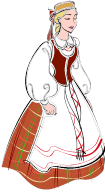 For my birthday recently, my son and daughter-in-law gave me a sølje, a type of jewelry pin worn with a traditional Norwegian costume, the bunad. They thought I should have one of these beautiful pieces of artwork prior to my trip to Norway this summer. This gift prompted me to do a little research on the bunad.
I turned to the Viking magazine, a publication of the Sons of Norway organization. They ran a feature article on the bunad in the May, 2013 issue. According to this article, the bunad is worn on festive occasions and consists of a complete outfit. Each region, valley, or town has its own style, and there are over 450 types of bunads in Norway. Not everyone owns one because they are very expensive and are worn only once or twice a year.
To identify the style of bunad my family should wear, I needed to identify my specific ancestral area. So, what exactly is my ancestral area? I thought it was the Bø municipality of Nordland. Then my husband/tech adviser spent his lunch hours in April and May searching the online Norwegian archives to verify this. He found that my family lived in fishing villages all over Nordland–Vesterålen, Lofoten, and Helgeland. Before that (prior to the Napoleonic Wars) they lived in Bergen.
To represent all these areas, I would need a chest full of pins. I have no idea which bunad I should wear.
I probably should not wear one at all. Besides, when would I wear it? In Colorado we do not celebrate Norwegian holidays. I guess I could wear one to weddings, but that would be rather impractical here. A bunad is quite warm, and most weddings occur during the summer. I think I will stick with the jewelry and wear the gift I received.
I am eager to look for other examples of these pins in Norway. Maybe I can find some in the Ringsaker District of Hedmark where my husband’s family lived for hundreds of years. Pins from that locality would be nice gifts for my granddaughters. And maybe I can get a picture of THEIR bunad.