Archive for the ‘Reed’ Category
Prairie Housing Yesterday and Today
 October 3rd, 2013 |
  Author:
  Not much to report this week because we had new flooring installed on the main floor of our house. We spent a lot of time moving furniture around.
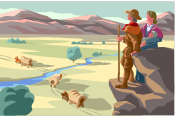
My beautiful new floors got me to thinking about the housing my ancestors inhabited when they came to the western United States over 100 years ago. Certainly they did not start out with multi-level homes and lovely oak floors. They lived in sod houses, or soddies.
I wonder how they felt about that. My great-grandmothers Laura Riddle and Petronellia Reed had lived in nice homes in Michigan and Illinois. It must have been difficult for them to get used to living in a house made of dirt. Laura eventually worked her way up to a nicer frame house in Palisade, Nebraska. Petronellia hated her life on the Wyoming prairie, sold her homestead, and moved to Missouri. There she also lived in a frame house.
And what about my other homesteading family, my Norwegian ancestors, Ole and Sofie Bentsen? They had lived in fishing villages in Norway. Last summer I visited a fisherman’s cottage at the Helgeland Museum in Dønna, Norway. It would have been similar to the housing the Bentsens left behind when they immigrated. Similar in size to a soddy on the American plains, it even had a grass roof. Perhaps life in a soddy did not seem so strange to them.
Yet the Bentsens, too, eventually upgraded to a frame house on their farm near Redstone, Montana. Even if they did not mind the soddy as much as Laura and Petronellia did, they weren’t satisfied to stay in one forever. Like the rest of us, they continued to upgrade their housing.
 Posted in
Cemetery Marker Photos Posted At Last
 At the beginning of the year, I stated my goal of getting all my photos of cemetery markers under control. After a huge segue trip to Norway this summer that took me away from my original task for weeks, I am finally working on the photos again. My project had four steps:
- Design a process for filing, digitizing, and publishing my pictures. I attended a couple of informative sessions offered by the Computer Interest Group of the Colorado Genealogical Society to learn ways to do this.
- Scan all my photos and place them in digital folders organized by state, cemetery, and name. Put the prints into an archival album.
- Copy all the cemetery marker images and store them as exhibits in my genealogy database, The Master Genealogist.
- Upload my images and build memorials on http://www.findagrave.com.
This week I began the fourth step. I uploaded all my Colorado photos and built memorials for Ruth Anna Hansen Reed Brown and Ralph Willard Odom, both buried at Boulder’s Green Mountain Cemetery. Someone else had already built memorials for my other family members in that cemetery, Dean Reed and the Towers–Hazel, Walter, and Josephine. Memorials for family members at Ft. Logan (Robert Lloyd Reed) and Fountain (Robert H. Reed) had already been created as well. I had earlier put up a memorial for Thomas and Henrietta Reed, buried in Cañon City, right after I visited that cemetery a couple of years ago.
Now I am moving ahead to my Illinois photos. My father took these many years ago at Ashmore, Enon, and Reed cemeteries in Coles County. Our family pioneered in Illinois in the 1820’s, so there are a lot of these photos, and they will take some time.
I hope to finish uploading the photos and building memorials by the end of October. It feels good to know that whenever I visit another cemetery, I have a system in place for saving the images of the cemetery markers.
Honoring Colorado Ancestors on Colorado Day
 The State of Colorado celebrates its birthday today—Colorado Day. The Centennial State achieved statehood 137 years ago on August 1, 1876.
None of my family lived here then. The Reeds came later, well into the twentieth century. But came they did. These folks made their way into the same state where I, too, settled. Today I am thinking of my Reed predecessors who came to Colorado:
- Robert Morton Reed, my great-uncle, worked as a railroad telegrapher in Denver in 1917. He registered for the WWI draft there. He had a long career with the railroad, serving in both Colorado and Wyoming. The Broomfield [CO] Depot Museum is currently documenting the service of all the men, including Robert Morton Reed, who served as station agents there. Uncle Mort, as we knew him, retired to Delta, CO. He and his wife Alta are buried in Delta.
- Grace Reed, my grandmother, moved her family to Loveland from Wyoming in 1936. My grandfather, a truck driver, had died in an accident near Brighton, CO the previous year. Wyoming had virtually no benefits for widows and orphans during those Depression years, but Colorado was more generous. Uncle Mort found a place for my grandfather’s family to live. Grandma is buried in the Loveland cemetery. Her second son, named Robert after Uncle Mort, is buried at Ft. Logan National Cemetery in Denver.
- Dean Reed, the American Rebel and my third cousin, was born in Denver in 1938. After a colorful singing career in Hollywood and behind the Iron Curtain, Dean died under mysterious circumstances in East Germany. His is buried in Green Mountain Cemetery in Boulder.
- Thomas Aaron Reed was my great-uncle and younger brother of Robert Morton Reed. He retired to Cañon City in the 1960’s. He and his wife Hettie are buried there.
Today many of their descendants call Colorado home. We enjoy living in the beautiful Centennial State. Happy birthday, Colorado!
Recognizing a Family’s History of Military Service
 Memorial Day weekend approaches. Not much goes on in Colorado to mark this solemn day. Instead, people use it to kick off the summer season with camping and backyard barbecues.
We prefer to spend the day remembering fallen soldiers and all those who have sacrificed to serve in our country’s military. My family came to the New World in the Great Migration of the 1630’s so we have had ample opportunity to serve in our nation’s wars. In my genealogical research I have identified these from my direct line:
- Revolutionary War: Gershom Hall of Massachusetts, John Day and Robert Kirkham of Virginia
- War of 1812: Benjamin E. Dunbar of Massachusetts
- Creek War: John Carter of Tennessee
- Civil War: Samuel H. Reed of Illinois and Thomas Sherman of Kentucky
- World War II: my Dad
- War on Terror in Afghanistan: my son—a West Point graduate and Bronze Star recipient
I am thankful that none of these brave men suffered injury or loss of life in these wars. We have collateral relatives who did, including Anderson Sherman who suffered from unspecified injuries during the Civil War. Thomas Aaron Reed was gassed in the trenches of World War I. Harold Reed never recovered from the shell shock sustained in the Korean War.
This weekend my Dad and I will visit the grave of another brave veteran, his late brother Staff Sergeant Robert Lloyd Reed, buried at Ft. Logan National Cemetery in Denver. Uncle Bob served in the Army Air Corps in World War II and later in the Air Force in Korea and Vietnam.
My daughter-in-law, an Army veteran herself, wants her children to know and appreciate why we commemorate Memorial Day. Maybe they will come along with us. Whether they do or not, I am glad that my grandchildren will understand that the day stands for more than the first day of summer vacation.
Advent Calendar and Santa Claus
 Do you believe in Santa Claus?
At our house in the ’50’s and ’60’s, we did. Each year he gave each child the nicest Christmas present he or she would receive. Santa always came around sometime during Christmas Eve while we were opening all our other gifts. Suddenly we would hear our doorbell ring, and we would rush to the door. There we would discover that Santa, like a modern-day UPS deliveryman, had left a wrapped gift for each of us on the front porch. This was the best he could do at a suburban house with no fireplace and chimney.
Only once did we actually see Santa. He was actually a guy from my dad’s office who dressed up in a Santa suit that year to deliver gifts to the children of co-workers. We lived several doors down the street from another of my dad’s colleagues, so our Santa went on foot from one house to the other. Unfortunately, the little boy who lived in a house between these two happened to look out his window just in time to see Santa walk right past his house with his bag of toys. Our stunned neighbor boy thought all his worst fears of being too naughty for gifts had come true.
I was about 5 or 6 years old when I began to suspect that Santa was not as my mother would have me believe. I noticed that when we went out shopping, he somehow made it from store to store before we did, and he looked a little different each time. In an amazing coincidence, he also used the same giftwrap paper that we had. I became very suspicious about the entire concept of Santa, and my mother finally came clean about it. I felt betrayed.
I never got over that feeling, so I did not perpetuate the Santa myth with my own children. Perhaps they in turn felt betrayed at missing out on the whole thing, because Santa visits their homes today. I still prefer to think that Christmas should be focused on something other than a mythical jolly man in a red suit, so he does not visit my house.
Advent Calendar and Christmas Cards

Do you still send Christmas cards? I do! They go to family members and old friends who live in other cities.
My cards probably would strike the average person as a quaint reminder of days long ago. You see, I have not, and will not, ever write a generic Christmas letter meant to be a one-size-fits-all summary of the year. I hand write a unique letter to every recipient, about 40 of them. Each person has different interests, and I try to address those when I include a one-page letter in each card. Often, I include prints of interesting family photos, too.
This is how my mom and grandmother handled Christmas cards, and I see no reason to change. Shortly after Thanksgiving, they began writing their letters and signing the cards they had purchased on sale after Christmas the prior year. They wrote family news in some cards, or they chatted about topics of mutual interest. They hoped to get them all out by Christmas, doing a couple per day. They displayed the cards they received in turn, and I do that, too.
Not many people send me a hand-written Christmas letter any more. I miss that. I have saved all those I received in the past, and I cherish those thoughts and writing samples. Many of the writers are gone now, but they remain alive in the Christmas cards they sent to me. I hope I will be remembered through my cards and letters as well.
Advent Calendar and Holiday Foods
 Who can remain uninterested in holiday foods this time of year? This subject lies at the heart of the Christmas season.
In the home where I grew up, Christmas baking began shortly after Thanksgiving. With four children plus grandmothers who always visited for a week or two during the Christmas season, my mom needed to have lots of snacks ready. We baked, and then we baked some more.
Chocolate chip cookies remained everyone’s favorite, and we mixed up quadruple or even quintuple batches. We also baked decorated spritz cookies in several colors. For these we used a hand-powered press containing stiff, refrigerated dough. Each person took a turn manning the press when the previous baker wore out. We displayed the finished product in large clear jars. We also liked to have candy around at Christmas time, too, so we usually made a big pan of fudge and put out colorful ribbon candy.
The biggest baking marathon took place when we prepared the traditional Scandinavian treats. For the fried bread called fattigmand, we prepared the rich dough with a dozen eggs, brandy, cardamom, and 6 cups of flour early in the day. Mom always insisted on fresh cardamom, so we had to shell it all and grind it. After dinner, Mom started rolling and cutting the dough into parallelogram shapes with slits in the middle while we kids folded each piece and shuttled them to Dad. He stood at the stove with the fan running while he deep-fried each piece in hot lard. When the kitchen grew too warm, we opened the front door to let the cold Wyoming wind cool us down. Everyone wanted fattigmand for breakfast or coffee breaks, and they did not last long.
To make our other Scandinavian delicacy, sandbakkelse (sand tarts), we used our thumbs to press sweet dough into tiny fluted tins. Getting the baked tarts out of the tins could be tricky and frustrating. Yet if some tarts broke, we did not mind because we could eat those right away instead of saving them until Christmas.
On Christmas Eve, Mom always made a ham because she found it easy and liked the leftovers. We gobbled it down because we were so eager to get to the gifts under the tree. Before we could begin tearing open the packages, we had to wait until someone made up the Cranberry Twinkle Punch prepared trays of cookies, cheese, salami, and crackers. Sometimes we had kipper snacks, too.
The next day, on Christmas Day, we would enjoy a turkey dinner, very similar to Thanksgiving Dinner of the previous month. We dressed up and dined using our best china and silver at a table decorated with candles and real cloth napkins. As an extra treat, the children were allowed to drink chocolate milk. We were careful to enjoy it all because we knew this meal marked the end of the Christmas cooking and baking season. We would not see food like this again for another year.
Advent Calendar and the Family Christmas Tree
 Tomorrow is the first day of Advent, and the geneabloggers group has a great idea for the season. We will write posts every day about some our family Christmas traditions. This way, we can gather, organize, and preserve our Christmas memories. We begin with Christmas trees.
As I grew up in the 1950’s and 1960’s, first in North Dakota and then in Wyoming, we always put up a Christmas tree. My siblings and I eagerly anticipated doing so each year.
Sometime before Christmas, we took a trip with our Dad to the local tree lot, selected a fresh 6-or-7-foot tree, and took it home on top of the car. Dad would set it up in the living room, and then we allowed it to “settle” for a day or two.
When my mom deemed the tree to be ready, the entire family took part in decorating it. Dad strung the colored lights while we children held the light strand to keep it from tangling. We then added metal reflectors behind each bulb. Most of the decorations were blown glass ornaments, but I also had a Styrofoam ball ornament decorated with ribbon and glitter that I had made in the first grade. My brother insisted that it be hung at the back of the tree every year because he thought it was so ugly. We finished the tree off by placing a star on the top and hanging icicles from the branches. I do not recall having a skirt around the base of the tree, but that did not matter because the area would quickly fill with brightly-wrapped gifts. When we finished decorating the tree, we turned off all the room lights in order to admire our handiwork. Perfect!
The tree remained up until New Year’s Day. While a televised football game played in the background, we all helped remove the decorations. We stored them all away (even the icicles) in boxes in the basement until the next year. Then we dragged the poor, now-dry tree out to the alley to await pickup by the local trash collectors. Christmas was over for another year.
Say No to the Shotgun Approach
I find that I make more progress with my genealogical research when I focus on one family line at a time. Recently I am feeling almost disoriented because I have not been following my own advice. All year, I have tried to find the discipline to study only the Finns, but I keep getting distracted.
Earlier this month, I went to Salt Lake City for a research trip. After one day with Finnish records, I needed a break from that difficult task. I spent the remainder of my time at the LDS library investigating my English and Scots-Irish lines in the American Midwest.
I resumed some Finnish research once I returned home, but a week later I attended the semi-annual Palatines to America seminar in Denver. This took my attention away from the Finns again as I spent an entire day learning about German research from Dr. Michael Lacopo.
What a harried month! The Finns, the English, the Scots-Irish, the Americans, the Germans! No wonder my head spins. I need to get everything I collected this month filed and put away pronto. Perhaps then I can get back to the focused research tool that works for me, the laser, not the shotgun.
Getting Ready
 Soon we will travel to Salt Lake City to visit the LDS genealogy library for three days, and we want to make the most of our time there. No using the online catalog or other online resources when that can be done ahead of time from home. I have a long list of Finnish records—microfilm and books—to view when I arrive. In case I run out of Finnish research before my time is up, I also plan to take a research plan for my Reed family in colonial New Jersey and Pennsylvania.
I want my husband to be able to use his time efficiently, too. He does not have the preparation time that I do, so I decided to lend him a hand. He has expressed curiosity about his German ancestor Catharina Woermann, and I looked at our database to see what information we still need about her. I put together what I thought looked like a days’ worth of work. He looked at it, and then to my surprise, he said he had already collected most of the information I thought he needed.
Sure enough, he pulled out a large file folder stuffed full of primary sources on Catharina Woermann’s family including baptism records, marriage records, and death certificates. I have spent all week analyzing them and doing the data input. Turns out, he views Catharina as one of those “brick wall” people because he knows nothing about her origins in Hanover.
Now, how can I help him with this? I did determine that he needs a few more American documents, and he could look for those in Salt Lake. A death record for Catharina. Additional information on her daughters, Elizabeth and Anna. I am preparing a list.
Beyond that, Catharina’s St. Louis marriage record gives us the name of her father, Gerhard. My husband has no information about him or any of his other children in either the U.S. or Hanover. It seems like a vague place to start, but one of the papers in the folder did mention the name of a Hanover village. With a name and a place, he might be able to pick up this line and move ahead a bit with his research. At least he is ready now.