Archive for the ‘Reed’ Category
Illinois Research—Genealogy Trails
 March 19th, 2015 |
  Author:
 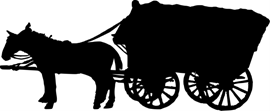 My roots run deep in Illinois. About 1830, my great-great grandparents, Jane and Caleb Reed, moved from Kentucky to Coles County, Illinois. Young children at the time, they traveled in covered wagons to their new home with their parents, Ann (Kirkham) and Thomas Reed, and Mary (Templeton) and John Carter.
The families settled near each other, and descendants remain in Coles County today. Consequently, I am very interested in Coles County records from inception to the modern day. I love when I locate something online.
One source that I have found quite valuable in researching my Reed and Carter families is Illinois Genealogy Trails (http://genealogytrails.com/ill/). About 15 years ago, volunteers dedicated to putting historical and genealogical information online began this wonderful website.
This week I have spent time pulling marriage information from their online index to Coles County marriages. Both Jane and Caleb came from large families, and I found the dates and spouses for all their siblings’ marriages.
This marriage index offers just one example of the information one can find at Illinois Genealogy Trails. You can bet that I plan to spend more time on this website. They encourage submissions by users, too, so I may contribute an obituary or two.
Sites like Illinois Genealogy Trails make needed records so much easier for us to find. We can quickly move ahead in our research with all this at our fingertips. I feel fortunate that my ancestors chose Illinois.
 Posted in
My Irish Heritage—Or Not
 With St. Patrick’s Day coming up next week, I began thinking about all those Americans who celebrate their Irish heritage that day. I used to be one of them.
I grew up in a small Wyoming town among many Irish-Americans. The locals even chose the name for my high school, Kelly Walsh High School, to honor of one of them. The Irish had settled in Wyoming over a hundred years earlier when they arrived to work on the trans-continental railroad.
Surrounded by so many Irish descendants, I probably felt like I fit in better if I, too, had Irish ancestors. Besides, I thought I had understood my paternal grandmother to have told me so.
Turns out, she claimed nothing of the sort. She said that our Reed family was “Scotch-Irish”. In my naiveté, I took this to mean we were Scotch and Irish. Never mind that Scotch is a beverage, not a nationality.
Only years later did I learn that the correct term, “Scots-Irish” referred to the American descendants of the Ulster Scots of Northern Ireland. These Presbyterians had come originally from the Scottish Lowlands to settle on the Irish plantations. Later, many of them moved on to colonial America. There they lived mostly on the frontier, as my family had.
I should have shown more suspicion about my supposed Irish roots for that and other reasons. Our family did not have a recognizable Irish surname (Reed?). My dad’s family was mostly Presbyterian, and we have not a Roman Catholic to be found.
Although I can no longer celebrate an Irish heritage, I can and will celebrate St. Patrick’s Day. I have pulled out my St. Paddy’s Day decorations and purchased my corned beef. My grandson and I have baked cookies decorated with green sugar. We are ready. Erin Go Bragh!
Carter Cousins
 My great-grandfather, Samuel Harvey Reed (1845-1928) came from the small town of Ashmore, Illinois. I always knew he had a big family there.
Mostly, I knew of all the Reed cousins. One Reed descendant wrote a book called The Reeds of Ashmore back in the 1980’s. He traced our Reed line from Samuel’s grandfather Thomas, an original settler in Ashmore. I have used this book a lot, and consequently I am familiar with the names of Samuel’s cousins on his father Caleb Reed’s side:
- Daniel Reed
- Nancy Jane Reed
- Caleb Robertson Reed
- William Fred Reed
- Mary E. Reed
- James Reed
- Kate Reed
- Susan Ann McAlister
- Thomas Alison Walton
- Nancy Jane Walton
- Jerome G. “Aris” Walton
- Martha Ellen Walton
- Nevada Dorcas Walton
- James Thomas Galbreath
- William Riley Galbreath
- Anna Eliza Galbreath
All these cousins lived near Ashmore, and Samuel obviously knew them well. In 1872 he even served as a witness for Mary Reed’s will shortly before she died at age nineteen.
These Reed cousins comprise only half of Samuel’s extended family. His mother Jane Carter, also from Ashmore, had many siblings, too. Thus Samuel had Carter cousins as well. This year I am finally working to identify the grandchildren of John Carter (Jane’s father), and so far I have this incomplete list:
- Edith Austin
- Susan C. Boyd
- Caleb Boyd
- G. R. Boyd
- Gus Boyd
- Tabitha J. Boyd
- Mary Ann Boyd
- John Boyd
- John M. Carter
- John J. Collins
- William J. Carter
- Thomas B. Carter
- David W. Carter
- Mary J. Carter
- Alice M. Carter
- John A. Carter
- Delilah B. Carter
- Jacob S. Carter
- Margaret Ellen Carter
I am confident I will find the names of even more Carter cousins. I am in the process of working through the census records for all of Jane’s siblings to see how many I can locate. Samuel Reed must have been related to nearly everyone in Ashmore!
A Grave Beginning
 This week I am spending my time in a virtual graveyard. Although it sounds morbid, a genealogist usually loves a place like this.
It began as I sorted through the information I had gathered on my Carter family of Coles County, Illinois. I came across a list of family members buried in the Ashmore and Enon cemeteries of that county.
My distant cousin Dr. Michael Hayden, author of The Reeds of Ashmore, had walked these cemeteries in the 1980’s. He transcribed the cemetery markers for all our Reed and Carter family members buried there. I counted over 150 names on his list. The burial dates begin shortly after the settling of Ashmore Township around 1830.
This week I am putting the names and dates for all the Carter descendants into my database. Many of these graves do not appear on the FindAGrave website. Maybe someday I will build online memorials to these people.
For now, getting the data onto my own website publishes the information and provides a jumping-off spot for further Carter research. I am off to a grave, er great, start.
Gone To America
 For the past three years I have focused my genealogical research on my mother’s family from Finland and Norway. This year, because I am planning a summer trip to Virginia, I plan to study my dad’s American lines. Some of these ancestors lived in colonial Virginia. First up, the Carters.
My Carter line begins with my great-great grandmother, Jane Carter Reed. I have not done any research on her or her family, but I have inherited some things that pertain to them. Thus, I have this information on Jane for a start:
- Born 15 December 1824 in Wayne County, Kentucky to John Carter and Mary Templeton.
- Married Caleb Reed on 22 February 1844 in Coles County, Illinois.
- Had 11 children (Samuel, Mary, Martha, George, Thomas B., Emma, John, Thomas L., James, Ida, and Albert).
- Died 30 April 1907 at the home of her daughter Martha in Ashmore, Illinois.
- Buried 2 May 1907 at Ashmore Cemetery.
I do not have evidence to support all this information. I do have a pile of papers pertaining to the Carters, though, that I have gathered over the years. Last night I began poking through it and putting it in chronological order.
In there I found a photocopy of Jane’s funeral card. It confirmed the birth and death dates I had received from other family members. It also gave me an additional piece of information. Jane’s funeral service was held at the “family residence”.
Where was that? Daughter Martha’s house in Ashmore? Or the big white house where Jane raised her family on the Reed farm in rural Coles County? I wish I knew, but I probably have no way of finding out. Fleshing out Jane’s story will provide a challenge.
As I begin this research on Jane and her family, the journey promises to be quite different from my Bentsen and Mattila research over the past three years. Instead of spending most of my time with Lutheran church records, I am eager to do family history the American way again.
Lives Cut Short
 This week I found another one, another husband and father who died too soon.
My family tree seems sprinkled with men who died in their prime, leaving behind wives and children. Imagine the struggle these survivors faced without their breadwinners.
I have found these sad records wherever I have done research, from America to Norway and Finland. These stories will tug at your heart:
- Henric Miettin (abt. 1804-1836). He lived in Halivaara, Kuopio, Finland and passed away at age 32 due to a fever. His widow Anna Toivain, left with at least four children who were not yet teenagers, soon remarried.
- Anders Bentsen (1823-1857). Anders died at age 33 in Bø, Nordland, Norway, also from a fever. His wife, Anne Larsdatter, seemed unable to raise their two small children because both lived with other families after their father’s death. Anne eventually remarried.
- Antti Abelson Mattila (1826-1882). Although perhaps not-so-young at 55 when he died in Viipuri, Finland from tuberculosis, Antti still had six children under 18 at the time. At least one daughter already suffered from tuberculosis, too, and the youngest child was just four years old. Antti’s widow Elisabeth Myllynen made her living by laying out the dead, taking her young son along with her on these jobs.
- Owen Herbert Reed (1896-1935). At age 38, Herb died during the Depression in a vehicle accident near Brighton, Colorado. His 18-year-old daughter promptly left home to get married. His widow Grace and their five sons were forced to leave their family home in Wyoming and relocate to Colorado where a brother-in-law set them up in a house. All the boys immediately had to go to work, including my then-8-year-old father who helped deliver milk.
Since I descend from all these unfortunate men, I also descend from the widows facing the need to make a living, and from children who grew up without a parent. How did they ever keep going despite broken homes and hard times? It makes me sad every time I read of another ancestral family enduring this fate.
I feel so fortunate that it did not happen to me. I am able to visit my 87-year-old father regularly; I live happily with my husband; my children are grown. Life turned out better for me than it did for some of my ancestors.
A Sad End to the Line
 This past week I traveled to Virginia on a sad journey to attend the memorial service for my nephew Tyler William Reed (1988-2014). He died at too young an age, just twenty-five. He had no children.
With him, the line of male Reeds descending from my grandfather, Owen Herbert Reed (1896-1935), has “daughtered out”. I have two Reed brothers, but one has never married and the other is left with two adult daughters. We have no Reed first cousins.
Nevertheless, we can find other more distantly-related male Reeds out there. The line continues through a couple of my grandfather’s brothers. Our Reed name will live on despite the terrible tragedy of Tyler’s death.
We have survived such losses before. Previous generations in Coles County, IL also felt the sting of the unexpected death of a promising young man. Like me, the aunts of these Reeds mourned their untimely passing:
- Albert M. Reed (1866-1890) the youngest son of my great-great grandfather Caleb Reed, died at age 23 after an illness,
- Daniel T. Reed (1836-1859) and William Fred Reed (1844-1875), Caleb Reed’s nephews, died at ages 23 and 28, respectively, and
- William Reed (1822-1845), Caleb Reed’s younger brother, died of unknown causes at age twenty-three.
Those left behind sadly wonder why we had to lose all these men before they had the chance to live their adult lives. It seems so unfair. We search for answers. Perhaps my sorrowful brother, speaking this week at his only son’s memorial service, offered some explanation when he said, “Father Knows Best”.
Farewell, Tyler
 Our world upended last weekend. My 25-year-old nephew Tyler William Reed drowned. I feel like the fabric of our family has ripped apart with my heart torn out.
Tyler went missing after a night out with friends at the Washington Nationals game on May 5. He left a restaurant to take the Metro home to Alexandria, Virginia. No one ever saw him again.
Our family searched frantically for him for the rest of the week. Then on Saturday we received the terrible news. The police had recovered his body from the Anacostia River, near the Nationals’ field and the Navy Yard metro stop. He had suffered no trauma and still had his wallet and cell phone.
Tyler, what happened to you?
We probably will never know for sure how my nephew landed in that river. He was a happy guy with many friends. He worked two jobs that he liked, and he had recently re-enrolled in college to complete his degree in sociology. He had a passion for music, playing both piano and guitar, and he wrote many songs.
I ache for my brother whose only son’s life ended too soon. Like all fathers and sons, they had their little frictions, but they shared so much. They even had the same birthdate. How will my brother celebrate his birthday now when his son can no longer join in the celebration?
I hardly know how to say good-bye to this young man who was on the brink of adulthood. We should be congratulating him on his college graduation, not attending his memorial service. Tyler, I am so sad to see you go.
Why I Have Not Done a DNA Test
 Everyone seems interested in testing their DNA these days. Genealogists in particular flock to companies offering these tests. Why do they want DNA tests, and why have I not joined the throng?
This week our local Computer Interest Group met to hear genealogist Ric Morgan speak about DNA testing. He described the three types of tests available: Y DNA, mitochondrial DNA, and autosomal DNA. Over the past decade, the cost of these tests has come down even as the scientific potential of them has grown. Still, I cannot bring myself to mail in that cheek swab.
Here’s why:
- Y DNA testing is for men only, so I obviously cannot do this one. This test can identify those men among us who are related to one another and who descend from common male ancestors. In my own family, my father’s first cousin Leslie Reed submitted a sample several years ago. This tied us in to the family of Thomas Reed of colonial Morris County, New Jersey. The puzzle now is to sort out all the Reeds in New Jersey at that time and document the families. At this point, we need no further Y DNA testing.
- Mitochondrial DNA traces the direct female line. Mine goes back to Finland. We have had substantial success documenting my Finnish lines without resorting to DNA testing. Because mine is a small family, I have been in touch with most of my American relatives of Finnish descent. I do not know any current family members in Finland, but I also do not think the current DNA databases contain many native Finns who would be possible matches for me. Submitting a mitochondrial DNA test would not tell me more than I already know, especially about my direct lineage.
- Autosomal DNA offers the new frontier in DNA testing according to Ric Morgan. It also poses the greatest privacy threat. Autosomal DNA contains the complete genetic record for an individual. Wouldn’t insurance companies or the government love to get their hands on that! I go to great lengths to protect my privacy, so this test poses no temptation for me. I will keep looking for another way to identify the man who fathered my paternal grandmother in rural Nebraska sometime in 1895.
So there you have it. I plan to keep my DNA untested because the sex-linked tests would be of no immediate value to me. I am unwilling to open the autosomal test door. I will keep doing genealogy the old-fashioned way, one document at a time.
Newsworthy Fatalities
 Recent news about deaths from natural disasters, accidents, and crimes made me wonder how many deaths in my own family occurred this way. These events cut a life short, so they usually make the news. As a genealogist, I try to collect this information as part of my research. I have found several news stories in my own family tree.
Working back in time, here is my list of our twentieth century fatal events:
- Hugo Alexander Mattila (1918-1987) died in a home fire in Gainesville, Florida,
- Betty Karoline Johansen Harrigan Cummings (1904-1954) was murdered by a local handyman in her Seattle, Washington home,
- Johan Martin Johansen (1889-1947) drowned in the Gulf of Alaska after being swept overboard from a fishing boat during a storm,
- Alexander Mattila (1878-1945) died due to trauma from being hit by a train as he walked home along the railroad tracks in Hibbing, Minnesota,
- Francis Edmonds (1876-1944) fell from a horse and broke his neck while herding sheep in the Lewis and Clark National Forest in Montana,
- Rose Wilhelmina Mattila Porras (1896-1941) froze to death in a snowbank in Hibbing, Minnesota,
- Owen Herbert Reed (1896-1935) died from injuries received in a truck accident near Brighton, Colorado.
Only one of these deaths, the Seattle murder, resulted from a crime. Another, the drowning, occurred during a storm. The rest were accidents.
Now we find ourselves well into the twenty-first century, and we have had no deaths from anything other than natural causes. With all the danger in our modern world, we can count ourselves lucky.