Archive for the ‘Genealogy’ Category
A Hjelmstad Photo Op
 April 25th, 2013 |
  Author:
  Our patriarch “Grandpa” Al Hjelmstad (from North Dakota) met his wife Thecla Walz (from Minnesota) in the oil town of Casper, Wyoming. They had both just arrived there looking for temporary work after World War II. He planned to earn money to move on and start a business in the Pacific Northwest. She wanted to spend the summer after high school with her sister. They ended up marrying and staying in Casper to raise their family.
Today most of their descendants live along the Rocky Mountain corridor. Last weekend nearly all of us gathered at the home of a grandson in Pueblo, Colorado for an impromptu reunion. People came south from Casper and north from Las Alamos, New Mexico. One outlier even arrived from Ithaca, New York. We had 4 generations represented ranging in age from 2 months to 83 years. Of course meeting the 2-month-old little girl was the excuse for the get-together.
My daughter-in-law is learning photography so she took many pictures of this event, including some group photos. Now she wants a place to post them for all the clan to see.
Many (most!) of us are not Facebook users, so this could pose a problem. But my husband/tech advisor can solve this! He will use Photo Gallery software to create a family album online where we all can post and share photos. This will work well for the Hjelmstads who shy away from social networks.
As a genealogist, I love that we have another multi-generational photo to add to the collection. I just wish Grandpa were still with us to see how the family grows.
 Posted in
An Adventure in Norwegian Research
 My husband works with computers all day, so what do you suppose he does during his lunch period? Works on computers!
This quirk of his personality worked to my benefit this week. In anticipation of our trip to Norway, during his lunch hour over the past several weeks he has researched his family using the Norwegian online archives http://arkivverket.no/eng/Digitalarkivet. When he could find no more information on his family, he offered to look for mine!
I had complete information only for my great-grandparents, Ole Bentsen and Sofie Sivertsdatter, who immigrated to the U.S. in 1905. Using the online archives, I had located baptism, confirmation, and marriage records for them and their siblings. I had confirmed the names of their parents (Lorents Nicolai Bentsen, Karen Johansdatter, Sivert Knudsen, Martha Hansdatter) as given to me by their daughter. These records told me that prior to immigration, my family had resided on various farms in the Vesterålen district of Nordland County, Norway. I hoped to visit these farms, the same way we will visit my husband’s farms in the Ringsaker District of Hedmark County.
Before the trip, he wanted to identify my earlier generations and whether they had lived in the same places in Nordland. Soon he found that my family research presented difficulties he had not faced with his. The Hedmark records had been indexed; Nordland had not. Hedmark records went back further in time than the Nordland records. And then there were the farms.
Not really farms at all in Vesterålen, but rather geographic areas of administrative convenience, my family’s residences turned out to be fishing villages on remote islands. My husband came marching into the house after work one evening and announced that we would not be visiting my family “farms” because we have no way to get there. Even the ferries do not stop at many of these places. I will have to be content with visiting the main islands of Vesterålen.
I appreciate all the work my husband did to advance my research. For his sake, I wish it were easier. Now, he should take a break and find something relaxing to do at lunchtime.
Boomer or Xer?
 During a conversation with my daughter-in-law this week, the term “Generation X” came up. This phrase refers to a particular cohort of people born immediately after the Baby Boom, roughly from 1964 to 1980.
Several theories for the origin of the term “Generation X” exist. Some claim they named it after a popular punk band. Another hypothesis has greater appeal for me as a genealogist. According to the idea I like most, the “X” stands for the Roman numeral ten. This explanation assumes that “Generation X” refers to the tenth generation of Americans.
I like this interpretation because it places me into the relatively youthful Generation X instead of the older Baby Boomer generation! I am among the 10th generation of my family to live in America. My earliest American ancestors, John Hall and Edward Bangs, lived ten generations back in the 1630’s Massachusetts Bay Colony.
The only problem with calling myself a member of Generation X is that no one else in popular culture actually defines the generations this way. Imagine how confusing these terms would be if we all had to count back the generations on our family trees to find out which generational label applies to us. People of the same age would belong to different generations, and the terms would become meaningless. It is more practical to define terms according to commonly-accepted ranges of birth years.
So, to the world, I remain a Baby Boomer. But in my heart I know that I am a proud member of the younger Generation X.
Chugging Along With Photo Scanning
 Finally I am making some progress with my photo scanning project. I have finished with those taken in Colorado, Nebraska, Nevada, and Wyoming cemeteries.
Now I am working on a stack of pictures my Dad took 25 years ago in Illinois. The photos look pretty good and readable even though many of the cemetery markers stood in the shade. As a bonus, my ever-attentive-to-detail Dad copied all the information from the stones onto the backs of the photos.
The markers in the Reed-McAllister cemetery for our ancestors Ann (1782-1869) and Thomas (1783-1852) Reed do not give birth dates for these people. However, they do provide their ages at death in years, months and days. Using a handy online calculator at http://www.searchforancestors.com/utility/birthday.html I determined their birthdates. Unfortunately, these dates do not match the ones given to me by other family members.
What should I believe? A cemetery marker is not a great source for birth information because someone far removed from the birth event provides the data. Besides working with this sketchy information, the carver of the stone could have made a mistake while copying it onto the stone.
Is the information from my family records any more reliable? Turns out, probably not. Our 135-page family history written in the 1980’s provides only birth years with no sources. A cousin unearthed actual dates about 10 years later, but his source was another family’s genealogy, not primary source material.
Thus, neither of the dates I have for the births of Ann and Thomas are proven. I have some clues, but these dates need corroboration. I will work on that someday, but for now, I want to get back to the scanning.
Find Out What Your Cousins Know
 Last night I received an unexpected phone call. The woman at the other end of the line identified herself as one of my mother’s Mattila cousins.
My mom had spoken of this cousin, and we even have her high school picture. But we lost contact with her and her one surviving sibling after the parents divorced many years ago.
Now another relative has put her in touch with me to get a little information about our shared family history. I am always happy to share what I know, and that is why my family trees are posted on the norsky.net website. I hope my new-found cousin and I will correspond in the future and make discoveries together, as I do with other cousins on other branches of my family tree.
A wise genealogist once told me that I should never stop writing to cousins. Different information flows down different family lines. We can put together complete family pictures only when we all share our information and stories. I am looking forward to learning more about the Mattila family from the lady who reached out to me last night.
Taking Time to Identify Family Farms
 This week I needed something to do when a computer problem prevented me from scanning photos as I had originally planned. I designed a short project related to the trip to Norway that I plan to make this summer.
A couple of years ago I spent a lot of time retrieving and analyzing church records from the National Archives of Norway (http://www.arkivverket.no/eng/Digitalarkivet). These baptism, confirmation, marriage, and death records usually include the name of the farm where the ancestor lived at the time. When I did the original research, I made copies of the records but did not enter the farm names into my database. The unfamiliar farm names were just too hard for me to read, especially when they were abbreviated or the script was faint.
Since then, I have located and saved a list of all the main farms in the district of Vesteraalen where my family lived. I pulled out all my church records and located the farm names. Then I compared the farm names on the records to the farm names on the printed list. Everything matched up! I went back to my database and added the appropriate farm name to each event. I noticed that most of the time during the period I had researched, my Bentsens lived on the Bervik farm in Bø municipality and my Sivertsens lived on the Valfjord farm in the Hadsel municipality. I hope we can visit these places when we take our trip to Norway next summer.
This little project provided a pleasant diversion while I was on my forced hiatus from my scanning project. Now the computer hard drive has been replaced, and I can resume my scanning. I have photos from Nevada, Illinois, and Massachusetts left to do. Next week I will be back to the research plan. But this week I did enjoy revisiting the Norwegian records.
Another Setback on the Photo Project
 Last week I was too sick to work on digitizing my photos of cemetery markers. This week, the computer was too sick for it.
I began happily enough on Monday, zipping through all my Colorado photos. The flatbed scanner worked just fine for this, and the photos went smoothly to a temporary folder. From there, I labeled everything and moved the images into their permanent folders. I had set up several of these for towns in the state where my ancestors have lived, including Boulder, Cañon City, Denver, and Fountain.
On Tuesday, I sat down at the computer to scan a handful of Nevada photos. Instead of finding the desktop screen with the scanner icon, I encountered a black screen telling me the computer needed to be rebooted. I did so, and proceeded to scan the first photo. It did not go to the same temporary folder I had used the day before. Somehow the path had changed with the reboot. I tried it again. This time the black screen reappeared, but now it contained an ominous Hard Disc Failure message.
Well, this was discouraging. I was using a brand new computer, installed just the week before. What had gone wrong? Even my husband/tech advisor was stumped. He finally resorted to calling the manufacturer, and a repairman is scheduled to look at it on Monday. No more scanning until sometime next week unless I want to connect the scanner to a different computer (I don’t). So I spent the week on the other computer doing data entry from a few documents I have collected over the winter.
All is not lost on the scanning front, though. I am registered to attend a scanning workshop tomorrow. The Computer Interest Group of the Colorado Genealogical Society is hosting a day-long seminar on scanning, digitizing, and genealogy software products. Maybe I will pick up some good tips before I get too far along in my own project.
How to Do Genealogy When You Do Not Feel Up To It
 So it has been a crummy winter health-wise. My extended family includes 13 of us in the Denver area, and we have all been sick again and again this winter. After a previous cold and a bout with norovirus, I am now fighting a respiratory infection that just won’t go away.
How do you keep up with genealogy when you do not even feel like getting out of bed? I found some ways.
- Reading back issues of genealogy publications that I normally have no time to read.
- Watching old recorded episodes of Who Do You Think You Are?
- Blogging (between coughing spells).
- Dreaming about my upcoming trip to visit Iceland and our ancestral homes in Norway.
You get the idea. Not much really productive work is going on this week at my genealogy desk. But I am keeping my hand in genealogical pursuits until I feel well enough to do some real work.
In the Shadow of the Cathedral
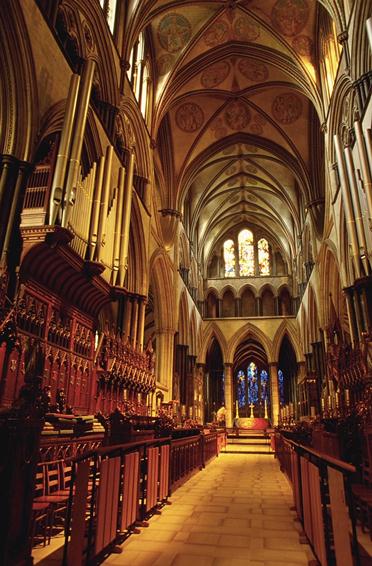 Last weekend we had the opportunity to attend a retreat in the Roosevelt National Forest near Estes Park, Colorado. We stayed at Highlands camp, a facility owned by the Presbyterian Church and rented by our Lutheran congregation for the weekend. We set aside this time to study some of the religious artwork housed at the National Gallery, London. Our textbook, The Art of Worship, showed reproductions of about 50 paintings from their collection. Each of us chose one to discuss.
I picked an 1831 John Constable painting of Britain’s Salisbury Cathedral. I have visited several cathedrals in England, France and Germany, and Salisbury Cathedral is one of my favorites. I like to wonder whether any of my English ancestors ever visited this place. Dating to the 1200’s, the Salisbury Cathedral was built long before the Reformation, when even my family was Catholic. Religious pilgrims traveled there from the beginning.
When I go into a cathedral, I recall how it served as the focal point for the community over the centuries. Our modern life no longer revolves around the Church and the religious calendar the way it did when the great cathedrals were built. Perhaps Salisbury Cathedral, or some other cathedral, played an important role in the lives of some of my ancestors. Visiting a cathedral today provides me with a window into the religion-centric life of the past.
My own ancestors finally rebelled against Church authority and all that the cathedral represented. Those in Scandinavia became followers of Martin Luther. Those in England joined the Puritan movement.
How did these ancestors feel then about the cathedrals? I think I know the answer. They did not build cathedrals when they came to America. They were finished with all that.
Maybe that explains my fascination. Having never seen a cathedral here, I enjoy visiting those across the water and trying to envision the life of an ancestor in a cathedral town.
Photo Project Update
This week I set up the hierarchy for my scanned photos of cemetery markers. Under My Documents, I set up folders and subfolders: My Documents>Genealogy>Cemetery Markers>State>City or County>Cemetery. I moved all our scanned images into the appropriate folders. Next step is to re-label the images with labels more descriptive than the camera number.
Mining Those Home Sources
 This week I had the good fortune to hear certified genealogist Lou-Jean Rehn speak to the Germanic Genealogical Society of Colorado. She offered a wonderful talk on searching for her German-speaking Swiss ancestors. One of her valuable pieces of advice was to continue mining your home sources for information. I decided to give it another try even though I thought I had already covered all this ground.
My mother-in-law happens to be visiting this week, and she attended the meeting with me. Lou-Jean’s urging inspired us to spend some time letting my mother-in-law reminisce about her German family and traditions while I avidly took notes. As a result, this week I have learned many interesting family anecdotes from the early twentieth century. I found out why the Walz family moved from Jordan to Mahnomen, MN (they lost all their money in a bad investment and had to start over) and how my husband’s grandparents met (she worked as a housekeeper for his uncle). I heard the sad story of the cousin who bled to death after shooting himself in the leg while trying to climb over a barbed wire fence.
I also learned that even though I thought we had copies of all pertinent family records for this family, we have overlooked some. Apparently, my mother-in-law has a family Bible that I have never seen. She also has a collection of family letters from pioneer days in Minnesota.
Next time I go to visit her, you can be sure I will be looking at these previously-unknown sources. Lou-Jean was right. Keep looking for records at home.