Archive for the ‘Genealogy’ Category
Exciting Possibilities, Disappointing Results
 May 12th, 2016 |
  Author:
  This week I came across two databases I hoped would provide some new family information. No such luck!
Perhaps others can find something they need in these places:
- Edgar County, Illinois Death Records, 1877-1892. Family Search has digitized these records, and you can browse them online at https://familysearch.org/search/catalog/290347?availability=Family%20History%20Library. My Sherman family lived in Edgar County in the 1870’s, and two of them died there. I hoped to find their death records. Unfortunately, Rebecca Sherman passed away in 1876, the year before this record-keeping began. Jasper Sherman died in 1878, but his name does not appear on the register.
- Michigan Marriage Records, 1867-1952. Ancestry.com, a subscription site, added this database recently. After years of searching, I have not found a Michigan marriage record for my great-grandmother Laura Riddle, who is said to have married George Edmonds in the 1870’s. Would this comprehensive Michigan database reveal a long-sought marriage record for her? In a word, no. This woman’s life in Michigan continues to elude me.
Searching these databases did, however, open some new lines of inquiry:
- Did Jasper Sherman die in another county even though he is buried in Edgar County? I could check the death registers in surrounding counties.
- Who was the “other” Laura Riddle I did find in the Michigan database? That Laura, the same age as my Laura, also married a man named George (Whitney). Their marriage took place in 1871 in Van Buren County, one county northwest of St. Joseph County, where my Laura lived. The record states the Van Buren Laura was born in Kalamazoo while my Laura was born in Mendon. Are they related? Perhaps research into the Riddle family of Van Buren County can shed some light on my own Riddle family.
Even though I did not find the quick answers I sought in these databases, I have eliminated a couple of sources, and I have some ideas for further research. I will continue hunting.
 Posted in
A Discouraging Year So Far
 On this beautiful Cinco de Mayo, the second anniversary of my nephew Tyler William Reed’s death, my thoughts wandered to family deaths in general. I realized that in the first four months of this year, we already have had four deaths in my extended family. Not a good start.
In 2016 we have lost the following loved ones:
- Ronald Duane Bentsen, my uncle, passed away January 15, the day after his 85th birthday.
- Angela Nicolucci, my second cousin, died February 5 at the age of 43.
- Sharon Flageolle, with whom we share a granddaughter, lost her cancer battle on March 22 at the age of 53.
- Judith Ann Tegg, my mom’s cousin, died on April 9 at the age of 73.
Four months, four deaths. Usually they do not come so quickly, one after the other like this. Each month, I have had the unpleasant job of collecting obituaries and photos for these people and entering the information into the family history that I keep. Now their names appear on the family tree with birth and death dates in neat brackets.
The reminders of these sad deaths remain raw, but I feel the need to memorialize these family members while memories of them remain fresh, too. I want them to be remembered. So I continue to work on the tree, adding death dates no matter how unwelcome the news. We just have had so many in such a short time.
The Busy Local Genealogy Scene
 This week I reconnected with some genealogy friends I had not seen in a while. We gathered at Lucile’s restaurant in Denver, a Creole and Cajun place, for lunch.
Sandy Ronayne, President of the Colorado Genealogical Society (CGS), organizes these monthly lunches for the club. I cannot always attend, but this month I made it. We chatted about happenings in the local genealogy community and discussed our current research projects.
This month we talked about the good opportunities we have had this month to further our genealogical education. Several people had been to hear CeCe Moore’s presentations on DNA and genealogy at the CGS 2016 seminar. Most folks have already registered to hear F. Warren Bittner, CG, speak on April 30 at the Palatines to America Seminar and Book Fair. In the Denver area we often get to hear these and other nationally-known speakers.
We have some wonderful local resources, too. John Putman was to speak on New England research at the CGS meeting in April. Unfortunately, that meeting was cancelled due to snow. We hope Mr. Putnam can be rescheduled.
With all this going on, I find myself having to draw a line on how many events I attend. I need research time as well as fellowship and education time, so I must strike a balance. This month I participated in the lunch, and I have registered for the Palantine seminar. I also went to the Norwegian genealogy group meeting earlier this month. Despite taking time for three genealogy outings, I still had some time to pursue my own family history research project.
We have a wonderful genealogy community in the Denver area. One can participate as much or as little as one likes, because some group always has something going on.
Some Norwegian Research Tools
 Genealogists like to take training classes to keep their skills sharp. Here in the Denver area I have many opportunities to attend seminars offered by well-known American genealogists. But for Norwegian genealogy, I do not have a lot of options.
This week I came across not just one but two chances to learn more about Norwegian research methodology:
- Of course my local Sons of Norway lodge offers my first and best option. We meet nine times a year to exchange research tips and information. This month my own husband/tech advisor led a program on how to use bygdebøker—local history books that contain a wealth of genealogical information. Several hundred rural communities in Norway published these books. Some members of our Norwegian research group have purchased these for the areas where their ancestors lived in Norway so we had a chance to thumb through a couple of the books. Of course, they are written in Norwegian, so that presents a problem for those of us who do not read the language. For those with some fluency who do not want to purchase one, some college libraries in Minnesota and North Dakota have collections of these.
- We have become acquainted with a Norwegian genealogist, Martin Roe, who writes a blog in English. Hooray! I have subscribed to his blog at http://martinroe.com/blog, and I expect to learn a great deal about Norway and Norwegian genealogy from him.
Slowly but surely I am gaining more expertise in Norwegian research. Although I am not actively researching a Norwegian line this year, I will have the tools when I need them.
Traveling the Way My Ancestors Did
 For some time, my husband/tech advisor and I have pondered traveling by train. We took a half-day trip many years ago, and we kept thinking we might enjoy a longer rail journey. Last week we had the opportunity to try it when he needed to attend a conference in San Francisco. We seized the chance to take the train to get where we needed to go, the same way our ancestors used to do.
We caught Amtrak’s California Zephyr at Union Station in Denver. This line runs daily from Chicago to San Francisco. They say it offers one of the most beautiful rides in North America. We loved the scenery during our two-day trip. Highlights included the Rocky Mountains, the Moffatt Tunnel, scenic canyons, and Donner Pass.
We also loved the pace of train travel. We had a roomette with large, comfortable seats, a table, and big windows. As we rolled along, we relaxed and caught up on reading, napping and conversation.
The train served three tasty meals a day in the dining car. There we had the opportunity to share a meal with fellow travelers. At night, a steward converted our seats into upper and lower bunk beds.
During our trip, I found myself thinking about my forebears who had traveled on the train to new homes. The Bentsen ancestors caught the train to Culbertson, Montana after traveling across the ocean from Norway. My great-grandmother Laura Riddle went by train from Michigan to Nebraska when she began her life as a homesteader. For them, train travel represented the state-of-the-art mode of transportation.
In the mid-twentieth century, my grandmother Grace Reed preferred train travel for her journeys. She took her young children on the train to visit her family. In later years, she traveled from Colorado to Wyoming to visit her grandchildren. I remember her disappointment when the railroad discontinued passenger service on that route in the 1960’s. After that, she took the bus for her visits, but she really missed the comfort of the train.
On our own trip, we learned that we like train travel. Others seem to like it, too. Several of the passengers on our trip spoke of their goals to take all the rail lines in the United States as a way to see the country. Next time we need to travel somewhere, I think we would consider booking another train trip.
We Reluctantly Fill In a Death Date
 This week our family experienced the sad side of genealogy. Our three-year-old granddaughter lost her other grandmother to pneumonia, and we regretfully must complete Sharon’s death date space on our family group sheets.
Our granddaughter knows that her grandma has died, but she does not understand what that means, nor does she appreciate the finality of it. This little girl does not fully understand that she will not see her grandma again.
Sharon was a wonderful grandmother who spent countless hours with her grandchildren, taking them to school and soccer practice, cutting their hair, and encouraging them to root wildly for the Denver Broncos. But she will not be there for our mutual granddaughter’s soccer games and school performances. Nor will she be there for the new little granddaughter due to arrive any day now.
Sharon won’t be buying any more Bronco cheerleader outfits and championship T shirts for her granddaughters. She won’t be re-creating her beautiful back yard where they have played every summer. She won’t be hosting any more holiday dinners for them.
It is a sad week for all of us, and our little granddaughter has lost her grandma all too soon.
52 Ancestors in 52 Weeks no. 8—Anna Petronellia Sherman (1865-1961)
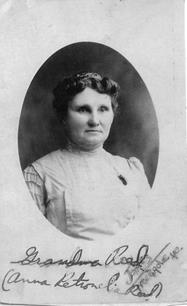 Anna Petronellia Sherman lived a very long life. According to death certificate information provided by her son Thomas Aaron Reed, she was born on April 1, 1865 to Thomas Sherman and Catherine Stanabaugh and died in Clinton, Missouri in 1961 at the age of 95. Contrary to the information on her death certificate, she was probably born in Indiana. No record of her mother has been found, and family lore claims that she died in Indiana before 1870. The mother was reportedly from Germany or Holland, making little Petronellia either half German or half Dutch.
The motherless girl strongly disapproved when her father remarried 19-year-old Alice Farris in 1881. Ironic then, that two years later on September 6, 1883 Petronellia herself, at the age of 18, married an older widower, 38-year-old Samuel Harvey Reed, in Coles County, Illinois. She became the stepmother to his two daughters, Annie and Clara. He called her “Pet” and drove her around in a buggy while she held a fancy parasol. She later said she was attracted to his big, white house (which actually belonged to his father) and to the highly-respected Reed name. The Reeds, in turn, hardly approved of Samuel marrying the daughter of a poor blacksmith who drank, especially when Samuel’s first wife had been very well off. Samuel immediately moved his new bride to Kansas and later, to Missouri. They had seven children: Bertha Evaline (1884), Caleb Logan (1887), Viola May (1889), Robert Morton (1891), Samuel Carter (1892), Thomas Aaron (1894), and Owen Herbert (1896 or 1897).
People who knew Petronellia have described her as temperamental, religious, and hard-working. Sometimes she kept a perfect house; at others she allowed chickens indoors. One time she chopped down all the trees in her yard because the songbirds annoyed her early in the morning. She had a fiery temper and could not get along with others. She and Samuel divorced in 1904.
She joined the No. 1 Methodist Church in Mountain Grove, Missouri when she was 23 and remained a member for the next 73 years. She read the Bible completely more than 20 times, played the church organ, and taught Sunday School until she was in her 90’s. She lived a simple, frugal life without an indoor toilet. If her children tried to give her money, she would donate it to Boy’s Town in Nebraska.
Petronellia worked for the Post Office off and on. She met Samuel Reed while working at the Charleston, Illinois post office. She was the first Postmaster at Graff, Missouri, serving from 1895 to 1899.
After her divorce from Samuel Reed, she married Captain James W. Coffey, a Confederate veteran of the Civil War, in 1906 in Texas County, Missouri. Some of her sons worked on Coffey’s farm. The marriage lasted only a few years and ended in divorce. With her children grown and no husband, Petronellia needed to earn a living.
She resumed the Reed surname and decided to apply for a homestead. Selling a proved-up homestead was a good way for single women to build a nest egg. To do so, she needed to move to a public-land state with homesteads available.
Several of her younger children had relocated to the Nebraska-Wyoming area, and her son Robert Morton Reed was the railroad station agent at Farthing, Wyoming, near Iron Mountain in Laramie County northwest of Cheyenne. Petronellia joined him there and took up a stock-raising homestead in 1918. She raised chickens and a few head of cattle, and she tried to grow some crops, without much success. One year, she harvested only a bucketful of potatoes. She became a crack-shot antelope hunter to survive.
By the end of her five-year homestead term, her son’s family had moved on to Wheatland, Wyoming with his railroad job. Petronellia hated the cold, windy, treeless prairie, so she sold her homestead and moved alone back to Missouri. Her homestead is now part of the large Farthing Ranch.
She lived out the rest of her long life in Mountain Grove, Missouri, growing blind in old age and eventually moving into a nursing home the last year of her life. She is buried in the churchyard of the No. 1 Methodist Church. She lies next to the grave of her daughter Bertha’s unnamed stillborn daughter who had been laid to rest there over 50 years earlier, in 1909.

Genealogical Clean-up
 I keep several stackable trays on the credenza near my desk. I have each one labeled with one of my family surnames. As I come across documents pertaining to a surname, I make a copy and toss it into the appropriate tray.
If I kept digital copies of these items, I never would think to go back and look at them. But with paper copies staring me in the face, I remember to go through the bin whenever I am working on a surname. This week I pawed through the Sherman tray.
I found several things in there that I had forgotten I had:
- Thomas and Anderson Sherman’s 1863 Civil War draft registration record from Johnson County, Indiana.
- Evaline Sherman Alvey’s Civil War widow’s pension index card.
- Thomas Sherman’s listing as a taxpayer in Edgar County, Illinois in 1878, and as a blacksmith in Loxa, Illinois in 1895.
- Sherman death listings in various places where Thomas lived, including Johnson County, Indiana and Coles County, Illinois. Can these people be relatives of his?
All of these documents shed light on the life of my great-great grandfather, Thomas Sherman. I need to analyze them for all the information I can glean. Hopefully they will help me focus my next research steps. I feel like there is so much more to discover about Thomas.
He did not leave many footprints in the historical record. Once I pull everything out of the Sherman bin that pertains to him, I can fashion a research plan that will enable me to learn more about his life.
The Shermans and the Draft
 Nearly one hundred years ago the young men of America marched off to register for the World War I draft. I looked at some of those registration cards this week. There I found Charles, George, Claude, and Walter, the four sons of my great-great grandfather Thomas Sherman. I learned several things about them:
- Birthplaces. Interestingly, the draft boards did not use the same registration form every year. The forms filled out by the younger sons, Claude and Walter, in 1917 asked for birthplace. The forms filled out a year later by the older sons, Charles and George, did not. From census records I know that Charles was born in Missouri, but I wish the draft card had given an exact location. The other boys were all born in Illinois, and now I know that Walter was born at Janesville, Illinois. Claude’s card says he was born at Johnstown, Illinois. I am unfamiliar with this location and did not know that the father Thomas Sherman had ever lived there. I need to do some more investigating of this clue.
- Residence. When they registered, George and Claude lived in Charleston, Illinois, as I expected. Walter lived nearby in Bushton. Charles resided in Dexter, Missouri. He had left Illinois that year at the request of the Coles County Overseer of the Poor after having lived hand to mouth on the county dole for many months. Charles was quite the black sheep.
- Occupations. The Shermans were blacksmiths, and all but the youngest son Walter pursued this trade during World War I. Walter worked at a grain elevator.
- Physical Descriptions. All the sons but George were described as slender. The older boys, Charles and George, were of medium height; the younger sons were tall. They all had dark hair. Only Walter had blue eyes while the others had brown. Does my dad look like any of them? He was tall, slender, blue-eyed, and had dark hair.
- Claude and Walter claimed exemptions from the draft on the grounds of being needed to support dependents. The form did not name these people, but the list included Walter’s mother.
These draft cards gave me a good look at family members from another era. You can find the records on Ancestry.com.
Two Girls Named Clara
My Sherman family lived in Illinois in the early twentieth century. Luckily for me, I can read the local Mattoon newspapers online to learn about them. I have searched for most of the Sherman names in my database, and this week stories of two of my grandfather’s cousins turned up:
- Clara Sherman (1908-1926). The daughter of Charles Sherman, this young woman married Howard Cook at the age of fourteen. She suffered from tuberculosis, died at seventeen, and left behind a 5-month-old daughter. Members of the Spiritualist Society conducted her funeral service at her maternal grandparents’ home.
- Clara Gladys McNamer (1905-1974). This Clara was the daughter of Ethel Sherman and Edward McNamer. One Sunday night in December, 1921 when Clara was 16, a local boy named Forrest Stoner arrived in his car to take her to a church meeting. They did not return that evening, and her parents notified the authorities. An all-night search commenced, but no one could find them. The next morning, the County Clerk in a neighboring county called to let someone know that the couple had eloped and married that morning.
I do not think my grandfather ever met these cousins. His family lived in the Missouri Ozarks. The families did not seem to keep in touch. The girls were the  daughters of my great-grandmother Petronellia Sherman’s half-siblings, and she had not approved of her father’s re-marriage.
After these families lost touch with one another, we knew nothing of those cousins who had a close blood tie with us. The newspapers have helped me again to know these people a little better.