Archive for the ‘Genealogy’ Category
A False Lead in the Search for John Davis Riddle
 March 24th, 2018 |
  Author:
  Oftentimes, we genealogists hear cautionary advice about trusting family trees we find online. So many of these have no sources attached, and we cannot verify the information. In other words, we cannot take a family found on the internet and assume it is correct.
This month I learned the soundness of this advice. For years, I have searched for the birth family for my ancestor John Davis Riddle (1821-1896). Family papers and the U.S. census for Michigan tell me that he was born in Pennsylvania.
As I resumed research on him and his line this year, again I looked online for any family trees that included his name. Usually I have found nothing, but this time I located a tree connecting him to a Riddle family in Chester County, Pennsylvania. A clue, at last! Was this the breakthrough I have sought so long?
I eagerly contacted the person who had posted the tree. I wanted to find out how they had matched the Davis/David Riddle in Pennsylvania to the John Davis Riddle of Mendon, Michigan. My hopes were dashed after we exchanged messages. Unfortunately, the person had simply hypothesized this relationship without any real proof. He/she had added John Davis Riddle and his children to the online tree on spec, hoping to locate relatives and to identify DNA matches. The posted tree was a fishing expedition although it was not labeled as such.
Am I again at a dead end? Perhaps my John Davis Riddle did hail from the Riddles of Chester County. But so far, no one seems to have any documentation for that. It is disappointing that an unproven family tree was out there to mislead the unwary.
After my correspondence with the person who posted the erroneous tree, it has been removed. But how long had it been up there? I wonder how many people viewed it and copied the unproven relationship into their own trees before I questioned the information. I hope they all knew to verify family trees they found online.
I make it a practice in my own research to post only information that I have verified. I have provided source lists for every fact I put online. You will not find hypothesized information in my online trees.
The hunt for a family for John Davis Riddle continues.
 Posted in
Three Nebraska Homesteads
 The Homestead Act of 1862 opened up settlement in the western United States. Adult heads of families could apply for land at little or no cost in return for five years of residence on the land. A quirk in the law, intentionally or not, allowed women to apply for a homestead. This enabled many women with no other means of support to establish small farms and later sell them, pocketing a nice sum of cash to live on.
My great-grandmother, Laura Riddle (1853-1933), was one of these women. She had three homesteads in Nebraska:
- Lands near McCook, Red Willow County. In 1885, Laura made a cash entry on a tract near one owned by her sister and brother-in-law, Theodocia and John Evert. Laura was newly-arrived from Michigan with three young sons in tow. That summer she paid the cash entry fee of $200 for 160 acres in Section 22: T 3 N, R 29 W. She and the boys lived there nearly 10 years.
- Lands near Palisade but in Hayes County. In the early 1890s, the Everts decided to move on to northern Nebraska. They left Red Willow County. We do not know why Laura did not accompany them. Perhaps she had a boyfriend. Whatever the reason, she and the two sons remaining at home instead headed west to the Palisade area and filed on a quarter section in Hayes County. Laura proved up this homestead in Section 33: T 5 N, R 33 W in 1899.
- Lands near Haigler, Dundy County. A 160-acre homestead in the arid west did not provide much of a living. Laura had a very hard time. Finally, the government came around and allowed for larger homesteads, more suitable for stock raising. At the suggestion of her friend Leslie Lawton, Laura decided to take advantage of this opportunity. She and her sons Lewis and Joseph left Palisade and filed on larger homesteads that had become available farther west. In 1912, she proved up her claim to lands in Sections 8 & 9 in T 3 N, R 41 W.
Eventually, when she was in her early 70’s, Laura decided to sell out. About 1926, she returned to Palisade and bought a house with the proceeds from the sale of the Dundy County homestead. Lewis and Joseph went with her and took odd jobs in town. All three lived out their days in the small community. They are buried side-by-side in the Palisade Cemetery. Homesteading had offered a way for all of them to make a living.
Now I want to see these homesteads. This summer I plan to take a genealogy road trip to visit each one. I will also stop at the local libraries and courthouses to look for more information on the lives of these Nebraska ancestors. Many years ago, I made the same trip, my first research journey. I had much less information about these people then, and I did not have the location information for the homesteads. We can be more thorough in our research this time.
Unknown Brothers
 Years ago, when I first began researching my paternal grandmother’s family, I asked her for some family history. She claimed to know nothing about her family other than her mother’s name, Laura Riddle. She suggested that I contact my grandfather’s sister Bertha instead. I thought this a little strange, wondering how a sister-in-law would know more about Grandma’s family than she did herself. I failed to follow up at that time.
My grandmother passed away several years later at the age of 79, but her sister-in-law lived much longer. When she was nearly ninety, I finally contacted Bertha and asked about Grandma’s parents.
She responded immediately, and her letter contained surprising information. She told me that Laura had been married to a man named George Edmonds. Even more surprising, she said that George and Laura had three sons. My grandmother had three older half-brothers, men my grandmother had never mentioned to her own children and certainly not to me. Bertha provided their names but said she thought they were all dead.
Armed with this information, I have been able to verify her information and document the lives of the brothers. All were born in Michigan around 1880 and before. While they were still young, George Edmonds left the scene for an unknown reason while Laura and her sons migrated to a Nebraska homestead.
After learning this, I began gathering any information I could find on these men, my great-uncles:
- Francis “Frank” Edmonds (1876-1944). He became a sheep herder in Wyoming and Montana. He died from a broken neck when he fell from his horse, and he is buried in Great Falls, Montana.
- Lewis “Louie” Edmonds (1877-1935). He traveled between the homes of his mother in Nebraska and his relatives in Michigan doing odd jobs. A distant cousin recalled that he carved little wooden toys for her. He is buried in a family plot in Palisade, Nebraska.
- Joseph Enis “Joe” Edmonds (1880-1956). He lived always with his mother. Together, they left the Palisade homestead about 1904 and took up new homesteads near Haigler, Nebraska. Several years later, they retired back in Palisade. I have a good description of Joe from his WWII draft registration card where he was described as 5’10” tall and 135 pounds with brown hair and eyes.
Why had my grandmother never mentioned her brothers? Bertha said Grandma had known them but did not like them. Perhaps she wanted bad memories to stay buried. I never heard her say an unkind word about anyone. She may have subscribed to the old advice that if you cannot say something nice about someone, do not say anything at all.
Grandma definitely kept her own children in the dark about their maternal family. Yet thanks to her hint about contacting Bertha, I have filled out her Family Group Sheet.
Sidetracked
 My self-assigned genealogy task for this year is to further the research on my Riddle line. This week I got sidetracked. I made no progress on that line, but I did locate information on another.
One of the genealogy blogs I follow provides a regular list of new databases on Ancestry and Family Search. I scan the titles for resources I might be able to use. This week I saw that Montana divorces had become available.
I have Montana ancestors in my Norwegian line, but as far as I knew, none had been divorced. Still, there was one great-aunt who I thought was a possible candidate.
I had met her only a couple of times over the years, and we did correspond some. Her husband had worked in another state, so I never knew him. I did know that they lived apart, but no one ever said they were divorced. I just thought he found work more easily elsewhere.
Nevertheless, the search of the Montana database was simple, so I plugged in their names. Sure enough, I found a Montana divorce certificate issued for the couple when I was just a toddler.
Norwegians in my family are notoriously private, so no wonder I never heard about this divorce. No one would have said anything about it to me unless I had come out and asked directly. Of course, I never would have dared offer such an intrusive question. Now that both parties are deceased, it does not feel so nosy of me to learn more about this couple.
I spent the rest of my research time this week documenting this event and trying to learn more about the man who had once been part of my family. I found his memorial on FindAGrave.com. I found his family entry in the county history for Sheridan County, Montana.
I did get sidetracked, but I did not waste my time. Next week I will get back to the Riddles.
A House History
 Earlier this month I needed to search through some old family photographs. I must confess that my photos lack organization. In fact, they are a mess. To find the ones I needed, I had to search through albums (mine and my mom’s) as well as piles and sacks of pictures I have collected over the years but have never taken time to store properly.
One rubber-banded group of snapshots caught my attention. I had forgotten that when we purchased our house, we received a stack of work-in-progress pictures taken when the home was built in 1992. I had tucked the pictures in a cupboard after we bought the place in 2011.
Now the question arises: Should I keep these?
They might prove useful for their X-ray views of the innards of my house. That is probably why the original owners passed them along.
Or I could hang on to them for historical reasons. My home is 25 years old this year. This anniversary would offer a good opportunity for documenting the building of my house, the changes to it over the years, and the people who have lived here. Perhaps I should create a house history using the pictures I found.
Entire websites dedicated to searching and recording a house history exist these days. People like to know the story of their homes. The search process takes time when one lives in an old house.
For my not-so-old house, the work would not take long. Starting with the photos I inherited, I could create a history of the property so far and then document any changes we make in the future. When we leave here someday, we would have a good history of the place to give the new owners.
This small project could mark a start on cleaning up my photo mess. Tackling all prints I have seems overwhelming. Pulling out one group and organizing it properly seems much more doable. A house history sounds like a good winter project.
This Week’s Genealogy Happenings
 Sometimes I cannot spend a week focused on just one genealogy activity. Too much goes on around me.
- A new distant cousin recently contacted me. She has taken a DNA test with Ancestry. I have not tested with that company, but one of my second cousins has. They were a match. The new cousin asked the second cousin for information on our common Sherman line. Not having much about it to offer, my second cousin referred the new cousin to me. I learned that the new cousin is descended from my Thomas Sherman’s (1841-1912) younger brother, John. Our common brick wall ancestor is the father, Daniel Sherman (abt. 1800-?). I am very excited to have a collaborator for this Sherman research, and I hope we can make some progress together on the Sherman line.
- Information from the new cousin equipped me to fill in the descendance of John Sherman. He had been the most difficult of the Sherman brothers for me to trace because he moved around a lot and had such a common name. The new cousin sent me his 1943 obituary, and that opened the door to locating information on his children and grandchildren. I have barely begun the process of putting it all into my database.
- Genealogists need and enjoy some social time. Once a month, members of the Colorado Genealogical Society (CGS) meet for lunch. Yesterday we gathered at a new American Indian restaurant. As we ate delicious Indian tacos and shredded bison, we swapped research tales and talked about upcoming training opportunities.
- I continue to take time to read the periodicals put out by CGS and the National Genealogical Society (NGS). I often get research ideas from these publications. The most recent NGS magazine has a good article by Michael Lacopo on how to find religious newspapers and use them for research on 19th and 20th century ancestors. I hope to follow through with some of his suggestions to find information on the Shermans and others.
As this week ends and a new one begins, I plan to get back on task. I continue to work on contacting DNA matches at FamilyTreeDNA and 23andMe. Wouldn’t it be great if I could find a male Sherman match who would take a Y DNA test? That would move us ahead in finding the origins of Daniel Sherman.
Great American Eclipse
Did you join millions of your fellow Americans to watch the solar eclipse this week? I did.
 Months ago we learned that our Casper, Wyoming hometown would sit in the path of totality for this event. What better excuse to have a family reunion?
We invited everyone we could think of to attend a viewing party at the home place, and many people accepted the invitation. We offered free places to stay with relatives while motel rooms were going for $2500 per night. Family members came in from Colorado, New Mexico, and New York for our eclipse party.
They say the population of Wyoming nearly doubled that day as people flooded in. For a time, Wyoming (normally the least-populated state) had more people than other small states such as Alaska, the Dakotas, Delaware, Montana, Rhode Island, and Vermont. The little Natrona County airport handled private planes loaded with eclipse watchers landing every two minutes. We heard rumors that a Saudi prince came in to watch the eclipse from the tarmac.
We prepared for our viewing by collecting eclipse glasses and discarding any that were not properly certified. My granddaughter and I also made a projector box out of an old shoebox, a skill I had learned as a Cub Scout den leader when Colorado experienced a partial eclipse in the 90’s.
The fun began about 9:00 a.m. on Monday morning. People grabbed their special eclipse glasses and scanned the sun, trying out the glasses and waiting for the show to begin. It was not long before we could see a corner of the sun disappear.
When it was time for a snack, we served Moon Cake. My mother-in-law has served this at family gatherings for many years, so there was no question that we would eat it on this day. My sister-in-law baked three of them to make sure we had enough. You can find a recipe for it on allrecipes.com. http://allrecipes.com/recipe/19895/moon-cake/
As the eclipse progressed, we gathered everyone to take group photos, some with glasses, some without. We wanted to remember this day.
When the precious minutes of totality drew near, everyone quieted down as we all gazed at the sky. The air grew noticeably cooler. Finally, twilight descended, and the sun disappeared. Only a brilliant corona remained, and we experienced what appeared as a 365-degree sunset. We could see Venus in the sky above. Exuberant town residents celebrated by setting off fireworks.
I will never forget that moment. We all felt a little sad when the sun slowly began to reappear, and the unworldly vision ended.
My son and his family stayed for a picnic lunch and then prepared to head back home to Denver. Little did they know of the massive traffic tie-up they faced. Thousands left Casper and the surrounding area at the same time. Most needed to travel south on one of two thoroughfares—Interstate 25 or Wyoming Highway 487, a two-lane road. The usual 4-5 hour drive took my son 11 hours to get home. Traffic was backed up for hundreds of miles. Both Wyoming and Colorado urged people not to stop at the border to take selfies.
Luckily, I had the luxury of staying in Wyoming for one more day. My husband/tech advisor and I did some housecleaning at the old home place before we left. On the road home to the Denver area the next day, we encountered heavier traffic than usual but nothing like what had gone down those roads the day before.
We came home with great memories of a great American eclipse and family reunion.
Mourning Samson
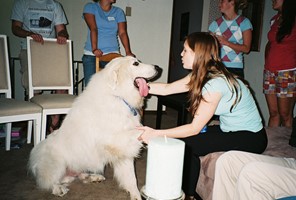 Yesterday we lost a beloved canine member of our family, my son’s dog Samson. He had been part of our clan for ten years.
Can it have been that long since I received the telephone call about Samson from the animal shelter in San Antonio, Texas? I learned that my son, a newly-minted second lieutenant in the Army, wanted to adopt a rescue dog, a malnourished Great Pyrenees named Samson. Problem was that the Lieutenant had no permanent home address yet because he was on a short assignment at the time. The shelter wanted someone to agree to take Samson in the event the Lieutenant could not care for him. Would I do that? What?
“May I speak to the Lieutenant, please?” I asked.
Of course, he talked me into committing to giving Samson a home if he could not. He told me young Samson had suffered abuse and was severely underweight. With a thick, white fur coat, he suffered mightily in the Texas heat. My son promised to nurse him back to health and take him to his permanent base at Fort Drum later in the year. Fort Drum, where the Army does winter training. A much better location for a dog like Samson.
The Lieutenant was as good as his word, and I never had to take Samson in to my home. With proper care, he regained his health.
The big dog thrived in cold upstate New York, and he romped happily in the huge backyard my son provided for him. Over the next years, Samson oversaw the growth of a family—first a wife, and then three children. He adapted to new surroundings when the family moved to Colorado. All the while, he offered wonderful companionship to his family and served as a faithful watchdog.
Then his hips began to fail. Samson could no longer make mud wallows in the yard or frisk about in the snow. The day came when he could not walk outside to relieve himself on his own. We knew the time was coming to say good-bye to our fluffy friend.
Now he has joined all the other gone-but-not-forgotten doggy members of our family—Timmy, Daisy, Eric, Sam, Thor, Skye, Sunny, Mac, and Bailey. We miss them all.
A CCC Record Sheds Some Light on the Family
 As a youngster, I heard that my Dad’s older brother, Owen Howell Reed, had served in the CCC (Civilian Conservation Corps) during the Great Depression. No one ever offered any details, and I did not think to ask. I was vaguely aware that the CCC was a
public work relief program that operated from 1933 to 1942 in the United States for unemployed, unmarried men from relief families as part of the New Deal. I knew nothing about where or how long my uncle served.
Some time ago, one of the genealogy newsletters that I read regularly contained an article about how to obtain CCC records from the National Archives. I recalled my uncle’s service and decided to learn more.
I submitted a search request on Form NA 14136 (02-14) to the National Archives at Saint Louis asking whether they had a personnel record for my uncle. I provided his birthdate, birthplace, parents’ names, and hometown at time of CCC employment. They soon replied to tell me they had the record I sought.
I sent in an Order for Archival Reproduction Services with my $70 payment (pretty steep!). Of course they processed my credit card payment right away, but the record never arrived. That was in March of this year.
After nearly three months had passed, I finally sent an e-mail message asking about it to the Archivist who had handled my request. She sent the record again, and this time I received it.
As I read the 12-page file, I enjoyed learning a bit more about my uncle’s life. The file also contained some new family information for me:
- It provided a physical description of my 17-year-old uncle in 1940—5’10” and only 125 pounds.
- It included the education levels achieved by his parents, my grandfather and grandmother. They had completed the 7th and 8th grades, respectively.
- It told me that my uncle had done Very Satisfactory work as an Assistant Education Advisor in Wellington, Colorado for 5 months after his high school graduation in 1940. He left on his 18th birthday to join the United States Army.
- I learned that my widowed grandmother had received a $22 per month allotment during the time of his service.
I know that times were hard for my Dad’s family during the Depression years. His father, the breadwinner, had died in 1935, and all the young boys had to work after that. A place in the CCC must have been a real blessing for the family. My Dad surely benefited from that monthly payment earned by his older brother. I am glad I ordered the record to find out more about this chapter of the Reed history.
A Key Sparks a Conversation
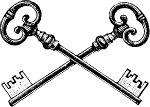 A few days ago, my young granddaughters made a discovery when they visited my house. They found my blacksmith’s iron key. They wanted to know what it was and why I had it.
Their curiosity presented me with a teachable moment and an opportunity to tell them a little about their family history. I explained that they come from a long line of blacksmiths in the Sherman branch of their family tree. My key reminds me of that although it does not unlock anything that I own. It serves as a paperweight.
I have not had it very long. Knowing my family history, my husband/tech advisor gave me the key and several richly-illustrated children’s books about blacksmiths for Christmas last year. Now I was happy to share some information about blacksmithing with the girls.
I explained that the key they found is a replica of antique keys once made by blacksmiths. They were amazed that common household items like farm tools, pots, locks, and keys used to be made, one at a time, by village blacksmiths, including their ancestors. As we discussed the role of a blacksmith in the community, they were relieved that today they have the luxury of visiting a dentist instead of needing the blacksmith to pull a bad tooth with the same tool he used to remove nails from a horse’s hoof.
The girls liked the photos of blacksmiths hammering hot metal at the anvil while wearing heat-resistant leather aprons. They learned new words like forge and smithy and bellows. One of girls recalled visiting a working blacksmith shop at the Littleton [CO] Historical Museum. Now the other granddaughter wants to see it, too.
Not bad for a spur-of-the-moment history lesson.