Archive for the ‘Genealogy’ Category
A DAR Invitation
 June 3rd, 2021 |
  Author:
  My mother used to tell me, “You should join the DAR. I can’t, but you can.”
As the grandchild of Scandinavian immigrants, perhaps Mom felt that membership in an organization that honors family lines extending back to the founding of the nation meant truly belonging to America. Or maybe it was just the cachet of it all.
I never took her advice.
In recent years, I have been reconsidering this decision. I learned from genealogy friends that one reason to join lineage societies like the DAR (Daughters of the American Revolution) is to preserve your research. A membership application must include a detailed direct line which they review and keep.
Last year I embraced this idea by applying to the General Society of Mayflower Descendants during the 400th anniversary year of the Mayflower landing. They accepted my documentation of my paternal grandmother’s lineage from passenger Stephen Hopkins.
Now the DAR has come calling. Colorado’s Mayflower historian contacted me this week to see whether I was interested in using this same lineage to join the DAR. She offered to do all the paperwork and submit it for me.
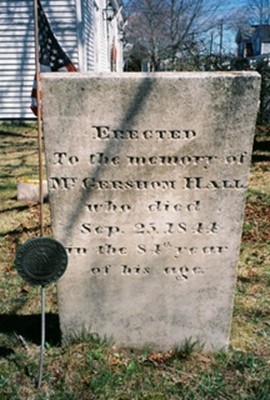
The patriot ancestor who would be my ticket in was Gershom Hall (1760-1844) of Harwich, Massachusetts. He was married to Lucy Snow (1760-1795) of my Mayflower line. They were my fourth great-grandparents.
I knew Gershom Hall had served in the Revolution. I have been to his gravesite in Harwich and seen its Revolutionary War medallion.
Gershom Hall was not my only Revolutionary War ancestor. Robert Kirkham (1745-ca1820) served in Kentucky at Boonesborough with Daniel Boone. John Day, Jr. (1760-1837) enlisted in Washington County, Virginia. Both these men were in my paternal grandfather’s line. Family members have joined the DAR based on both these records.
Since my Mayflower Society application preserves the information for my grandmother’s line, I had meant to join the DAR to preserve my grandfather’s information.
But this offer from the Colorado Mayflower historian is too good to pass up. I would need simply to send in a check. I could always file supplemental applications for my Kirkham and Day lines later, after I have time to gather all the information I need. Information that now sits unsorted in bins and folders.
Perhaps it is time to follow my mother’s advice about the DAR, take the easy route, and apply to join now. It could not hurt to have my grandmother’s genealogy on file at two places.
 Posted in
Commemorating Memorial Day
 Memorial Day, called Decoration Day before the 1960’s, is a federal holiday in the United States for honoring and mourning the military personnel who have died in the performance of their military duties while serving in the United States Armed Forces (Wikipedia).
My family has served in nearly every war this nation has fought. Most of the time, our soldiers and sailors returned home. Memorial Day gives me a day to honor those who did not.
I know of just two family members who died in the course of their military duties:
- Jas Robert Boyd (ca. 1845-1862) died from wounds received in the Civil War battle of Fort Donelson at Dover, Tennessee.
- George Riley Boyd (ca. 1843-1863) died a year later in the Vicksburg (Mississippi) campaign.
These brothers were Union soldiers. They were also my great-grandfather’s first cousins.
I think it is important that we continue this tradition of remembering our war dead.
I live far away from where the Boyds are buried and cannot visit their graves on Memorial Day. Instead, this weekend I will go to Fort Logan National Cemetery in Colorado and decorate the graves of family members who are buried there.
I can also attend a Memorial Day service in my community. The local American Legion and VFW posts hold these in several locations—the town cemetery, the WWII memorial, and the veterans monument.
Because of the Covid-19 virus, we did not have this opportunity last year. This year we again have a solemn occasion available for remembering people like the Boyds who gave up so much for their country. I plan to go.
Graduates
 Our eldest grandchild will be graduated from high school this weekend. Hurray for her!
She is not the first in our family to reach this milestone. The occasion made me think about who might have been our earliest high school graduate.
It was not me. I graduated at a time when nearly everyone did, and so did my parents.
My grandparents were a different matter, and only one of them completed high school:
- Martha Mattila (1906-1977). Martha was our first high school graduate. The child of Finnish immigrants who settled in Hibbing, MN, she finished high school, probably in 1924 or 1925. She then went on for two years of college, studying elementary education. She taught school off and on throughout her adult life in Minnesota, Montana, Wyoming, and South Dakota.
- Bjarne Bentsen (1906-1986). He finished the 8th grade at the country school near his parents’ farm in Montana. Because the high school was too far away, he pursued additional education by taking a correspondence course in electrical engineering. After a stint as a policeman, he became an electrician.
- Grace Riddle (1896-1976). Grace finished the 8th grade in her rural Nebraska community. I have her graduation certificate.
- Owen Herbert Reed (1896-1935). Herbert’s parents divorced when he was just 8 years old. Cousins tell me that schooling ended for the Reed children at that time, and all were put out to work. He did farm labor before becoming a railroad freight agent and later a truck driver.
In my family, then, my Finnish grandmother had the first high school diploma. This does not surprise me. The Nordic people valued education. Their societies were literate very early because they felt everyone should be able to read the Bible. They built community schools as soon as they could after they arrived in America.
My granddaughter does not know all of this about my family. Does she realize that as recently as 100 years ago, many young people did not attend high school? Graduation is routine for her, something everyone does.
In two days, she will walk across the stage in her cap and gown. Due to the current pandemic, I will not be there to watch her receive her diploma. At home, I will celebrate the day with gladness that she has an opportunity that those before her did not.
Benjamin Dunbar, Town Citizen
 This week I continued my review of Chatham, Massachusetts records on Family Search (www.familysearch.org). My Dunbar family lived at Chatham during the early 1800’s.
I looked at two record sets:
- Selectman’s Town Records for the period 1804-1854. These pages list tax payments collected from residents each year, but oddly, my ancestor Benjamin E. Dunbar’s name never appears. I do not know what the criteria were for owing this tax. Benjamin must not have met the threshold.
- Town Meeting minutes. I have found that Benjamin was appointed to do his part to keep the town running several times over the years. He served on the Grand Jury, served on a committee to oversee eel and shell fishing, and served as Constable.
Other people appeared in these records much more often than Benjamin did. His wife’s uncle, Capt. Benjamin Buck, often served on committees or as Constable. He also oversaw the collection of supplies for benefit of the clergy.
Reading these records helped me learn about the town life my ancestors experienced. I found that some themes in human life never change.
The townspeople complained about outsiders fishing in their waterways. They disliked their church minister and convinced him to resign. They created a system to prevent the youth from misbehaving. They looked for new ways to raise revenue. They feared hardship as the War of 1812 loomed.
It will take more time for me to complete the task of reading the Town minutes. I began with the year 1794, when Benjamin Dunbar turned 18. I am now reading the pages for 1814. Benjamin would live in Chatham until 1831, so I still have a way to go.
Benjamin’s Life
 How can you learn about the lives of your ancestors if they did not leave behind letters or diaries?
Perhaps you cannot know the minutiae of their daily activities, but you can find out more than you might think. Newspapers and local histories are good sources.
As I try to learn about the life of my third great-grandfather, Benjamin E. Dunbar (1776-1831), I spent some time this week searching for Massachusetts records that might tell me more about him.
The Family Search website (www.familysearch.org) allows for searches by locale. I went to the list of records for Chatham, Massachusetts where Benjamin spent most of his adult life.
I made a list of all the Chatham records that Family Search has available online. Then I worked my way down the list, viewing each item.
I found some interesting information in a town history of Chatham:
- The Methodist denomination started to take root in the Chatham area about 1795, near the time Benjamin arrived there. Benjamin’s name appeared on a list of Methodists in the 1820’s.
- The saltworks industry appeared at Chatham around 1800. Benjamin operated a saltworks. He must have been taking advantage of an opportunity in a new and growing industry.
- The War of 1812 posed a real threat to the people of Chatham. British war vessels patrolled the coast, and the residents could not go out to fish. Benjamin served in the Massachusetts militia, and the war would have affected his daily life in several ways—food supply, military service.
A history written for the 200th anniversary of Chatham’s Congregational Church in 1920 did not mention Benjamin, but it did give me an unexpected glimpse into the life of an even earlier ancestor, Gershom Hall (d. 1732). He was the third great-grandfather of Benjamin Dunbar’s wife, Rhoda Hall (1784-1850). Gershom lived at Harwich, a town bordering Chatham. I knew he was a lay preacher.
From the church history, I learned that Gershom was called twice to serve the congregation at Chatham. Their pastor drowned in a fishing accident in 1702 so Gershom was asked to fill in. He served for several years, until 1706, when the congregation finally attracted another trained minister. A few years later, when the pulpit was vacant again, the Chatham congregation requested Gershom Hall to return. He served from 1716-18. They must have liked him.
I have a few more sources to look at on the Family Search site. Perhaps I can find more about the times during which the Dunbars lived at Chatham. When Benjamin himself left few records, these histories can help me draw some conclusions about his life.
I Want To Learn More
 Benjamin E. Dunbar (1776-1831) was my third great-grandfather. He spent most of his life in Massachusetts but relocated to Ohio shortly before he died.
More than twenty years ago, a spent a great deal of time researching his life. During those years I had the good fortune to collaborate with other genealogists who shared an interest in the Dunbar line.
Those relatives, my third cousins Ruby Prestly and Jayme Anderson, have since passed away. After their deaths, I focused on other ancestors.
This year I decided to revisit the Dunbar research. With all the databases available now, I hope I can learn more about Benjamin Dunbar’s life and family.
As good genealogists do, I must begin by reviewing documents I already have:
- Halifax, MA birth record for Benjamin Dunbar, son of Benjamin and Hannah, 1776.
- Chatham, MA land purchase, Fear (Dunbar) and John Ryder to Benjamin Dunbar, 1805.
- Chatham, MA marriage intention and marriage record, Benjamin Dunbar to Rhoda Hall, 1805.
- U. S. census records for Benjamin Dunbar’s household in 1810, 1820, and 1830.
- Chatham, MA birth registrations (1806-1827) for all but one of the children of Benjamin Dunbar and Rhoda Hall.
- War of 1812 service record for Benjamin Dunbar of Chatham, MA.
- History of Barnstable County by Simeon L. Deyo (1890) describing Benjamin Dunbar’s salt works.
- Chatham Town Records of Benjamin E. Dunbar registering as a Methodist (1824) and being appointed Constable (1828).
- Benjamin E. Dunbar FindAGrave memorial for Stow Cemetery, Stow, Ohio.
- Benjamin E. Dunbar probate file, Portage County, Ohio.
I seem to recall that I had another document pertaining to the disposal of Benjamin’s property in Massachusetts, but I cannot find it.
A close look at all these papers may reveal information I overlooked before. Even if it does not, it offers me a chance to re-familiarize myself with Benjamin’s life.
Once I do that, I can devise a research plan to look for more details. I have a several questions:
- Who was Benjamin’s mother? His birth record says simply “Hannah”. Was she Hannah Hathaway, as alleged in The Descendants of Robert Dunbar of Hingham, Massachusetts by Ann Theopold Chaplin (1992)? Or was she the Hannah Latham claimed on several online trees?
- Did Benjamin’s mother remarry after his father died (bef. 1779 when Benjamin and his brother Hosea were just toddlers)? If so, did Benjamin have half-siblings?
- Where was Benjamin Dunbar’s youngest daughter Laura Ann Dunbar born?
- Where in Chatham was the salt works located, and who were the neighbors?
- Was Benjamin a sea captain? When I visited the museum in Chatham years ago, I spoke with a man who claimed that he was.
More information about Benjamin E. Dunbar begs to be discovered.
The Dunbars of Chatham
 My ancestor Benjamin E. Dunbar (1776-1831) married Rhoda Hall (1784-1850) at Chatham, MA in 1805. I do not believe he was a native of Chatham.
According to our family history, The Descendants of Robert Dunbar of Hingham, Massachusetts by Ann Theopold Chaplin, he was born at Halifax in Plymouth County to Benjamin Dunbar and Hannah Hathaway. Other researchers disagree, saying his mother was Hannah Latham.
Regardless of his parentage, my Benjamin appeared in Chatham about the time he married Rhoda. Do the Chatham records contain any clues to the identity of his people?
Benjamin purchased Chatham land shortly before his marriage. The sellers were John Ryder and his wife Fear Dunbar.
I wondered if Benjamin was closely related to Fear. Perhaps this was a family transaction.
All the Massachusetts Dunbars descend from Robert Dunbar, so I decided to investigate the degree of kinship between Benjamin and Fear.
Using the family history mentioned above and the resources available on the American Ancestors database (www.americanancestors.com), I learned that the lineage split early, and the two descended from separate sons of Robert. My Benjamin’s line was through Joseph Dunbar (1661/2-1725). Fear descended from a different child. They would have been distant cousins.
Nothing in the land transaction tells me that they knew one another before this sale. Perhaps a conveyance from one Dunbar to another was no more than a coincidence.
I might be tempted to dismiss it as such but for one more interesting piece of evidence. John Ryder, the husband of Fear Dunbar, had a great-aunt named Eunice Ryder Nickerson. Eunice left a will in 1808 wherein she named numerous legatees. John Ryder was one. Benjamin Dunbar was another.
Was this Benjamin the same man as my Benjamin? If so, he must have had some relationship to Fear and the Ryder family. I must investigate the associates of the Ryder family in my quest to document the family of Benjamin E. Dunbar.
Perhaps I will learn that two Benjamin Dunbars were living in 1808. Or maybe, If I am lucky, there was only one. In that case, I will be a step closer to finding my Benjamin’s true roots.
The Side-lined Genealogist
 This family historian was laid low by Covid-19 this week. No, not the virus. The vaccine.
I received my second dose of the Moderna shot on Monday. Within 12 hours, I had fever, headache, and fatigue.
The next day I slept most of the time and had no appetite.
The following day, I got out of bed but still had little energy. I ate sparingly and began to feel better as the day went on.
By the third day I seemed more like myself. I felt grateful to have experienced only vaccine side effects rather than the full-blown virus.
Covid-19 has taken so much from us over the past year. Perhaps the symptoms I experienced were a minimal price to pay for protection.
Today, I am back at the genealogy desk.
Kansas Settlers
 The State of Kansas beckoned several of my relatives during the nineteenth century.
Long ago I learned that my dad’s paternal aunt Bertha Evaline Reed (1884-1981) was born in Harper County, Kansas. Her father Samuel Harvey Reed (1845-1928) possessed what the family referred to as “that Reed wanderlust”, and he had taken his new bride to Kansas shortly after they married in Illinois.
Only recently did I discover that some of my dad’s maternal family also settled in Kansas. Two of my grandmother’s great-aunts spent time in the Sunflower state:
- Susannah H. Dunbar (1819-1900), her husband Joel Cutting (1816-1886), and their son Dewitt (1840-1920) left Michigan and settled in Cloud County, Kansas in the early 1870’s. Joel had a sister living there. After Joel died, Susannah proved up their homestead before she and Dewitt moved back east to Akron, Ohio near the town where she had grown up.
- Laura Ann Dunbar (1829-1899) and her husband Hoxie Fuller (1826-1903) eventually followed the Cuttings to Cloud County sometime after 1880. They lived out their lives in the Miltonvale area and are buried there.
No descendants remain in Kansas today. The Reeds moved on to Missouri shortly after their daughter Bertha was born. The Cuttings also left the state. Although the Fullers remained in Kansas, they had no children.
I have not visited the spots in Kansas where my family lived. Perhaps one day I will stop to take a look at the rural communities that drew my family 150 years ago. Kansas is not so far from where I live in Colorado.
Times must have been hard in the states my people left behind. These folks were all in their 40’s and 50’s when they sought new opportunities in Kansas. Yet the Reeds and the Cuttings did not find a permanent home there. Kansas pulled them into a new life for a time, but it did not last forever for them.
The Dunbars: An Unexpectedly Small Family
 If you were an early 19th-century couple with twelve children, how many grandchildren would you expect to have? In 1850, the average household had 6-9 children.
Would it have been reasonable, then, to anticipate around 60 grandchildren?
Not if you were my ancestors Rhoda Hall (1784-1850) and Benjamin E. Dunbar (1776-1831). Their family in Stow, Ohio imploded.
I have spent many hours this year tracing their children and grandchildren. The children fall into two groups: those with children and those without.
The Childless Dunbars
- Saphronia (1806-1849). She married George Tiffany in 1832 but they had no family. She left her entire estate to him.
- Rhoday (1807-bef. 1810). This daughter died in childhood.
- Daniel H. (1809-?). I am not sure Daniel belongs in this group. He disappears from the record after a land sale in 1843. No marriage or death records for him have been found.
- Benjamin S. (1812-aft. 1880). He married Lucy Jaquays in 1846, but they split after a short marriage and no children. He never married again.
- Moses W. (1814-1906). A mariner based in Cleveland, he married twice. He had no children with either wife, Mary Ann Sellers or Mary Jones.
- Lucy S. (1827-1899). She married her sister Saphronia’s widower, George Tiffany, in 1853. After his death in 1869, she married George Monk. Both marriages were childless. A niece, Lucy S. Sessions, was named after her.
- Laura A. (1829-1899). In 1852 she married Hoxie Fuller. They had no children, but her sister Olive named two children for the couple: Laura Ruamy Riddle and John Hoxey Riddle.
Dunbars with Children
- Rhoda A. (1811-1879). She married William Burnham in 1846. They had one son, Leander Burnham.
- Rebecca W. (1817-1873). She never married, but her brother Benjamin lived with her after he separated from his wife. Rebecca and Benjamin raised a child, Mahala Dunbar. I surmise that Mahala was Rebecca’s daughter.
- Susannah H. (1819-1900). She married Joel Cutting in 1838. This couple had three children, Dewitt, Mary Edna, and Clara.
- Hannah S. (1821-1890). After their marriage in 1843, Hannah and her husband, John Sessions, also had three children, Violetta, Samuel, and Lucy S.
- Olive H. (1823-1902). She and her husband, John Davis Riddle, were my ancestors, and they had the largest family with 8 children: Tamson, Theodocia, Isaac, Ethan, Laura, John, Seymour, and Olive Riddle.
Of the twelve children born to Rhoda and Benjamin Dunbar, then, only one (my great-great grandmother Olive) had an average mid-19th century size family. The Dunbars had just 16 grandchildren.
I cannot account for why the six siblings who reached adulthood and married would have had no children. Because this group included all three sons, the Dunbar name daughtered out.
Of those sixteen grandchildren, nearly half repeated the pattern of remaining childless: Leander Burnham, Mary Edna Cutting, Clara Cutting, Violetta Sessions, Lucy S. Sessions, Isaac Riddle, and Seymour Riddle. The number of Dunbar descendants remained small into the twentieth century. It grew somewhat once great-grandchildren began to arrive.
I have no explanation for this unusual family pattern. Most couples during this time period had many more children than the Dunbars did. Were there health problems? I will never know.
I am ready to move back a generation and investigate the family of the patriarch, Benjamin E. Dunbar. How many siblings did he have? Did they leave descendants? Or will I find another round of small and non-existent families?