Author Archive
52 Ancestors in 52 Weeks, no. 31—Thomas Reed (1783-1852)
 September 11th, 2016 |
  Author:
  Thomas Reed was my paternal 3rd great-grandfather. He was born in one place, raised in another, and lived his adult life in yet a third locality.
According to family records, Thomas arrived perhaps on the 18th of December, 1783 in Fayette County, Pennsylvania. His father was Caleb Reed, and his mother may have been Rebecca Carr. Thomas’ actual birthdate remains uncertain because his cemetery marker in the Reed family cemetery provides the calculation for a different date. It states that he died on 21 December 1852 at the age of 70 years, 11 months, and 23 days. This information means he would have been born 29 Jan 1781. So far I have no explanation for the difference in proposed birth years, nor do I know which, 1783 or 1781, is more likely correct.
In either case, Thomas came into the world during the close of the Revolutionary War era. The family lived on the fluid border between Pennsylvania and then-Virginia, now West Virginia. His uncle Joshua Reed served in the Virginia militia during that conflict. As with all American families at the time, the Reeds were affected by the war.
At some point, the Reeds relocated to Kentucky, near Louisville. Thomas married Ann Kirkham in Nelson County, Kentucky on 24 November 1806. The couple settled onto a place in Spencer County and had a family of five children:
- Robertson Mitchell Reed (1808-1871)
- Eliza Reed (1810-1886)
- Jane Reed (1817-1899)
- Joseph Caleb Reed (1818-1903), my great-great grandfather
- William Reed (1822-1845)
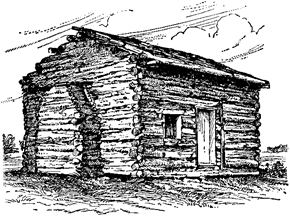
In 1829, Thomas and Ann made the decision to move on to new lands opening up for settlement in Illinois. They left Kentucky on December 1, their son Caleb’s 11th birthday, and headed for southeastern Illinois, near the Indiana border. With a 6-horse team, the journey took nearly a month. They stopped in Edgar County, Illinois for a few days, and they liked the Grandview area very much. However, the “milk sickness” malady was rumored to be common there, so they went further west into Coles County. They settled about a mile and a half northeast of the village of Ashmore where Thomas entered a tract of land. Among his Coles County neighbors was Thomas Lincoln, father of the future President.
Once settled in, Thomas Reed went walking one day with his neighbor, Daniel McAlister. They stopped at a particularly beautiful spot and decided it would make a lovely place for a burial ground. They set it aside as the Reed-McAlister Cemetery. Both would be buried there someday.
In 1832, Thomas’ father Caleb, who had also left Kentucky and moved on to Indiana, passed away. Thomas received his timepiece.
Thomas and Ann worked to build up their farm and raise their family in Illinois. Thomas was known as a quiet and industrious man, and at one time he farmed nearly a thousand acres. It was about half prairie and half woodland with streams of water flowing through most of it.
Politically, Thomas was a strong Whig, but he never sought public office. Farming took all his time.
Thomas passed away on 21 Dec 1852 and was buried in the family cemetery in Coles, County, Illinois. He died intestate, and his farm was divided into four parts. Each surviving child received a share, but the daughters sold theirs to the sons, with Robertson, the eldest, receiving a larger share. Thomas’ daughter Eliza’s husband James Walton served as Personal Representative.
Thomas Reed became the patriarch of a large Reed clan in Coles County, Illinois. Descendants live and farm there to the present day. Thomas chose a good place to settle down.
 Posted in
In Memory of Mary Ann
 For the fifth time this year, we have lost a family member. It has been a bad year.
Mary Ann was my daughter-in-law’s beloved grandmother, 83 years old. She lived miles away in Oklahoma, but she stayed closely in touch with her grandchildren. They spoke on the phone often, and the younger generation regularly received care packages from their grandma. They visited back and forth, too.
Mary Ann was one of the friendliest and most generous people I have known. She paid for preschool for her great-grandchildren as long as they attended a church-affiliated one.
A week ago, she missed her usual Sunday morning church service. Her fellow parishioners became concerned and sent someone to check. Of course they soon found that she would not be attending church with them anymore.
Today I will attend a memorial service for her here in Colorado, her long-time home before she retired in Oklahoma. It’s too bad she cannot be there in person to greet all of us. She would have loved a large family gathering. She and Charlie probably will watch from above.
Mary Ann, fondly remembered, sadly missed.
52 Ancestors in 52 Weeks, nos. 29 & 30—Matti Lampinen (b. 1835) and Anna Miettinen (b.1832)
Karelia
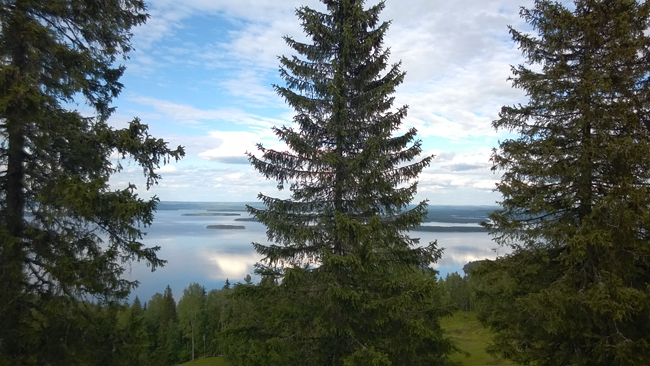
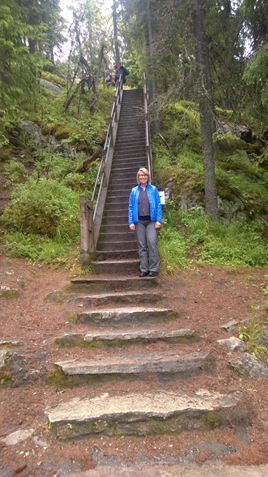 The Lampinen family lived in the area of the present-day Koli National Park in eastern Finland. The park lies west of Lake Pielinen, the fourth-largest in Finland, in the sub-region known as Karelia. Here the gorgeous forest landscape near the lake includes rock outcroppings intermingled with lush groves of spruce, birch, and other trees. The undergrowth is rich in mushrooms and berries. Wolverine, lynx, bear, and beaver abound.
People have lived in the Koli area since before Christianity. It had been a center of pre-Christian religion. The highest point above the lake is still known as the Temple of Silence. The cave formations in the nearby rocks were thought to house wizards and witches.
The Karelians consider themselves the true Finns, uncorrupted by Swedish intermarriage and Germanic influence. Unlike many other Finns, they are lively and talkative. Historically, they ate a distinctive diet marked with local fish and game, often made into pasties.

Karelia, especially the Koli area, became a vacation destination for hikers and skiers in the 19th century. Others, including Finland’s great composer Jean Sibelius, came to enjoy the local folklore and the traditional culture. By the time these visitors discovered Koli, the Lampinen family had lived there for a long time.
In the 1830’s they ived in the tiny Karelian village of Nunnanlaks on the western shore of Lake Pielinen. There Valborg Johansdotter Ruottin (1808-after 1860) gave birth to her son Matti Lampinen on 27 September 1835.
She and her husband Henric Mårtensson Lambin (1806-1837) had him baptized in the Juuka parish on 25 October 1835. At this time, spelling and naming patterns had not become standardized, so we see the family name in the records in several iterations, including Lambin, Lampin, Lambinen, and Lampinen. Karelians were early adopters of surnames because they moved around a lot.
Little Matti joined an older brother, Henric, who had been born on 8 August 1832 in the same village. They probably lived in a log house decorated with carvings, but those houses no longer remain. Today Nunnanlaks is known for its soapstone mine.
The boys were born into an ancient swidden, or slash-and-burn culture. Crofters like their father lived by cultivating clearings in the forest. They felled and burned broad-leaf trees, especially birch, in 10-to-30-year intervals. This created a patchwork landscape of varied woodland habitat around settlements.
In the second year, crofters planted turnips, sowed by spitting the seeds. They stored these and other root crops like carrots and rutabaga in cellars dug in the ground.
The third year, they could plant grains such as oats, flax, buckwheat, and rye. They built traditional pole fences to protect these crop fields from livestock. In the fall, they harvested the crops by hand, with a sickle, and then threshed them in a barn.
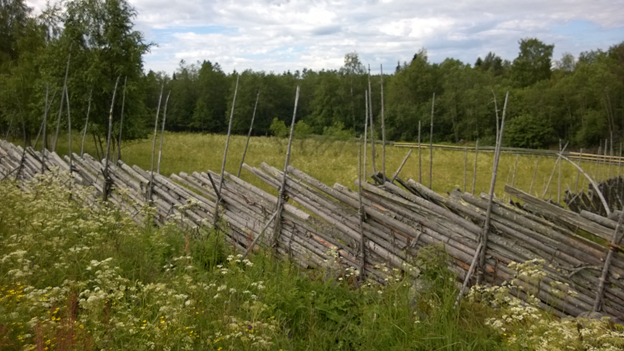 A traditional Finnish fence
Once the soil became depleted, they began the swidden cycle again in a new location. As young trees began to grow back, they grazed livestock in the sparse, well-lit forest. They often acquired a pig around midsummer to fatten up for Christmas.
The little Lampinen family did not stay long at Nunnanlaks. By early 1837, when Matti was just over a year old, they had moved on to an inland village, Kuhnusta. That year, the elder Henric contracted typhoid fever and died on 10 February 1837 at the age of thirty. It is unlikely that Matti would have had any memories of his father.
His mother remarried the next year. Valborg Ruottin and Christer Mårtensson Karjalain were wed in Juuka parish on 1 September 1838. Their son Eric, Matti’s half-brother, was born on 29 April 1839 at Nunnanlaks. He was followed by a half-sister named Christina on 24 September 1841.
By 1842, this family, too, had located in Kuhnusta. There, tragedy struck again, and on 2 June 1842 Christer Karjalain died at age 31 from a heart attack. Seven-year-old Matti was fatherless for the second time.
It seems Valborg waited several years to marry a third time. When Matti and Henric were 14 and 17, their mother and Anders Rompanen married. Again in the Juuka parish, the wedding occurred on 14 April 1850. During the following decade, Valborg and Anders lived sometimes at Kuhnusta and sometimes at Nunnanlaks.
Also during the 1850’s Matti courted a young woman from the neighboring village of Halivaara. Anna Miettinen was three years older than Matti. Her parents were Henric Henricson Miettinen (c.1804-1836) of Halivaara and Anna Andersdotter Toivain (1802-after1858) of Kajo.
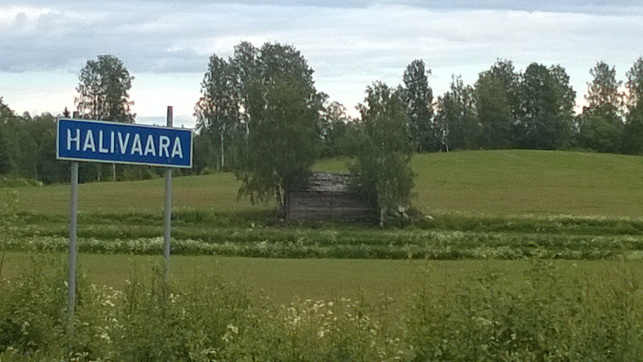
Anna Miettinen’s parents had married in Juuka parish on 27 December 1819, and they had seven children, all born at Halivaara:
- Carin, born 30 June 1821,
- Henric, born 3 August 1823,
- Christina, born 9 November 1827,
- Margret, born 17 September 1829,
- Johan, born 17 February 1830,
- Anna, born 5 February 1832,
- Brita, born 7 August 1835.
Like Matti, Anna lost her father at an early age. Henric Miettinen died of a fever at age 32 at Halivaara on 22 October 1836, when Anna was four years old. No more is known of Anna’s mother Anna Toivain. She was still living at age 55 when she attended a kinkeri or catechism meeting in Juuka parish in 1857.
Matti Lampinen and Anna Miettinen were married in Juuka parish on 7 December 1856. As his father had, Matti worked as a cottager, or tenant farmer.
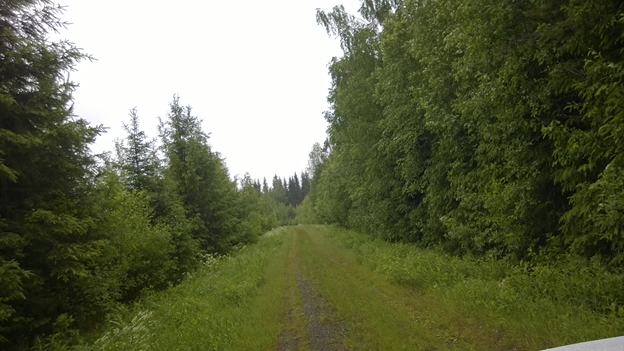 Forest near Nunnanlaks and Kuhnusta
They lived sometimes at Nunnanlaks and sometimes at Kuhnusta, and they had the typically large Finnish family of twelve children:
- Henric, born at Nunnanlaks on 14 July 1857,
- Anna Valborg, born at Kuhnusta on 2 May 1859,
- Eva Stina, born at Kuhnusta on 26 March 1861,
- Hendrika, born at Nunnanlaks on 27 November 1862,
- Matts, born at Nunnanlaks on 9 May 1864,
- Alexander, born at Nunnanlaks on 1 April 1866,
- Adam, born at Nunnanlaks on 1 April 1868,
- Alexis, born at Nunnanlaks on 2 August 1868,
- Mathias, born at Nunnanlaks on 7 December 1870,
- Lovisa, born at Nunnanlaks on 11 March 1873,
- Anders, born at Nunnanlaks on 6 December 1876,
- Ada Alina, born at Nunnanlaks on 25 September 1879.
We do not know how long Matti and Anna lived because the available records end in 1880, the year after Ada Alina was born. Presumably, they lived out their lives in Juuka parish and were buried there.
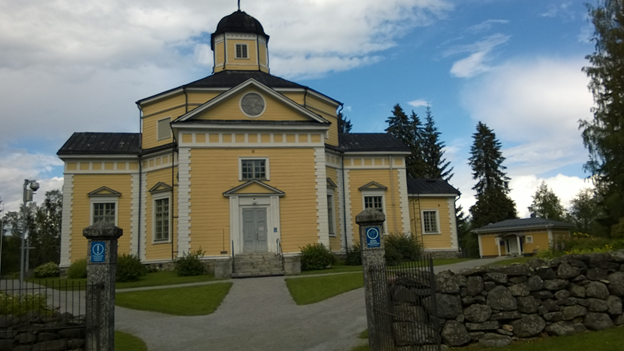 Juuka church
During their lifetime, the Koli area began to attract big names in Finnish art. Painters like Eero Järnefelt and composers like Jean Sibelius returned year after year for inspiration. Järnefelt painted the internationally-known An Autumn Scene on Lake Pielisjärvi in 1899, and Sibelius composed his fourth symphony (“Koli”) in 1909 after a trip there. The Koli National Park was eventually founded in 1991. Today, the entire area where Matti and Anna Lampinen lived is a beautiful park enjoyed by all the Finns.
Floundering in Indiana
 My Sherman family lived in Indiana during the 1860’s, mostly in Johnson County. I have a little information about them at that time but not enough. Big events occurred in the family during that decade, events for which I have no proof or documentation:
- My ancestor Thomas Sherman (1841-1912) is said to have married a German girl named Katherine sometime during the Civil War. They had a daughter, Anna Petronellia, born 1 April 1865 near Indianapolis. The wife died shortly thereafter. I have found no proof of this marriage in Indiana civil or church records. I have found no grave for Katherine. Her reported maiden name, Stillenbaugh, does not appear in the modern-day German phone book, so I suspect this name has been corrupted by the family through the years.
- Thomas and several family members had relocated to Indiana from Kentucky in the early 1860’s. His father Daniel sold land in Madison County, Kentucky in 1863. Daniel disappeared from the record after that. I have not found a grave or any other information about him in Indiana or elsewhere after the land sale. His wife Rebecca was a widow by 1870.
- Some of Thomas’ descendants claim he served the Union during the Civil War, enlisting at Louisville, KY. I have not found a service record for him from Kentucky or Indiana.
Over the years I have searched every Indiana record I can find in an effort to learn about Thomas’ first marriage and his Civil War service. I have looked for information on the death of Daniel Sherman which must have occurred during the same time period. Nothing.
I have heavily researched most of the children in the family in an effort to shed light on the lives of Thomas and Daniel. I have a couple of people to go—sisters, Polly, Emily, and Elizabeth. As we all know, searching women’s lives presents quite a challenge. Yet this is the only avenue I have left in my effort to uncover information in the Sherman men in my direct line during the 1860’s.
52 Ancestors in 52 Weeks nos. 25 & 26—Antti Abelsson Mattila (1826-1882) and Elisabeth Myllynen (1836-a. 1908)
Born on 4 November 1826, Antti Mattila lived during the years when Finland retained a strong legacy of the Swedish language in both spoken use and record-keeping. Hence, in the records we sometimes find him called by his Finnish name, Antti, and sometimes by his Swedish name, Anders. The English version of this name is Andrew.
He must have been named for his grandfather because his father’s name was Abel Andersson (c. 1798-1852). The Andersson patronymic means son of Anders. Abel was Anders’ son, so Antti (Anders) was Anders’ grandson. Antti’s mother was Greta Caspersdotter (c. 1798-?). Families at the time had no surnames, and women kept their own names after marriage. During Antti’s life, however, the idea of surnames began to catch on, and his father increasingly became known as Abel Andersson Mattila.
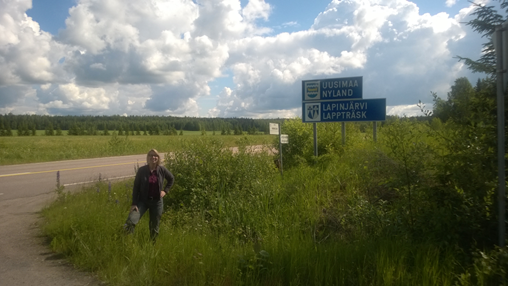 The family lived in the south of Finland, in the Uusimaa province where Helsinki is the capital.
Antti was baptized in the Lapinjärvi parish northeast of Helsinki when he was three days old, on 7 November 1826. He had an older sister Eva (b. 1824) and at least three younger siblings: Abel (b.1829), Anna (b. 1832), and Johannes (b. 1842).
At the time of his birth, Antti’s family lived on the Kimoböle farm. The family remained in the Lapinjärvi parish, and Antti’s father died there in 1852 from a heart attack at age fifty-four. Until modern times, heart disease has been a leading cause of early death in Finland.
Although he was the oldest son, Antti left the family home. At some point he made his way east to the area of Viipuri, Finland’s second-largest city at the time. Perhaps he was lured there by the prospect of work on the Saimaa Canal being built between Lake Saimaa and Viipuri in the 1850’s.
On the Saimaa Canal boat:
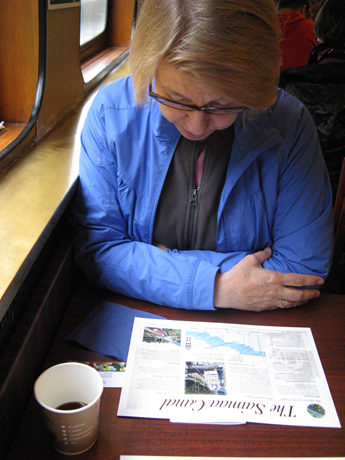
Eventually, he met a young woman, Elisabeth Myllynen, whom he married on 16 August 1863 in the Viipuri rural parish. She was the daughter of Simon Mattson Myllynen (1810-1857) and Sofia Henriksdotter Ampuja (c. 1812-?). Elisabeth, or Liisa, was a native of the area having been born on the Tervajärvi farm on 25 April 1836 and baptized in the rural parish on 8 May 1836.
Elisabeth was part of a large family of approximately seven boys and three girls. Elisabeth was several years older than her sisters Helena (b. 1841) and Regina (b.1844). The number of brothers in the family is unclear from the existing records, but they seem to include the following:
- Matthias (b. 1834)
- Henric (b. 1838) probably died young
- Henric (b. 1841)
- Philip (b. 1847) probably died young
- Adam (b. 1849) probably died young
- Filip (b. 1851)
- Adam (b. 1851)
The second Filip and Adam, although born the same year, were not twins. The family seemed to re-use well-liked names if a child died. This was common practice.
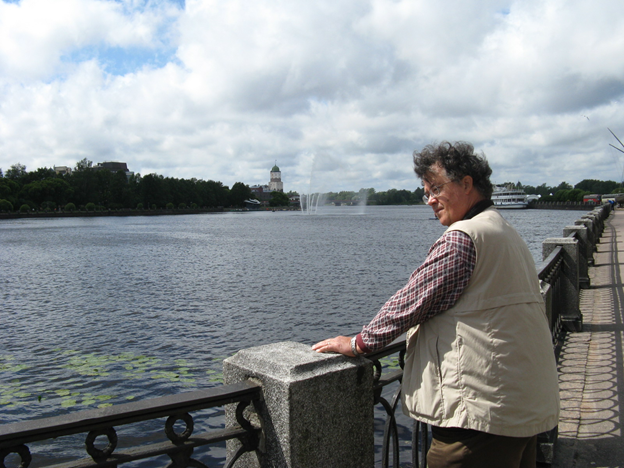
Antti and Elisabeth did not settle near her family on the Tervajärvi farm. Instead they went southwest of Viipuri and settled in a coastal village. Not far from the city, they may have been able to see the ancient castle built there by the Swedes in the 1200’s.
Husband/Tech Advisor with Viipuri castle in the background:
Antii worked as a steward, and they began their family. They had eight daughters and a son:
- Karolina, born 10 September 1863 at Horttana and baptized 20 September 1863. She was confirmed in 1878 in the Viipuri rural parish, but nothing more is known of her. She may have been one of the sisters purported to have married a Russian soldier.
- Eva Emilia, born 7 November 1864 at Hortanna and baptized 13 November 1864. She, too, was confirmed in the Viipuri rural parish in 1879 and may also have married a Russian soldier.
- Helena, born 20 May 1868 at Korpela Autio and baptized 28 May 1868 in the rural parish. She died from tuberculosis in 1884 at age 15 in Hortanna.
- Anna, born 23 May 1866 at Hortanna and baptized 1 June 1866 in the rural parish. Shortly after her father’s death, Anna moved out of the Viipuri area at the age of 17 and relocated to the coastal city of Kotka. A couple of years later she married Charles Anderson. They emigrated to the United States and first settled in Eveleth, Minnesota. When Anna and Charles had no children of their own, they adopted Charles and Helen Mais in the early 1900’s. Charles Anderson died between 1910 and 1920, but Anna lived another 30 years. She migrated to Hibbing, Minnesota where she was a member of the Finnish Temperance Society. She must have taken this seriously because her great-niece Joyce Bentsen Reed recalled that Mrs. Anderson strongly disapproved of liquor. She even left her niece Aida Mattila’s wedding reception in a fit of pique when she learned that her brother Alex was serving alcohol. Anna died in Hibbing on 28 April 1947 at the age of 80.
- Sofia, born 7 April 1870 at Korpela Autio and baptized in the rural parish on 1 May 1870. There she married Kalle Ville Ripatti on 15 November 1896. They had three children, Rosa Wilhelmina, Olga Alina, and Juhana Aleksander between 1896 and 1898. A few months after Juhana’s birth, Sofia’s 23-year-old husband Kalle drowned at Kolikkoinmaki (an eastern suburb of Viipuri) on 12 October 1899. Sofia’s life as a young widow after this tragic event is unknown. Her daughter Rosa eventually emigrated to America about 1913, and she too settled in the Hibbing area. She married Waino Porras and they had one son, Arthur, in 1919. Rosa died of pneumonia in 1941 at the age of 44 in Hibbing. According to family lore, she had been found nearly frozen in a snow bank before her death.
- Ida Marie, born 15 July 1872 at Korpela Autio and baptized in the rural parish on 29 July 1872. She married Juhana Mattsson there on 9 November 1890. For the next ten years they lived near Viipuri and had five children. After that, Juhana disappears from the record and Ida relocated to Kotka. In 1908, her brother-in-law Charles Anderson returned to Finland to accompany her and her surviving children to the United States. They traveled under the Mattson surname on the S.S. Republic and landed in Boston. Her travel documents describe her as 5’3″ tall with blond hair and blue eyes. Upon their arrival, Ida purportedly married a man named Sam Parks, and they settled on Minnesota’s Iron Range in Biwabik in about 1909. Together, she and he had one child, and her other children assumed the Parks surname. Sam Parks disappears from the record after the birth of their daughter. Ida’s life was cut short by stomach cancer a few years later in 1917. She died in Biwabik at the age of forty-five. Her children included:
- Elsa (1892-b. 1978) born in Finland; married Edward Glass and remained in Minnesota,
- Alice (about 1893-b. 1978) born in Finland; married William Goldsworthy and settled in Wayne County, Michigan,
- Aleksander—born in Finland, and died at two months of age in 1894,
- Yrgo (George) (about 1896-b. 1978) born in Finland,
- Martha (1900-2000) born in Finland; married (1) Joseph Hendrickson, (2) Ray Hyzer and lived in Berkeley, California,
- Bertha Ethel (1910-1986) married Eliot Haberlitz; settled in Santa Barbara, CA.
- Olga, born 20 January 1874 at Horttana and baptized in the rural parish on 1 February 1874. Olga continued to live in the Viipuri area until she was twenty-seven years old. In 1901 she moved to Kotka. Her older sister Anna Anderson returned to Finland that same year to accompany her to the United States. Three years later in 1904, Olga married Oskar Silberg in Duluth, Minnesota. They settled in Superior, Wisconsin and had one son named Alex (1906-1989). Oskar died of gangrene incurred from a shipyard accident in 1935. Olga lived almost 35 years in widowhood until she died of pneumonia at the age of ninety-five in 1969.
- Auna Elisabeth, born 23 January 1876 at Alasommes and baptized in the rural parish on 5 June 1876. Auna lived a short life of just two years, dying of croup on 22 June 1878.
-
Alexander, the only son, born about the ninth of May, probably 1878. The records conflict as to the exact date, but his baptism was recorded in the Viipuri rural parish on the 12th of May, 1878.
After the births of eight daughters, we can only imagine how Antti Mattila and Elisabeth Myllynen felt upon the safe arrival of their only son Alex. Unfortunately, Antti did not have long to live to enjoy his little boy. He died at age 55 when Alex was just four years old.
According to family lore, Antti drowned at sea. The church records, however, do not confirm this story. They state that he died of tuberculosis on 27 April 1882. He was buried in the Viipuri rural parish a few days later, on 2 May 1882. He was not the only one in the family with this terrible disease; his daughter Helena would die from it a couple of years later.
So why the story of a drowning? Perhaps American family members confused this death with the drowning of Sofia’s husband Kalle Ripatti. Both traumatic events occurred long ago in faraway Finland, and it would be easy to mix up the details.
After Antti’s death, Elisabeth cared for her younger children and made her living laying out the dead. Alex often accompanied her.
She probably lived a long life. Twentieth century Finnish records are closed, so we cannot locate a death date for her. We do know she was living at least as late as 1908 when she would have been seventy-two. That year her daughter Ida listed her as next-of-kin when she sailed for America.
Divorce Not Found
 As I have worked on my Sherman line, I have spent a lot of time chasing down my ancestor Thomas Sherman’s elder brother, Anderson (1832-1910). Because of difficulty in researching such a common surname as Sherman, which the brothers shared with a couple of famous Civil War general officers including one named Thomas, searching for an unusual name combination like “Anderson Sherman” has proven easier than searching for my own Thomas. An added distinguishing bonus is the brothers’ blacksmith profession. Uncovering Anderson’s life has helped me shed light on Thomas’ life.
Yet Anderson has presented me with a conundrum. How did he free himself to marry a second wife?
I have prepared a short timeline of his life to help me sort this out:
- 1832—Anderson Sherman born in Bath County, KY.
- 1854—Anderson Sherman marries Sarah Jane Prewitt (1838-1907) in Madison County, KY.
- 1858—Anderson Sherman resides in Johnson County, IN.
- 1860—Anderson Sherman resides in Brown County, IN.
- 1863—Anderson and Thomas Sherman register together for the Civil War draft in Johnson County, IN.
- 1870—Anderson Sherman works as a blacksmith in Johnson County, IN.
- 1874—Anderson Sherman works as a blacksmith in Johnson County, IN.
- 1876—Anderson and Sarah Jane’s last child, Minnie, is born in Johnson County, IN.
- 1880—Sarah Jane Sherman, widow, lives in Johnson County, IN. Anderson Sherman, widowed, lives in Edgar County, IL. Huh?
- 1882—Anderson Sherman marries his brother Jasper’s widow, Armecia, in Edgar County, IL.
- 1884—Anderson Sherman of Edgar County, IL applies for a Civil War pension based on his service as a blacksmith.
- 1889—Twins Maud and Claud Sherman born to Anderson and Armecia Sherman in IL.
- 1900—Anderson Sherman works as a blacksmith in Saline County, MO.
- 1910—Anderson Sherman, local blacksmith, dies at Saline County, MO and is buried at Antioch Cemetery in Liberty Township.
- 1912—Thomas Sherman’s obituary lists Anderson Sherman of Missouri as a survivor.
Again I ask, how did Anderson and Sarah Jane’s marriage end? He left Indiana sometime between the birth of their youngest child in 1876 and his enumeration on the Illinois census in 1880. His wife held herself out as a widow that year.
At least one person has taken her at her word and built a FindAGrave memorial for Anderson in the Nineveh, IN cemetery showing an 1880 death date. The cemetery has no record of this interment. I suggest that is because he did not die that year, nor was he ever buried there. Sometime before 1880, he left Indiana for Illinois and ultimately Missouri, where he died in 1910.
I thought perhaps Anderson and Sarah Jane actually divorced and simply claimed widowhood to avoid social stigma. Unfortunately, the Johnson County, IN courthouse has no record of such a divorce. So did Anderson simply desert his wife and eight children in Indiana to start a new life in Illinois between 1876 and 1880? I can find no other explanation.
Anderson is not my direct ancestor, so I will not pursue this question any further for the time being. But if any of his descendants (he had eleven children) have an explanation, I would like to hear it.
52 Ancestors in 52 Weeks #26—Martha Hansdatter (1841-1900)
 Martha Karoline Dorthea Hansdatter was born on 20 March 1841 on the Dungan farm in Øksnes, a municipality on the large island of Langøya in the county of Nordland, Norway. She was baptized in the Øksnes church in 1841 and confirmed there in 1858.
Her family included her father, the husmænd Hans Enok/Enoch Pedersen (1813-1898) and her mother, Maren Anna Serina Andersdatter (ca. 1812-1886). Martha had at least one sibling, her brother, Enok Andreas K. Hansen, born about 1850.
In 1861, twenty-year-old Martha gave birth to her first son, Johan Andreas Martinsen, son of Martin Grunbek Kaspersen. No record of a marriage to Martin has been found, but the baby’s patronymic Martinsen tells us that the father must have acknowledged the child.
Martha married Sivert Knudsen several years later on 11 September 1865 in Øksnes parish. The couple and young Johan settled on the Roten farm in Øksnes for a few years before moving on to nearby Valfjord. Only three of the eight children born over the next twelve years survived to adulthood:
- Kaspera Helmine Siversdatter (1866-?)
- Hans Edvard Sivertsen (1870-?)
- Sofie Marie Sivertsdatter (1878-1966)—my great-grandmother.
We know very little about Martha’s life outside of her role as a wife and mother. In 1885 she served as godparent for her granddaughter (Johan’s daughter) Olina Johansen.
Martha passed away on 21 October 1900 at the age of fifty-nine. She barely outlived her father Hans Pedersen who had died a couple of years before. Martha died from a lung problem, perhaps asthma or tuberculosis. Because the ground had already frozen at the time of her death, she was not buried until the next spring on 20 May 1901.
We cannot visit her grave today. In Norway, burial sites are rented for just 20 or 30 years. The rental contract can be renewed up to three times if the community has no immediate need for the grave. Once the family stops paying the rent or the contract expires, the headstone is removed, and the gravesite is reused. Today, we know Martha only through the Øksnes parish records. Her American grandchildren, all born after her death, knew next to nothing about her.
We Bring Home a Genealogy Treasure
 We had vacation time last week and took a trip to Wyoming to visit family around that state. We also spent a glorious day swimming in the hot springs at Thermopolis State Park. And off course, we stayed with my mother-in-law for part the week.
She used to pursue genealogy, trying to track her Walz and Flottemesch families back to their German and Dutch homelands. Over the years she accumulated several folders full of documents on these lines.
We borrowed the folders from her and brought them home to add her information to our genealogy database. This week my husband/tech advisor has worked to scan and preserve those records we did not already have. Being a tech guy, he enjoys the computer aspect of our genealogy work.
As he works through this task, he has compared his mother’s genealogical conclusions with his own. Sometimes they differ, and he also enjoys resolving the conflicts by reviewing all the evidence.
In this way, he makes sure that we update our website with the most accurate information we can find. We always try to abide by the Genealogical Proof Standard by doing a reasonably exhaustive search for information and explaining any discrepancies we find.
These Germanic lines often present a challenge. Working with the language, the Gothic script, and the name variations make German research notoriously difficult. My mother-in-law made it a little easier by collecting and saving so much information.
52 Ancestors in 52 Weeks #25—Sivert Knudsen (1843-1907)
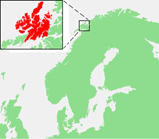 In Norway’s Nordland County, on the Vesterålen archipelago, the Øksnes municipality covers part of the large island of Langøya as well as many smaller islands north of there. Bø and Sortland municipalities share Langøya with Øksnes.
The Øksnes Church, built in 1703, stands on one of the small islands, Skogsøya. The actual parish grounds have been maintained since the 1400’s, and parts of the present church building date to the 1600’s.
Sivert Knudsen was born in this parish at Roten farm, probably on 23 July 1843, to Knud Sjursen and Brita Kristoffersdatter. The date is questionable because his baptism record does not provide a birth date, and subsequent records give conflicting information. Sivert’s confirmation record, arguably the most reliable record, (because the information likely would have been provided by his parents) gives the 23 July 1843 date. Sivert’s youngest daughter Sofie’s baptism registration offers an earlier birth year of 1842. His death record gives a third birth date of 3 June 1843. The July date is probably correct given that he was then baptized a month later on 27 August of that year. Norwegian babies were usually baptized shortly after birth.
When Sivert was a small boy, his family moved on to Hadsel parish. Sivert was confirmed there at age 17 on 9 June 1861. Of course, like most Norwegians, he had already received his smallpox vaccination several years earlier in 1856.
Until 1865, Sivert worked to help his father who was a tenant on the Bjørndal farm in Hadsel. That autumn on 11 September he returned to Øksnes and married 24-year-old Martha Karoline Dorthea Hansdatter. They wed in the same Øksnes church where his parents had been married. When Sivert married Martha, he acquired a step-son, Johan.
After Sivert and Martha married, they and her son settled on the Roten farm in Øksnes where Sivert had been born. Sivert made a living as a farmer and fisherman.
The couple lived at Øksnes for three years and began adding to their family. According to family records, they had twelve children in all, including:
- Johan Martinsen (Martha’s son and Sivert’s stepson, 1861- ca. 1889) eventually became a fisherman and married Jakobina Bergite Antonsdatter in 1884. His stepfather Sivert served as his best man. Johan and Jakobina had a daughter, Olina, and two sons, Helmer and Johan. The boys emigrated to America and married sisters, Alfreda and Marie Susag, in North Dakota. Helmer remained in that state where he farmed and raised a large family. Young Johan, who became known as Johnnie Johnsen, moved on to Bremerton, Washington. He, too, had a large family. Tragically, he died in 1947 while fishing in the Gulf of Alaska when he was washed overboard during a storm.
- Kaspera Helmine Sivertsdatter (1866- ), born at Øksnes. She was known as “Mina” by the family, and she married Petter Jentoft Nilsen, a shoemaker, in 1885 at Eidsfjord. They had 8 children and never left Norway.
- Anna Marie Birgitte Sivertsdatter (1868-1869) born at Øksnes, buried at Hadsel.
- Hans Edvard Sivertsen (1870-?), born at Valfjord. He was a fisherman and married Ingeborg Karoline Reinholdtsen in 1894. They had one son, Sydolf Sigvard Hansen in 1894. Hans and Ingeborg never left Norway.
- Karl Nordal Sivertsen (16-25 July 1872) born at Valfjord.
- Unnamed Sivertsdatter, stillborn 11 May 1874.
- Unnamed Sivertsen, stillborn 27 April 1876.
- Sofie Marie Sivertsdatter (1878-1966) born at Valfjord. Sofie married Ole Jørgen Bentsen in 1904 and emigrated to America the next year.
- Unnamed Sivertsdatter, stillborn 21 September 1882.
No record of the remaining reported children has been found.
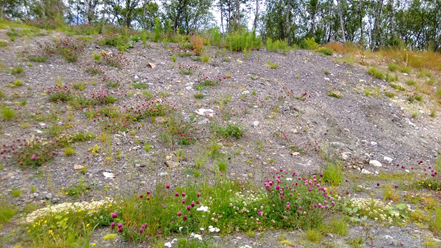
Valfjord Wildflowers
Eventually the family left Øksnes and relocated to the settlement at Valfjord. By 1900, Sivert was a leaseholder in a fishing operation there. Over the years, he served as a baptism sponsor for several of the grandchildren:
- Johan’s daughter Olina Andrea Johansen baptized at home on Oshaug on 21 June 1885,
- Mina’s daughter Karoline Berntine Pettersdatter baptized 15 July 1888 at Eidsfjord parish, and
- Hans’ son Sydolf Sigvard Hansen baptized at home on 25 November 1894.
Martha passed away in 1900 leaving Sivert a widower. He died at Øksnes a few years later on 10 Dec 1907 at age 64. The ground was frozen so he was buried the next spring on 2 May 1908 at Eidsfjord i Hadsel parish, where his wife had been buried. No cause of death was recorded in the parish records.
Sherman Serendipity
 I happened upon a treasure the other day. While contemplating the next step in my Sherman family research, for some reason I looked into a desk drawer that I had not opened in a while. There I found a folder marked “Sherman.” I had forgotten all about it.
It contained several Sherman-related documents I have collected over the years. I had tossed them in the folder awaiting a time when I could focus on the Shermans. Surprisingly, some of the papers were documents I had just been considering seeking as a next step in my research. What a find! (not to mention the opportunity to clean out something from the desk drawer).
First I turned my attention to a Civil War Widow’s pension file. It pertains to my ancestor Thomas Sherman’s brother-in-law, John Alvey. I learned the following from this file:
- Private John Alvey’s widow Evaline (Thomas’ older sister) filed for a pension in 1867, and she began receiving $8 per month. The pension continued until her death in 1922—a period of 55 years.
- The discrepancy on the 1851 Alvey marriage record between her name Evaline Sherman and the recorded name Emeline Shearer was explained as an Estill County, KY scrivener’s error.
- Pvt. John Alvey enlisted as a Union volunteer in August, 1862 at Hendersonville, KY. He served in the 8th Kentucky cavalry.
- Pvt. John Alvey died of diphtheria in January 1863 in a hospital at Hopkinsville, Kentucky.
- When Evaline filed for the pension, both she and two sisters who served as witnesses (Elizabeth Sherman Glover and Gilla Sherman Cobb) had moved from Kentucky to Williamsburgh, Indiana.
- Evaline and John Alvey’s only child, Roena, was born December 25, 1852.
Finding this Sherman folder just when I needed it becomes another example of that genealogy serendipity I experience every so often. Other genealogists talk about it, too. It is almost as if our ancestors want to be found, and they nudge us in the right direction. I cannot wait to see what else I find in this long-forgotten folder.