Author Archive
Newsworthy Fatalities
 November 21st, 2013 |
  Author:
  Recent news about deaths from natural disasters, accidents, and crimes made me wonder how many deaths in my own family occurred this way. These events cut a life short, so they usually make the news. As a genealogist, I try to collect this information as part of my research. I have found several news stories in my own family tree.
Working back in time, here is my list of our twentieth century fatal events:
- Hugo Alexander Mattila (1918-1987) died in a home fire in Gainesville, Florida,
- Betty Karoline Johansen Harrigan Cummings (1904-1954) was murdered by a local handyman in her Seattle, Washington home,
- Johan Martin Johansen (1889-1947) drowned in the Gulf of Alaska after being swept overboard from a fishing boat during a storm,
- Alexander Mattila (1878-1945) died due to trauma from being hit by a train as he walked home along the railroad tracks in Hibbing, Minnesota,
- Francis Edmonds (1876-1944) fell from a horse and broke his neck while herding sheep in the Lewis and Clark National Forest in Montana,
- Rose Wilhelmina Mattila Porras (1896-1941) froze to death in a snowbank in Hibbing, Minnesota,
- Owen Herbert Reed (1896-1935) died from injuries received in a truck accident near Brighton, Colorado.
Only one of these deaths, the Seattle murder, resulted from a crime. Another, the drowning, occurred during a storm. The rest were accidents.
Now we find ourselves well into the twenty-first century, and we have had no deaths from anything other than natural causes. With all the danger in our modern world, we can count ourselves lucky.
 Posted in
How to Search in the Norway Digital Archives
 Attention, all you Norway researchers! As promised, here is the link to my husband/tech advisor’s guest post on UpFront with NGS: http://upfront.ngsgenealogy.org/2013/11/using-norwegian-digitalarkivet-search.html
Sharing Our Norwegian Research
 That time of year has rolled around again where I refocus my genealogical efforts from research to writing. Every November I choose an ancestor or ancestor couple as a writing subject. For Christmas, I distribute my finished product to my children and siblings and also to any interested cousins descended from that ancestor. I like this method of preserving and sharing my research.
After my trip to Norway this summer, naturally I decided to write about Norwegian ancestors. My four Norwegian great-great-grandparents all lived in the same area of Nordland in the latter half of the 19th century, so I will prepare a compiled work on the four of them. I will include three items with the Christmas gift this year:
- Family group sheets for the Karen (1851-1916) and Nick (1854-1919) Bentsen family and for the Sivert Knudsen (1843-1907) and Martha Hansdatter (1841-1900) family,
- My only photograph of Karen and Nick Bentsen, and
- A character sketch I will write about the lives of these four people.
Amazingly, I have collected quite a bit of information on these ancestors, even though Sivert and Martha never left Norway. Much of that is due to the tireless efforts of my husband/tech advisor who has become quite an expert in navigating the online Norwegian archives.
He has a writing project of his own. He will share his expertise in Norwegian research in an upcoming guest blog post for Upfront with NGS, the National Genealogical Society blog. Stay tuned for the link when it appears.
Celebrating on October 31
 Today is All Hallows Eve, or Halloween, a secular name by which it is more commonly known. People will dress up in costumes and celebrate at parties complete with jack-o-lanterns, ghosts, spiders, witches, etc. My young grandchildren can hardly wait to rake in the candy when they go out trick-or-treating tonight.
Yet October 31 historically has had a much more religious significance. Christians have long kept vigil this night for the observance of All Saints Day tomorrow.
Of even more significance to my family is that October 31 marks the beginning of the Protestant Reformation. On All Hallows Eve in 1517, Martin Luther nailed his 95 theses on the door of Wittenberg Church to protest the excesses of the Roman Catholic Church. This shocking act marked the beginning of the Reformation and the Lutheran faith.
Luther’s teaching spread far, and the Nordic countries quickly left the Roman church to embrace Lutheranism. My mother’s family in Norway and Finland followed the state-mandated Lutheran tradition for hundreds of years.
The Lutheran church records in these countries still exist. They provide valuable genealogical information to me in their lists of baptisms, confirmations, marriages, and burials. With these records, I can trace my family back many generations relatively easily.
So Halloween means more to me than just another secular party day. In addition to All Hallows Eve, it is the birthday of the Lutheran church. This year my Lutheran congregation celebrated, not with candy and costumes, but by performing Bach’s cantata #80 based on the great hymn of the Reformation, A Mighty Fortress Is Our God. I celebrate Reformation Day today, not just Halloween.
Wishing For a Collaborator
 Supposedly, if you go back far enough back in time, someone has already researched your ancestors or else someone else concurrently works on them. Together the researchers build the family tree. Problem is, this rule of thumb works for my husband/tech advisor but not for me.
Several times he has found a new ancestor, and others promptly pick up on the information and disseminate it. Several people work on these lines simultaneously and all contribute something.
This week he located the birth record for his ancestor Maria Joanna Keulers in 1799 in the Limburg Province of the Netherlands. You can bet that other Keulers researchers will take this information once we post it, and they will run with it. The work will advance.
I never seem to encounter such luck. The researchers I worked alongside for years are either too elderly to continue or have passed away. How I wish I could find someone else working on any of my troublesome ancestors:
- Daniel Sherman, born around 1800 in New York. Married Rebecca Howe Day in Morgan County, KY on 4 Sep 1826. Children included Polly A., Anderson O., Evaline, Emily E., Eliza A., Thomas, Gilla Ann, John, and Jasper. Who were Daniel’s parents?
- Unknown mother of Anna Petronellia Sherman. The daughter was born 1 Apr 1865 in Indiana to Thomas Sherman and, according to family legend, a German girl named “Katherine Stillenbaugh”. After the death of the German wife, Thomas remarried. He and Alice Farris were parents to Anna Petronellia’s half-siblings, Charles, George, Ethel, Claude, and James Sherman.
- John Davis Riddle, born around 1821 in Pennsylvania. Married Olive Hall Dunbar in Summit County, OH on 12 Jan 1843. Children included Tamson Rebecca, Theodocia Orlinda, Isaac Newton, Ethan Henry, Laura Ruamy, John Hoxey, Seymour Alfonso, and Olive Delila. John and Olive also raised their grandson, Aden Ralph Riddle, son of Tamson. Who were John Davis Riddle’s parents?
- Unknown father of Grace Riddle. She was born in Palisade, NE to Laura Ruamy Riddle on 30 Aug 1896. Grace had three identified half-brothers on her mother’s side: Francis, Louis, and Joseph all born in Michigan to Laura and George Edmonds.
Surely some of the people mentioned above have descendants who enjoy family history. How I wish I could find them.
Searching for the Wrong Ancestors
 We all know that in genealogy we must carefully work backwards in time, verifying each fact for each ancestor. One mistake, and we run the risk of spending precious research time on the wrong people.
Earlier this year, we ignored this rule somewhat. We did some hasty research in an effort to glean as much information as we could before our trip to Norway. Did we spend time investigating the wrong ancestors? Yes and no.
In my husband/tech advisor’s line, we did take a wrong turn with the identity of one female ancestor. Luckily, the entire family comes from the same area in Norway. We visited the correct place despite the research error. We have since amended our family tree.
For my family line, we visited the island of Dønna in Helgeland, purported home of my great-great grandmother, Karen Marie Johansdatter Bentsen. We went to Titternes Farm, where she was born.
Imagine my surprise this week when I came across a family tree for her on Ancestry.com that is nothing like the tree I have built. It names different parents with origins in Denmark. Panic! How could I have made such a massive mistake?!
I pulled out everything I have collected for Karen Marie and reviewed all the evidence carefully. Everything points to the Helgeland origin. I do not think I have been researching the wrong ancestors; I think the person who contributed the tree to Ancestry made an error. Of course that tree lists no sources.
This happens when we take shortcuts. We need to do our research correctly so we do not waste our time and publish erroneous information.
I am glad to find that Karen Marie really seems to be from Dønna. It is a lovely place.
Do You Need Help With Your German Ancestry?
 A large percentage of Americans claim at least some German ancestry. My mother-in-law came from a German-speaking heritage, so my children are about ¼ German. We have lots of Germanic ancestors to research in this family!
Alas, German research can be notoriously difficult. You get nowhere unless you can identify the village of origin for your ancestor. People spend years looking for a clue to this elusive fact.
One group that can help with this is the Palatines to America (PalAm). This national organization dedicates itself to finding German speaking ancestors and their place of origin in Germany, Austria, Alsace, Switzerland, Luxembourg, Lichtenstein, Poland, Russia, Denmark, Netherlands, East Prussia, Pomerania, Brandenburg, Silesia, Galicia, Bohemia or other German speaking areas.
We in the Denver area are blessed to have a local PalAm chapter. Twice a year they bring in a nationally-known speaker with expertise in German research. Today Baerbel K. Johnson, AG, a professional genealogist who works at the Family History Library as International Reference Consultant, presented a program in Denver. Wearing traditional German dress, she spoke to a large crowd of German researchers on several helpful topics.
My husband/tech advisor and I are thinking of taking a research trip to Germany next year. Ms. Johnson’s program today gave us many helpful tools for planning a productive trip. Thanks, PalAm, for offering this opportunity.
Prairie Housing Yesterday and Today
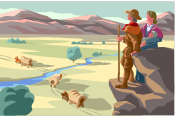 Not much to report this week because we had new flooring installed on the main floor of our house. We spent a lot of time moving furniture around.
My beautiful new floors got me to thinking about the housing my ancestors inhabited when they came to the western United States over 100 years ago. Certainly they did not start out with multi-level homes and lovely oak floors. They lived in sod houses, or soddies.
I wonder how they felt about that. My great-grandmothers Laura Riddle and Petronellia Reed had lived in nice homes in Michigan and Illinois. It must have been difficult for them to get used to living in a house made of dirt. Laura eventually worked her way up to a nicer frame house in Palisade, Nebraska. Petronellia hated her life on the Wyoming prairie, sold her homestead, and moved to Missouri. There she also lived in a frame house.
And what about my other homesteading family, my Norwegian ancestors, Ole and Sofie Bentsen? They had lived in fishing villages in Norway. Last summer I visited a fisherman’s cottage at the Helgeland Museum in Dønna, Norway. It would have been similar to the housing the Bentsens left behind when they immigrated. Similar in size to a soddy on the American plains, it even had a grass roof. Perhaps life in a soddy did not seem so strange to them.
Yet the Bentsens, too, eventually upgraded to a frame house on their farm near Redstone, Montana. Even if they did not mind the soddy as much as Laura and Petronellia did, they weren’t satisfied to stay in one forever. Like the rest of us, they continued to upgrade their housing.
Using Parish Records to Locate Previously-Unknown Children
 Genealogists get excited when they discover a previously-unknown child in a family tree. Often we do not know about those babies who were born and passed away between takings of the census. This week, I found two such unknown children.
According to my Norwegian great-aunt Signe, my ancestors Sivert Knudsen and Martha Hansdatter of Nordland, Norway had twelve children of whom only four survived to adulthood. Signe had no information about the eight who had died, so I set out to find them. I knew that the online birth and death records of the Norwegian Lutheran Church http://arkivverket.no/eng/content/view/full/629 likely contained this information. But these records are not indexed, so I needed a research plan.
I took these steps:
- Time Line–I placed the birth dates of the known surviving children on a timeline to establish a range of dates to search. The mother was unwed and 20 years old when her first surviving child was born in 1861. She was 37 at the birth of the last in 1878. Large gaps existed between the births, so I found I needed to search all her theoretical child-bearing years, say, 1857 when Martha was 15 until 1891 when Martha would have been 50 years old.
- Location–I identified the likely parishes where the unknown children would have been recorded. Early in their marriage, Sivert and Martha lived in Øksnes parish, Nordland. By the time the third surviving child was born, they had moved to Hadsel parish. I needed to search the records of both parishes. I could begin in Øksnes and search from 1857 until 1870 when the third survivor was baptized in Hadsel. I would then search Hadsel records from 1870 to 1891.
- Search–I examined the birth and death records of these parishes year-by-year, looking for any previously-unknown children born to Sivert and Martha. On the first pass, I discovered three, born in 1868, 1872, and 1882.
- Search Again–This week I searched the Norwegian index that is coming online at Family Search for any records mentioning the parents Martha Hansdatter or Sivert Knudsen. There I found references to two stillborn children in Hadsel in 1874 and 1876. I had missed them earlier because I had not realized the parish death form used in those years listed stillbirths in a separate column from the other deaths. Lesson learned. Thanks, husband/tech advisor for pointing this out to me.
I still do not have the information on all twelve of the reported children in this family. But I have made progress by adding two more this week. So far, I know of nine of the Sivertsen children:
- 1861 Johan Andreas Martinsen
- 1866 Kaspara Helmine Sivertsdatter
- 1868 Anna Marie Birgitte Siversdatter ( died in 1869)
- 1870 Hans Edvard Sivertsen
- 1872 Karl Nordal Sivertsen (died in 1872)
- 1874 unnamed Sivertsdatter (stillborn)
- 1876 unnamed Sivertsen (stillborn)
- 1878 Sofie Marie Sivertsdatter—my great-grandmother who looks like a “miracle baby”
- 1882 unnamed Sivertsdatter (stillborn)
The Good, the Bad, and the Very Ugly Facts on Moving to the New Family Tree
Last week I wrote about my wish to enable a smooth transfer of data from the genealogical software I use, The Master Genealogist, to the cloud site offered by Family Search. Here is a guest post from someone who knows a whole lot more about this complex issue than I do, my husband/tech advisor:

Many of us are looking for a place to save our research in case none of our relatives wants it. Most of us use a Genealogy program of some sort but many have already “taken the plunge” and gone to online programs.
Those of us who haven’t gone to an online program, and even some of those that have, face the issue of what’s going to happen to our hard work when we can’t do it anymore. If we don’t migrate ourselves, our research is subject to the vagaries of a family member taking it over or performing the migration plan we might have left behind. Web sites we’ve built with our research will go away when the contract is up, causing the data to be lost.
The only solutions:
· to plan on a transfer to a repository and hope the heirs will do it and will be able to do it,
· to have a family member who will take it over,
· to identify a repository and synchronize to it,
· to identify a repository and switch to using their on-line software.
I can hope that a family member will continue the work – but unlikely at this point – or that enough peripheral people are working in my areas to take my work and run with it, but the reality is that it most likely will fade away as the paid web site expires or the software it’s based on becomes unusable unless I start ensuring continuity now.
Because I don’t like making other people pay someone else to see my hard-won research, I’ve chosen the LDS New Family Tree (NFT) as my repository and would like to synchronize to it. I currently use The Master Genealogist (TMG) version 8. Oops, based on both past experience and asking questions, I don’t think synchronization is coming soon.
Basically, I’d love to stay with TMG as I like the program and know how to use it. But if there aren’t plans to start doing what all the other major Genealogy programs are doing – synchronizing to NFT. Rather than enter more data into a dead end program, I’ll have to move to a program that is keeping up with the Joneses. And I have about 300 Norwegian and Danish relatives and over 500 sources to enter – a very productive summer.
Two programs are “certified” for synchronization with NFT – RootsMagic (RM) and Ancestral Quest (AQ). However, there are different levels of certification. You can also upload GEDCOMs to NFT regularly to synchronize – but I’m giving away the plot. I guess I’ll consider moving to RM or AQ.
There are several good web blogs about the pain and anguish and advantages of moving from TMG to each. The bottom line is that both do a decent job of importing from TMG via GEDCOM. But, from what the blogs say, RM, AQ, and – it turns out – NFT do not “nicely move sources from TMG. NFT requires sources and if no sources are attached to a person, that person is not considered to be a “good” record. When a GEDCOM from TMG is uploaded to NFT, the TMG sources are treated as notes rather than sources. When other major Genealogy programs use their “direct” link, sources remain attached – but according to bloggers, I can expect problems here.
I’ve done some investigation into what Synchronization really means. Say I have grandpa, and so does NFT. NFT doesn’t have grandma or grandpa’s parents. For grandpa, I have 4 sources and NFT has 2.
· If I use TMG and GEDCOM – each record is added to FamilySearch and none are put in my NFT Tree. When I add a person to my Tree, the sources come as details. The details can’t be converted to sources. No siblings, parents, spouses, or children come along – even if they are there in the Person Record – I have to manually find and attach each one – just because they are on the Person Record doesn’t mean I can attach them from there. Basically entirely manual after a painful process to upload the GEDCOM – requires matching checking and verification and adding the record to FamilySearch one by one.
· While on GEDCOM to NFT – most FAM tags seem to be ignored after the first generation.
· If I move from TMG to RM or AQ and do a Synchronize – the only difference is that once I have the person in my Tree, source and details placed in RM or AQ will then be placed into the Person Record which is available to NFT. New siblings, parents, spouses, or children are not attached – I must Find them and attach them.
Basically, to use NFT requires me to start over and completely re-enter my tree and all my sources.
Of course when asked about this, they tell me that should only take an hour or so. [Insert here Words that can’t be printed.] I’m looking at a minimum of ½ hour for every source. 95% of my sources are not in FamilySearch. My grandfather born in 1877 in Norway and who came to the US at 14 months has two census records that FamilySearch has. I have 26 sources, of which 6 are “governmental”. There’s 12 hours of data entry. An afternoon, my left foot.
One good reason not to use Family Tree directly is that they don’t really support PDFs, and they don’t like “active” PDFs. All of my Norwegian documents from Arkivverket are active PDFs – if you click anywhere on the PDF, it takes you to the real original image location. A nice touch and one that TMG handles very nicely. Too bad Arkivverket doesn’t advertise it so other archives will start doing this..
Basically, since I’ve spent the summer getting all these source documents, I have to make a choice – hope that there will be a way to get them in Family Tree, give up on TMG and use a program that will put them in Family Tree, or just use Family Tree directly.
But I’d rather stay on TMG.
TONY HJELMSTAD