Author Archive
Farewell, Tyler
 May 15th, 2014 |
  Author:
  Our world upended last weekend. My 25-year-old nephew Tyler William Reed drowned. I feel like the fabric of our family has ripped apart with my heart torn out.
Tyler went missing after a night out with friends at the Washington Nationals game on May 5. He left a restaurant to take the Metro home to Alexandria, Virginia. No one ever saw him again.
Our family searched frantically for him for the rest of the week. Then on Saturday we received the terrible news. The police had recovered his body from the Anacostia River, near the Nationals’ field and the Navy Yard metro stop. He had suffered no trauma and still had his wallet and cell phone.
Tyler, what happened to you?
We probably will never know for sure how my nephew landed in that river. He was a happy guy with many friends. He worked two jobs that he liked, and he had recently re-enrolled in college to complete his degree in sociology. He had a passion for music, playing both piano and guitar, and he wrote many songs.
I ache for my brother whose only son’s life ended too soon. Like all fathers and sons, they had their little frictions, but they shared so much. They even had the same birthdate. How will my brother celebrate his birthday now when his son can no longer join in the celebration?
I hardly know how to say good-bye to this young man who was on the brink of adulthood. We should be congratulating him on his college graduation, not attending his memorial service. Tyler, I am so sad to see you go.
 Posted in
Visiting Mom
 Mother’s Day arrives this weekend, and many of us will visit our moms. We buy cards for them and take them out to brunch or dinner. In our family we also use this as an opportunity to do genealogy.
On Mother’s Day we will honor my mother-in-law, known universally as “Grandma”. She is 83 years old and has a lot of family history stored in her house and in her head.
Grandma came from Minnesota where she was raised in a German Catholic family of 11 children. Her father was one of sixteen. Consequently this presents a large family for us to research.
On Mother’s Day we will encourage her to reminisce once again about her family. Invariably she will dig family treasures out of the basement. She has kept baptism records, funeral cards, and other memorabilia. I am eager to see what else she has.
All of us will have a great time with Grandma this Sunday.
A Family for Ada Lampinen
“We knew nothing of our mother’s family. They all stayed in Finland.” This was the only information my grandmother could offer when I asked her about my great-grandmother Ada Alina Lampinen’s family. How do you build a birth family with so little to go on?
In genealogy we work backwards in time, so I began looking for data on Ada herself. My mother told me she had died in Hibbing, Minnesota on the twelfth of May, 1948. Mom also knew she had been 27 years old when my grandmother was born in Minnesota in 1906, suggesting that Ada was born in 1879. Lastly, Mom also recalled her grandfather saying the family was from Viipuri. Another daughter kindly visited the genealogy library at Iron World in Chisholm, Minnesota and found the family’s 1905 immigration papers.
Thus armed with a time frame and an approximate location, we began our search for the Lampinens in the Finnish records. Here is where my husband/tech advisor came in handy.
He located Finnish newspapers online (http://digi.lib.helsinki.fi/index.html) and found a 1904 marriage announcement for Alex and Ada (Lampinen) Mattila in Viipuri. This confirmed our location, and began our dive into Finnish parish records.
These records can be found online, too, at Finland’s Family History Association (http://www.sukuhistoria.fi/sshy/index_eng.htm). Luckily, the index offers a country-wide search, because we found no birth record for Ada in Viipuri parish. Using the broader search, we finally located an 1879 birth and baptism record for Ada in Juuka parish. We learned that her parents were Matti Lampinen and Anna Miettinen who married in 1856. So what about the rest of her family?
The Juuka parish registers for many of the years in which the Lampinen children would have been born have not been indexed. Now I am searching the Juuka images page by page to find them. In addition to Henric (b. 1857) and Anna Valborg (b.1859), this week I located the birth and baptism record for Eva Stiina (b. 1861). I still have 18 years of records to search before reaching Ada’s own birth record in 1879.
Although this is a slow process, I am eager to learn how many sibilings Ada had. Soon we will no longer be saying that we know nothing of her family.
Learn Your Place
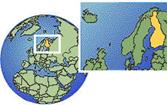 A cardinal rule in genealogy is to learn all you can about the places your ancestors resided. Normally I have not had trouble doing this, and I readily have found information on many places over the years of my research.
This year, however, I have encountered difficulty as I have tried to trace my Finnish heritage. Their history is so complicated, and so much depends on geography. I have yet to find a Finnish gazeteer or a good map.
I never feel comfortable adding new ancestor names to my database until I am reasonably sure they are actually my ancestors. If a purported husband and wife came from different villages, I want to know how close they were. Or in the words of genealogist Pat Hatcher, were they in “kissing distance”? I need a good tool for identifying place names and locations.
So far, I have struggled along with little snippets of maps from various Finnish websites. The Family Search wiki (https://familysearch.org/learn/wiki/en/Main_Page) has helped with place names in church parishes. Still, I wish I had the right tools to find my place.
Spending Time with the Descendants
 We have had busy times in recent weeks, but not with our genealogy. Or maybe I could call it genealogy, in a way. After all, genealogy includes the study of descendants as well as ancestors.
Our six grandchildren have needed more attention lately. Seems like I have had at least one kid around nearly every day. Enjoying activities with them precludes any serious research. I feel so very far behind on it.
Yet I choose to spend this time with them now, while I have these opportunities. So I have kept a two-year-old while his mom volunteers at the elementary school and takes his siblings to the doctor. I have taken a 10-year-old to a weekly Bible movie during Lent. I have entertained a one-year-old once a week so her mom can get a well-deserved day off. And then there are the soccer games.
Meanwhile, searching for all the grandchildren’s ancestors will need to wait a bit. After all, their Ampuja, Bentsen, Carter, Day, Dunbar, Hall, Howe, Lampinen, Mattila, Miettinen, Myllynen, Reed, Riddle, Sherman, and Templeton forebears are not going anywhere.
Myllynen or Myllyin?
 My great-grandfather Alexander Mattila’s 1945 death certificate states that his mother was “Lizza Myllyla” of Finland. His American-born daughter was the informant.
As I researched Alex, I found that this information conflicts with his baptism record from Finland’s Viipuri parish. That record says her name was “Elisabeth Myllynen”. The discrepancy needs an explanation.
I do not know much about Finnish ways, but it seems that “Lizza” must have been a nickname for “Elisabeth”. No real problem there, but what about the difference in surnames?
I searched for more evidence by locating the baptism records for Alexander Mattila’s many sisters. Not all the records provided a surname for her. Those that did variously gave her last name as “Myllynen” or “”Myllyin”. While it appears I can discard the “Myllyla” variation as something created by a granddaughter who never met her grandmother, I now had a new problem. Was the surname “Myllynen” or “Myllyin”?
I worked back to locate Elisabeth’s marriage record. There her name was “Myllyin”.
Next I needed to find her birth record for additional documentation. The Finnish Communion Books for Elisabeth Myllynen’s household 1887-1896 provided a birthdate for her, 25 April 1835. A search of Viipuri birth and baptism records for an Elisabeth born that day found only one likely candidate, Elisabeth, daughter of Simon Mattson and Sofia Henr:dr of the Myllynen house in the village of Tervajärvi. This highly-probative record indicates that her name was probably “Myllynen” rather than “Myllyin”, and that is the name I added to my database.
But then I began researching her father, Simon Mattson. All the church records for him gave his surname as “Myllyin”, not “Myllynen”. Again the question arises, what was the family name?
I cannot reconcile this discrepancy. I think I have found distinct people on these records that have gone by two similar surnames. I believe that perhaps the names were used interchangeably in the 19th century. Finland still had a mostly patronymic system then, and surnames did not have the importance we give to them today. Spelling probably was not yet standardized.
This is the best explanation I can devise. I am not completely satisfied with it. I plan to consult my Finnish friends to see if they can provide any more information on this issue of these surnames. Name discrepancies are red flags that one may be researching the wrong ancestors. I do not want to waste time doing that.
Why I Have Not Done a DNA Test
 Everyone seems interested in testing their DNA these days. Genealogists in particular flock to companies offering these tests. Why do they want DNA tests, and why have I not joined the throng?
This week our local Computer Interest Group met to hear genealogist Ric Morgan speak about DNA testing. He described the three types of tests available: Y DNA, mitochondrial DNA, and autosomal DNA. Over the past decade, the cost of these tests has come down even as the scientific potential of them has grown. Still, I cannot bring myself to mail in that cheek swab.
Here’s why:
- Y DNA testing is for men only, so I obviously cannot do this one. This test can identify those men among us who are related to one another and who descend from common male ancestors. In my own family, my father’s first cousin Leslie Reed submitted a sample several years ago. This tied us in to the family of Thomas Reed of colonial Morris County, New Jersey. The puzzle now is to sort out all the Reeds in New Jersey at that time and document the families. At this point, we need no further Y DNA testing.
- Mitochondrial DNA traces the direct female line. Mine goes back to Finland. We have had substantial success documenting my Finnish lines without resorting to DNA testing. Because mine is a small family, I have been in touch with most of my American relatives of Finnish descent. I do not know any current family members in Finland, but I also do not think the current DNA databases contain many native Finns who would be possible matches for me. Submitting a mitochondrial DNA test would not tell me more than I already know, especially about my direct lineage.
- Autosomal DNA offers the new frontier in DNA testing according to Ric Morgan. It also poses the greatest privacy threat. Autosomal DNA contains the complete genetic record for an individual. Wouldn’t insurance companies or the government love to get their hands on that! I go to great lengths to protect my privacy, so this test poses no temptation for me. I will keep looking for another way to identify the man who fathered my paternal grandmother in rural Nebraska sometime in 1895.
So there you have it. I plan to keep my DNA untested because the sex-linked tests would be of no immediate value to me. I am unwilling to open the autosomal test door. I will keep doing genealogy the old-fashioned way, one document at a time.
Training Time
 Seminar season rolls in during the spring months. Many genealogists recently attended the giant RootsTech conference https://rootstech.org/ in Salt Lake City last month. Others will head for Richmond, Virginia for the 2014 National Genealogical Society Family History Conference http://www.ngsgenealogy.org/ in May.
I have never attended RootsTech, but I have been to a couple of NGS conferences. In 1998, Denver hosted the event, so of course I went. I even served as a room monitor for a few of the sessions. Ten years later, I drove to Kansas City, Missouri for the 2008 conference. Both times I came away with renewed enthusiasm and much helpful information.
Unfortunately, it costs quite a bit to attend these wonderful conferences—travel, hotel, meals, registration fee. An additional deterrent to February’s RootsTech is that it requires a treacherous drive over the mountains to Salt Lake City in the winter weather. So I usually stay home.
In recent years, the motive for staying put in Denver has grown because so many nationally-known speakers now visit our area. Thanks to the efforts of our local societies working with the Denver Public Library (DPL), I can receive my genealogical training for a fraction of the cost of attending a national conference.
This spring I plan to visit DPL to hear four great speakers:
- On March 8 the WISE (Wales, Ireland, Scotland, England) research group will host an Irish seminar featuring Fintan Mullan and Gillian Hunt from Northern Ireland;
- On March 29 the Palatines to America will host noted German researcher Roger P. Minert;
- On April 26 the Colorado Genealogical Society is bringing in Judy Russell, the Legal Genealogist;
- On May 17 the Computer Interest Group will host Rick and Pam Sayre from Washington D. C. to speak about tech topics.
Thus I will get four full days of training for about $150, much less than it would cost me to attend a national conference. Call me the Practical Genealogist.
Where Did Grandma Live?
 My second great-grandmother Elisabeth lived somewhere in Finland’s Viipuri parish in the 19th century. As I research her family I want to pinpoint her residence. Church records for her family reveal that they lived in the Myllynen/Myllyin house. They adopted this house name as their surname when they abandoned Finland’s patronymic naming system.
So where do I find this house? The Viipuri parish records for the family also name its location, the village of Tervajärvi, or Tar Lake. Where is that? It turns out that I will encounter trouble identifying this place:
- Of course I go first to Google maps. There I received many hits for Tervajärvi, Finland. After sifting through the list, I find that none of these seems to be near Viipuri (which is now known as Vyborg, Russia).
- How about a search for Tervajärvi, Russia? There I get one result, in Russian Karelia some distance northeast of Vyborg. This is a possibility, but I do not know whether this Tervajärvi lies within the old Viipuri parish boundary. It seems the Finns used the same place names for many locations.
- Wikipedia has a list of rural municipalities in the old Viipuri province, but Tervajärvi did not make the list.
- What to do next? I remembered that my husband/tech advisor has already done quite a bit of research locating my ancestral places as he plans our upcoming trip to Finland. He has sent me at least 15 small maps showing many of these in the Viipuri area. I pull up his maps, but I cannot see Tervajärvi on any of them.
- A gazetteer for Finland or Russia might help, but I cannot find one online or in any of the local libraries. It seems like I am out of options.
- Then I remember another place I could try. The Denver Public Library (DPL) has some very detailed maps prepared by the CIA in the 1990’s. I quick look in the online DPL catalog tells me that they do have CIA maps for Finland and Russia. Perhaps my Tervajärvi will appear on one of those. I plan to visit DPL next week to find out.
In the meantime, if anyone knows the precise location of the Myllyin house in the village Tervajärvi near Viipuri/Vyborg, please let me know. My question remains, “Where did Grandma live?”
A Handy Tool for Genealogists
 One of my favorite things to do as a genealogist is to look at cemetery markers and death records. If I am lucky, I will find birth and death dates for the deceased here. Yet sometimes, especially in earlier records, I find the birth date omitted. The death record may give only the death date coupled with the age of the deceased.
I encountered this recently when I studied the church burial record for my Finnish ancestor Anders Abelsson Mattila. He had died on the 27th of April, 1882 at the age of 55 years, 5 months, and 23 days. The record did not provide a birth date for him.
In my early days of genealogy, I would have had to pursue a complicated formula to derive his birth date from the information on this record. No more. Now I can use a simple utility found on Search For Ancestors at http://www.searchforancestors.com/utility/birthday.html to calculate this date. The Tombstone Birthday Calculator on this site allows me to plug in the death date and age information, and then it calculates the birth date for me.
Using this tool, I learned that Anders was born 4 November 1826. This information exactly matches the date given on all his subsequent records. The quick answer I received from the online calculator gave me another rewarding experience analyzing a death record. You can bet I have this Calculator bookmarked as part of my genealogical tool kit.